

The WIP Limit: Why Opening More Chairs Slows Down Your Clinic
Published on: Jul 6, 2026
The Fallacy of the Extra Chair
When “The Bus” arrives—that inevitable moment when late arrivals and early birds collide to create an overflowing waiting room—the collective blood pressure of the orthodontic team rises. In most practices, the gut reaction is to open every available treatment room. We assume that if we have more patients seated, we must be working faster.
This assumption is a critical error in dental practice leadership, often driven by the anxiety of patient perception. A packed waiting area often triggers a short-sighted desire to look busy by seating as many people as possible, rather than focusing on actual workflow efficiency.
However, this is a classic trap in dental leadership. By increasing your “Work In Progress” (WIP)—the number of active patients in the clinical area—you often inadvertently trigger a traffic jam. In lean management, we understand that there is a tipping point where adding more tasks to a system actually decreases the rate at which those tasks are finished.
The concept of the WIP limit is derived directly from queuing theory, which demonstrates that system overload rapidly diminishes throughput. For a dental clinic, the resources—the doctor, specialized assistants, and specific equipment—are finite constraints.
When the number of active cases exceeds the capacity of these constraints, the workflow deteriorates into a series of stops and starts, masking inefficiency with frantic activity. Successful clinic leaders understand that controlling the queue before the chair is the key to mastering the speed within the chair.
Lessons from the London Underground
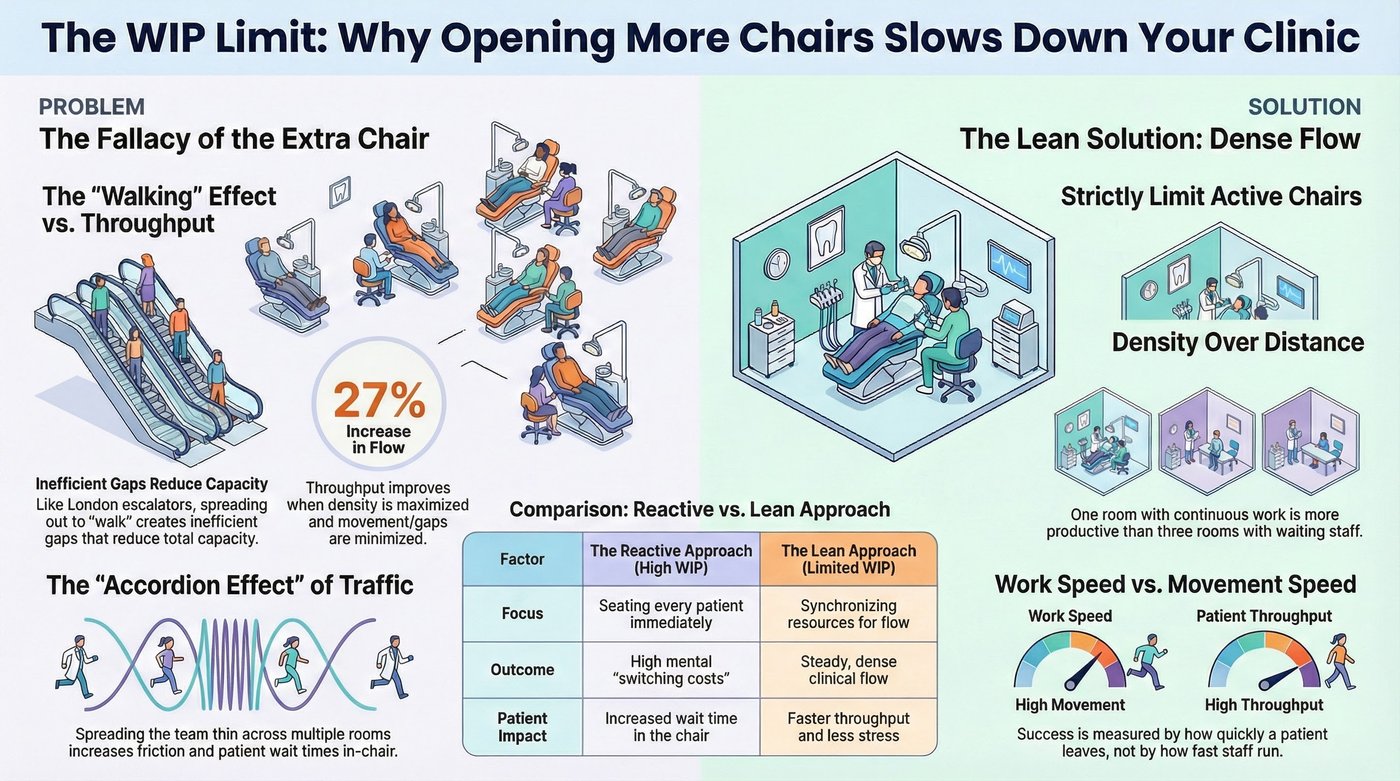
To visualize this, consider the “stand on the right, walk on the left” rule on escalators. While it seems faster to let people walk, studies from the London Underground found that during peak times, this creates inefficient gaps. When everyone stands on both sides, filling every step, 27% more people reach the top per minute.
This counter-intuitive finding highlights the difference between perceived speed (walking) and true density (full capacity utilization). The key variable is smooth, consistent flow without gaps or friction. Your goal as a clinic leader is to achieve “two-sided standing” in your operations.
In your clinic, opening an extra room creates the “walking” effect. The doctor starts jumping between chairs, the assistants are running down hallways to fetch supplies, and the turnover time between patients increases due to the physical distance and the mental “switching cost” of moving from one case to another. Everyone is moving faster, but the density of the work is low.
Specifically in orthodontic and multi-operatory dental settings, the cost of “switching” is profound. For the practitioner, mentally shifting from a complex bonding procedure in Room 1 to an appliance check in Room 3 requires a brief but costly period of reorientation.
This cognitive load, multiplied across multiple patients, introduces micro-delays that aggregate into significant schedule slippage by the end of the day. The physical act of moving to retrieve instruments or manage charts further fragments the focused, value-adding time spent directly on patient care.
The Cost of High Movement
Operational excellence in orthodontics is not measured by how much the staff runs, but by how quickly the patient leaves the chair satisfied. Every time a doctor has to walk to a new room, find gloves, and reorient themselves with a new chart, time is lost. This is the “accordion effect” of traffic. When you spread your team thin across multiple rooms, you create friction.
This friction translates directly into increased non-value-added time, which is wasted time from the patient’s perspective. Consider the typical 60-minute appointment: if 15 minutes are spent waiting for the doctor or an assistant to gather supplies from another room, the practice has delivered an inefficient, frustrating experience.
A high-movement system, therefore, reduces the staff’s capacity for complex, value-driven work by consuming energy on logistical tasks. The result is increased time the patient waits in the chair for the doctor, which is the primary driver of a poor patient journey in orthodontics.
This cycle not only frustrates patients but significantly increases staff fatigue and burnout, eroding team morale and potentially leading to clinical errors as focus is compromised by haste and fragmentation.
Limiting Work In Progress for Faster Throughput
The lean solution is to strictly limit your WIP. By keeping the number of active chairs manageable, you ensure that the resources—the doctor, the assistants, and the tools—are always synchronized. This creates a “dense” flow. It is better to have one room where the work never stops than three rooms where everyone is waiting for someone else.
Implementing a hard WIP limit, for instance, capping active treatment rooms at three regardless of waiting room occupancy, forces a discipline upon the team. This discipline creates a predictable rhythm that allows assistants to pre-stage all necessary tools and allows the doctor to maintain a focused clinical scope.
This strategy minimizes the time spent in transition and maximizes the time spent on the procedure itself, a metric known as “time on tool.” A consistent, dense flow dramatically reduces variability. Less variability means more reliable scheduling and improved patient throughput, turning chaos into a predictable production line.
The objective is to manage the ingress of patients, not the internal pressure. A well-managed queue is a sign of a high-performing system that values consistency over perceived busyness.
Conclusion: Lead with Mathematical Confidence
True dental leadership requires the courage to resist the urge to panic when the waiting room is full. By understanding the science of flow and the limits of work in progress, you can manage your clinic with the precision of a Swiss clock.
This involves making the difficult, data-driven decision to sometimes hold a patient in the waiting room—even when a chair is physically empty—because seating them would disrupt the existing flow and slow down the total rate of completion for the entire queue.
Instead of reacting to the chaos by spreading yourself thin, you should focus on maintaining a steady, dense flow that clears the queue faster and with significantly less stress. The ultimate mark of operational maturity is not speed, but reliable rhythm, which is achieved through disciplined WIP limits.