

The Volume Trap: Efficiency Over Exhaustion
Published on: Jun 7, 2026
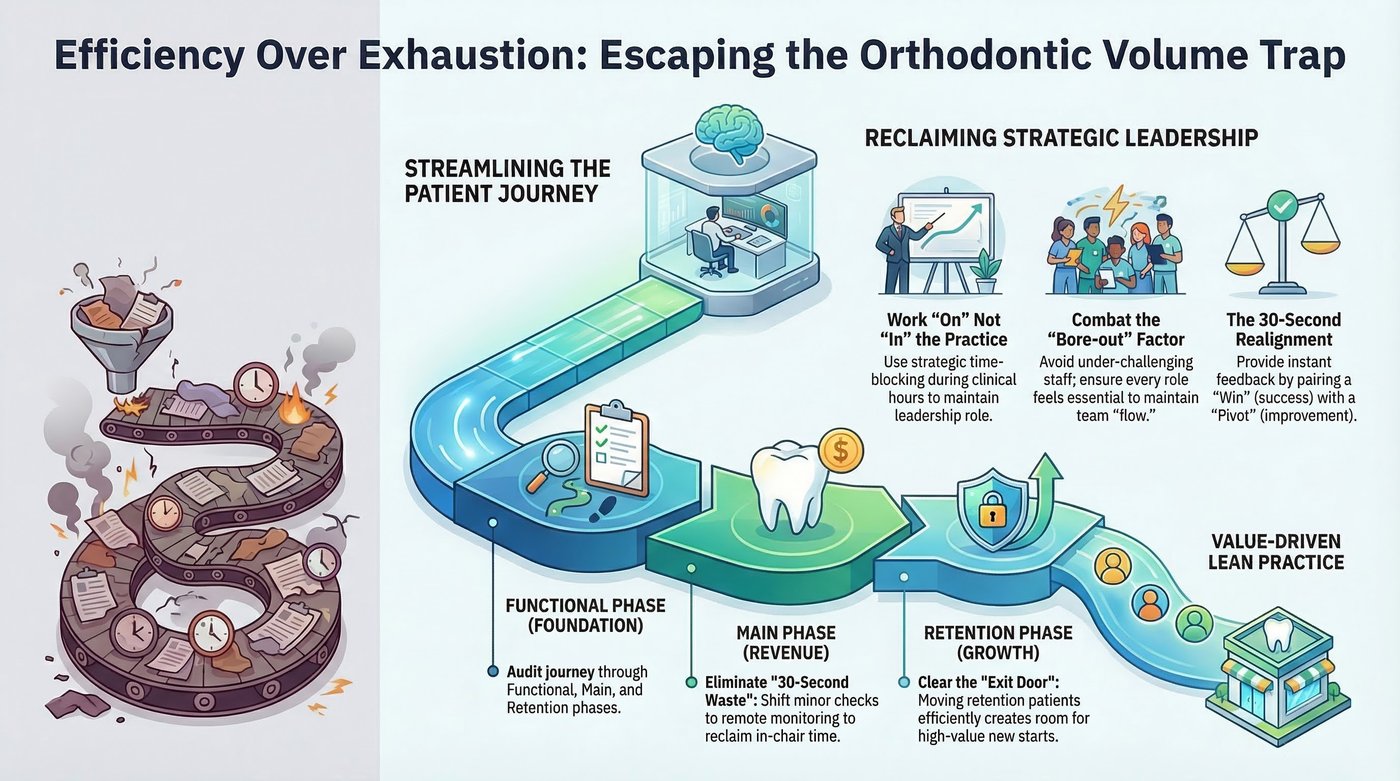
Many orthodontists brag about seeing 70 patients a day, yet their bank accounts and stress levels tell a different story. If you are working your “butt off” but the revenue doesn’t reflect that effort, you have fallen into the Volume Trap. This occurs when a practice prioritizes sheer patient throughput—often measured by the number of chair turns—over the actual value stream. This approach confuses activity with productivity.
True efficiency means maximizing the value delivered in every scheduled minute, not simply filling every available slot. The Volume Trap leads to provider burnout, diminished patient experience due to rushed appointments, and ultimately, lower profitability when accounting for overhead and staff stress. It’s a self-perpetuating cycle of exhaustion masked as enterprise.
To overcome this systemic drain, we must rigorously audit our patient cycles and reclaim our roles as intentional leaders rather than passive participants in our own schedules. This shift requires a forensic look at where clinical time is truly generating profit and where it is being wasted on administrative or low-value interactions.
Mapping the Patient Lifecycle
To identify systemic bottlenecks and sources of non-value-added work, you must accurately categorize your active patient list. For instance, seeing a patient for a 30-second “check” that could have been handled remotely via a telehealth platform or strategically scheduled later is a form of significant clinical waste. This time could have been dedicated to a high-production procedure.
In a lean-managed practice, we map the entire patient journey through three distinct, financially weighted phases to optimize resource allocation:
Functional/Pre-treatment: This is the diagnostic and preparatory phase. It includes initial consults, records, and treatment planning. The goal here is high conversion and clean hand-offs to the main phase. If this phase is inefficient, it gums up the clinical schedule with non-committed patients. We must ensure every consult is a high-probability start.
The Main Phase: This includes multi-bracket appliances or aligners and represents the primary revenue driver for the practice. Appointments in this phase should be structured for maximum clinical impact, performed by highly trained auxiliaries where appropriate, and timed precisely to minimize chair time. Unnecessary or poorly planned checks significantly deflate the profitability of the entire treatment.
Retention: This phase involves maintaining results while clearing the chair for new growth. Retention patients must be managed strategically, perhaps through designated retention days or leveraging hygiene appointments, to prevent them from displacing high-production Main Phase appointments. The long-term success of the practice hinges on a clear, efficient exit path from active treatment.
If your system is clogged with a backlog of retention patients or too many short, unnecessary Main Phase check-ups, you have effectively eliminated room for the high-value starts that truly drive profit. By clearing and optimizing the “exit door,” which includes efficient debonding and seamless transition to retention, you open the “entrance door” for new entrepreneurial success and sustainable growth. This focus allows the team to deliver quality care without sacrificing time or increasing stress.
Reclaiming the “Boss” Role
A diminished level of entrepreneurial success often happens when the owner-doctor abdicates their leadership role, allowing the schedule to dictate their day rather than their vision. If you are “too busy” to have a strategic conversation with your staff or address an operational inefficiency during the day, you are no longer the leader of the business; you are merely a highly skilled clinician being driven by the chaos created by your team and poor systems.
Reclaiming your focused, strategic time is the first and most critical step toward a practice transformation. This level of leadership is less about clinical skill and more about business acumen. This means shifting your daily engagement model to:
Choosing Solutions Over Problems: High-level leaders move past repetitive complaints quickly. Stop just talking about what’s wrong with a broken piece of equipment or a flawed workflow; you must decide, delegate, and hold the team accountable for how to fix it permanently. The focus must be on creating systemic solutions, not merely treating symptoms.
Strategic Time-Blocking: This involves carving out protected, non-negotiable time within clinical hours to work on the practice, not just in it. This dedicated time might be used for reviewing key performance indicators (KPIs), developing the next quarter’s marketing strategy, or conducting one-on-one leadership meetings with key staff. If it’s not on your schedule, it won’t happen.
This deliberate step-back allows you to gain the necessary perspective to see the entire practice as a system, identifying constraints that no one else sees when they are trapped in the day-to-day operations.
The “Bore-out” Factor: Challenging Your Team
Practice leaders often worry excessively about overwhelming their staff, but the greater and more insidious danger is often under-challenging them. Low engagement stems from a lack of purpose. For an employee to enter a “state of flow”—where they are highly focused and deeply satisfied—their work must feel essential, meaningful, and adequately challenging. If you hire too many people for the actual workload or fail to provide clear, elevated job descriptions and defined responsibilities, individual tasks lose their perceived meaning and value.
The result is staff who perform the bare minimum and require constant oversight, leading to the chaos that consumes the doctor’s time. Empowerment through responsibility is the key to minimizing this “bore-out” and achieving sustained performance.
The 30-Second Realignment:
Effective feedback does not require an hour-long, formal meeting that disrupts the daily flow. Use the “Realignment” method constantly throughout the day to drive immediate behavioral change and reinforcement:
The Win (Recognition): “You handled that patient complaint perfectly using our new communication protocol, Maria. The parent left happy and committed.” This validates the employee’s skill and shows you are paying attention.
The Pivot (Correction/Coaching): Follow the win immediately with a precise, forward-looking adjustment. For example: “For the next new-start case, let’s try to include the financial disclosure earlier in the conversation to avoid the slight confusion we saw today.” This frames the correction as coaching for future success, rather than criticism of a past mistake.
When your team feels noticed, valued, and their skills are being used to their full potential through clear, high-stakes responsibilities, the “success” of the practice transitions from a constant, exhausting struggle into a sustainable, effortless flow. This is the difference between a doctor-driven clinic and a truly autonomous, highly efficient enterprise.
Conclusion
Escaping the Volume Trap requires a mindset shift from simply being busy to being strategically productive. By mapping the patient lifecycle to eliminate waste, intentionally reclaiming your leadership time, and actively challenging your team, you can build a practice where high-value patient care generates exceptional returns without demanding personal exhaustion. Focus on the value stream, not the sheer patient count, and you will find your stress decreases while your profitability increases, proving that quality efficiency always trumps quantity.