

The Virtual Practice: Leveraging Cloud Infrastructure for Modern Flexibility
Published on: Jul 1, 2026
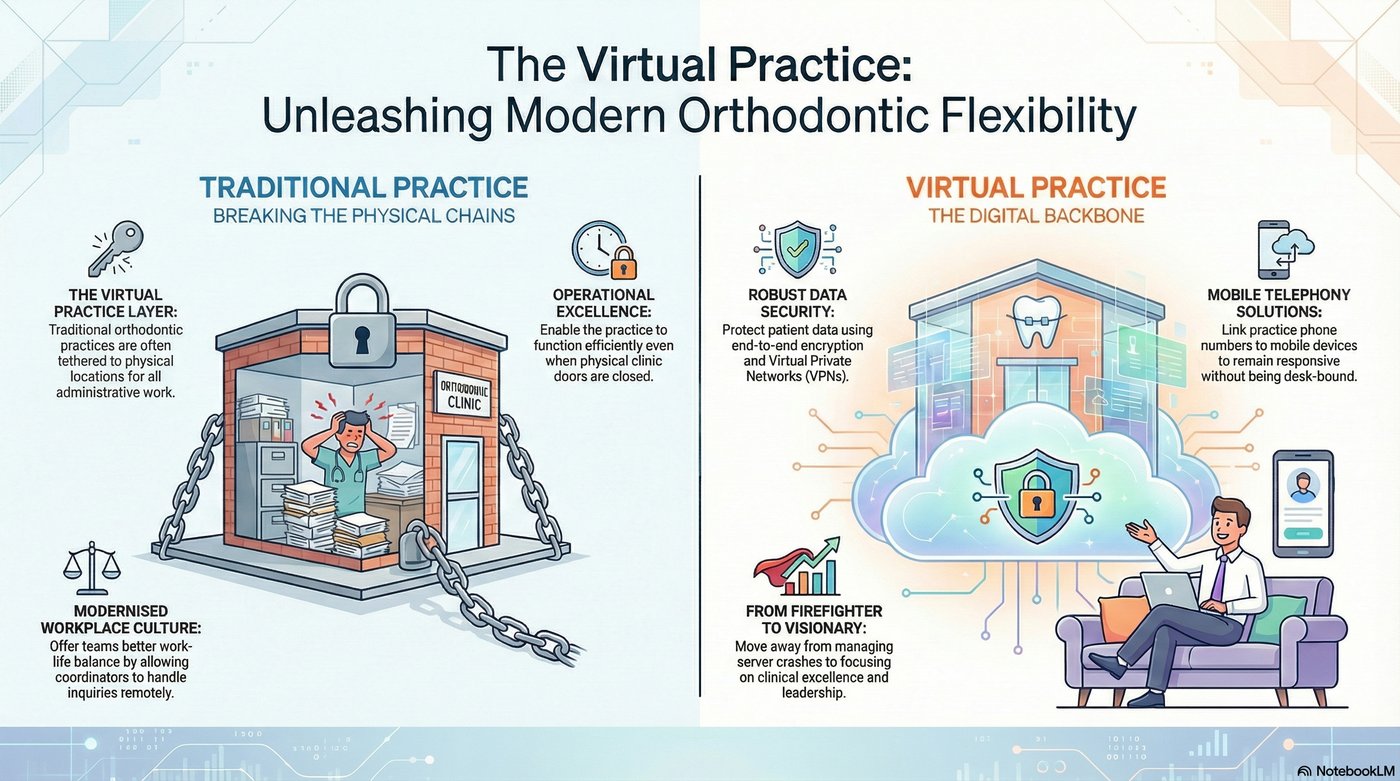
Breaking the Physical Chains of the Clinic
While the clinical treatment of patients must happen in person, the modern orthodontic practice is no longer tied to its physical location for administrative and strategic work. By upgrading to a modern IT network, you unlock the potential for a “virtual” practice layer that significantly enhances orthodontic practice management.
This shift fundamentally redefines overhead. Instead of investing heavily in expansive, in-office administrative spaces, capital can be redirected to clinical advancements, such as advanced imaging equipment or specialized training for assistants. The physical clinic becomes a focused hub for treatment delivery, not a prison for paperwork.
The transition to professional data centers and cloud infrastructure is what makes the modern home office possible. Tasks such as billing, data entry, and even initial consultations via telemedicine can now be handled from anywhere in the world. This flexibility is a hallmark of operational excellence, allowing the practice to function efficiently even when the physical doors are closed.
Consider the advantage during unexpected events. Cloud-based practice management software ensures business continuity during a power outage, inclement weather, or necessary office renovation. Key staff members can seamlessly transition to remote operations, maintaining cash flow and critical patient communication, minimizing downtime that traditional server-dependent offices suffer.
This strategic resilience is a crucial characteristic of modern, effective leadership. Furthermore, cloud infrastructure facilitates the centralization of disparate practice locations. Multi-site clinic leaders can enforce standardized protocols for scheduling and record-keeping across all offices simultaneously. This integration ensures a unified, high-quality patient experience, regardless of which physical door the patient walks through.
Security Without Compromise: VPNs and Encryption
A common concern regarding remote work is data security. However, with modern end-to-end encryption and virtual private networks (VPNs), remote access is more secure than ever. These systems ensure that sensitive patient information is unreadable to anyone without the specific digital key.
For clinic leaders, this involves choosing HIPAA-compliant or equivalent regional standard service providers that specialize in healthcare data. A secure, professional-grade VPN creates an encrypted tunnel between the remote device and the cloud environment. This effectively mimics the security perimeter of the physical office network, but globally.
As a leader and entrepreneur, investing in these robust security measures allows you to offer your team a better work-life balance. When a billing manager can process treatment plans securely from home, or a coordinator can handle patient inquiries on a flexible schedule, the overall dental team performance and loyalty increase. You aren’t just modernizing your IT; you are modernizing your culture.
This cultural modernization becomes a powerful recruiting tool. Top administrative talent often prioritizes flexibility, and a secure remote work policy demonstrates trust and sophistication. When a highly skilled team member can securely access EHR (Electronic Health Records) from home, they gain efficiency and reduced commute stress, translating directly into higher job satisfaction and lower staff turnover for the practice. Secure access is thus a business advantage, not merely an IT compliance checkbox.
Mobile Solutions and the Modernized Phone System
Digital leadership also involves rethinking how we communicate with our patients. Modernized telephony solutions allow your practice phone numbers to travel with you on mobile devices. This ensures that you and your team stay reachable and responsive without being tethered to a desk.
Moving beyond traditional landlines to Voice over Internet Protocol (VoIP) systems offers advanced capabilities essential for a high-volume practice. Features like integrated voicemail-to-email transcription and automatic call routing to the appropriate specialist—be it the scheduling coordinator or the treatment coordinator—streamline internal workflows. This level of communication automation is paramount to maximizing staff productivity.
This mobility reduces “administrative ballast.” It allows for faster response times to patient questions and more efficient coordination between team members. In the eyes of the patient, a practice that is responsive and digitally savvy is a practice they can trust. This enhances the patient journey in orthodontics, providing a seamless experience from the first phone call to the final retention check.
The patient’s perception of responsiveness is critically important in competitive markets. Imagine a prospective patient calls after hours; instead of a generic answering machine, they receive a call back within minutes from a team member who securely pulled their pre-screening information. This immediate, high-touch follow-up significantly boosts conversion rates and solidifies the practice’s reputation for premium service delivery.
Future-Proofing Your Practice Autopilot
An updated IT structure is the skeleton upon which your practice’s “autopilot” rests. When your data is accessible, your communication is mobile, and your systems are encrypted, you have the freedom to focus on your core clinical expertise. You move away from being a “firefighter” dealing with server crashes and toward being a visionary leader.
This infrastructure-as-a-service model ensures scalability without cumbersome hardware upgrades. As you expand from one to three locations, your cloud platform simply allocates more resources instantly. This future-proofing allows the practice owner to aggressively pursue growth opportunities without being constrained by the physical and financial limitations of on-site IT hardware procurement cycles. The technology scales with the vision.
Furthermore, cloud systems integrate seamlessly with next-generation AI and automation tools—from automated patient recall systems to predictive scheduling. By laying this robust foundation today, you position the practice to immediately leverage cutting-edge technologies as they become available, solidifying a long-term competitive advantage in the healthcare sector.
Conclusion: Lead the Digital Transformation
Inclusive digital leadership is the key to scaling your practice in the 21st century. By embracing the cloud and empowering your team with flexible, secure tools, you create a high-performing environment that attracts both top talent and savvy patients. The goal is clear: use technology to create more time for what matters—clinical excellence and personal fulfillment.
For the clinic leader, this transformation is an investment in strategic time management. Every minute saved by eliminating IT bottlenecks or manual data transfer is a minute regained for high-value activities, such as mentorship, complex case planning, or simply a better personal balance. Ultimately, the virtual practice model is not about working more, but about working smarter and leading better.