

The Value Balance: How to Communicate the Worth of Orthodontic Care
Published on: Jun 2, 2026
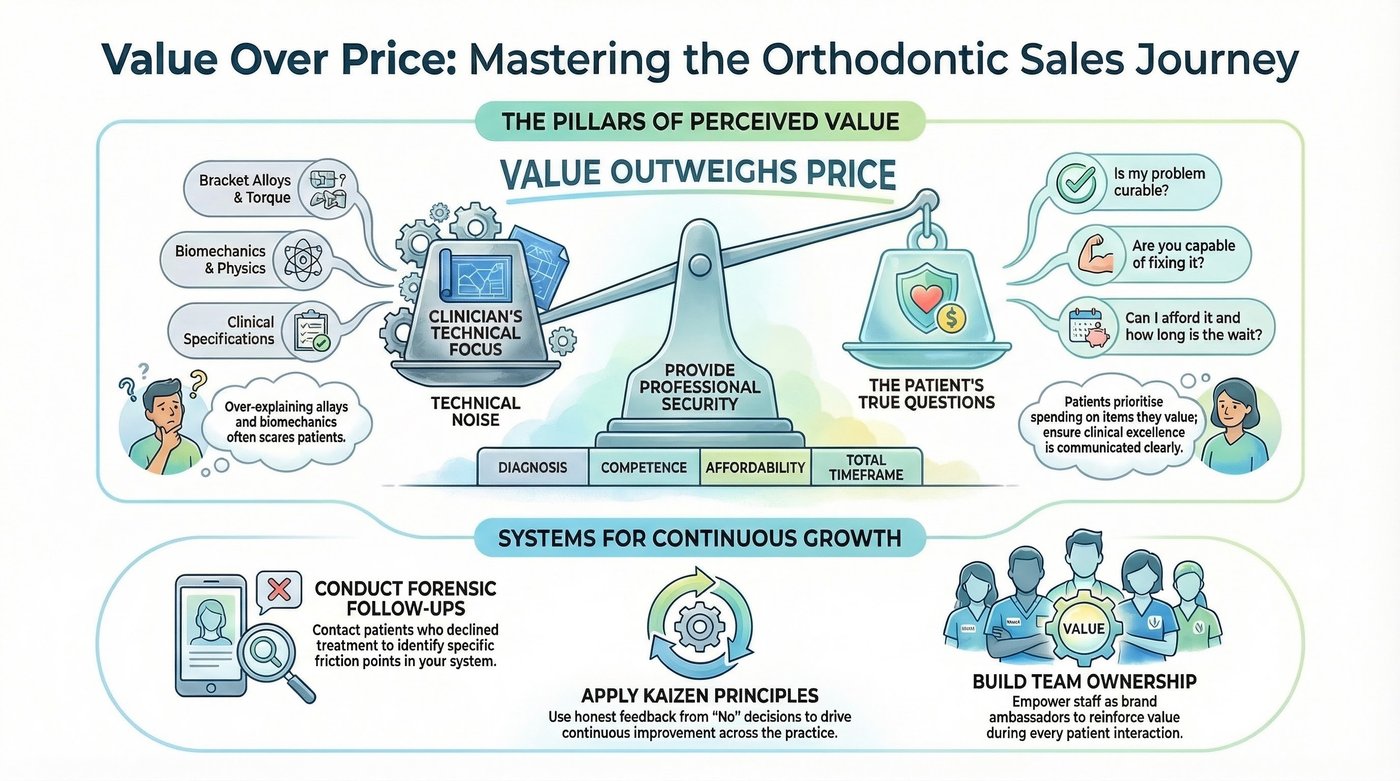
A common frustration for orthodontists is the patient who complains about the cost of a treatment plan but happily spends over a thousand euros on the latest smartphone. This isn’t a problem of “price”; it is a problem of Perceived Value. If your patients are dropping out of your system, it is rarely because you are too expensive—it is because the value of your clinical excellence has not been communicated clearly enough.
The immediate comparison of a high-ticket orthodontic plan to a consumer gadget illustrates a critical disconnect in perception. Patients view the smartphone as instant gratification and a necessary life upgrade, while often viewing orthodontics as a deferred, sometimes painful, medical expense.
The challenge for clinic leaders is to reframe the investment, moving it from a temporary expense to a permanent, functional, and aesthetic asset that increases the patient’s quality of life and long-term self-esteem.
Mastering the sales mindset requires a fundamental shift in focus. We must move away from reciting technical specifications and toward addressing the four fundamental questions that truly drive patient decisions. This strategic shift is what separates a clinic of highly skilled technicians from a high-performing, growth-oriented business.
The Four Questions Every Patient is Asking
Younger colleagues, fresh from university, often try to establish authority by over-explaining technical details. They talk about bracket alloys, torque values, and biomechanics. In reality, this “technical noise” often scares patients away, leading to information overload and doubt. Patients are not looking for a lecture on engineering; they are looking for reassurance from a trusted leader.
To establish yourself as the indispensable expert, your entire consultation process must be intentionally structured to answer these four core questions immediately and transparently:
Is my problem curable? (The diagnosis)
This question is about validating the patient’s intuition and clearly defining the endpoint. Your answer must confirm that a comprehensive solution exists and that the issue is well within your scope of expertise. Use diagnostic tools and plain language to clearly articulate the pathology and the definitive path to correction, establishing immediate confidence.
Are you capable of fixing it? (Your competence)
Competence is not proven through verbose explanations of technique, but through social proof and confidence. Showcase relevant case studies—before-and-after photos of similar malocclusions—to build immediate, tangible trust. Crucially, involve your team to reinforce your expertise, turning isolated clinical skill into a unified, reliable practice promise.
Can I afford it? (The financial value)
The term “afford” goes beyond the sticker price. It relates to the accessibility of payment. Present flexible, tiered financial options and clearly outline the return on investment in terms of oral health and quality of life. The communication here should focus on financial planning and partnership, detailing how the investment safeguards future health expenses.
How long will it take? (The timeframe)
Setting realistic expectations for treatment length is vital. Underscoring the commitment required from the patient—hygiene, appointments, compliance—justifies the duration. Providing a clear, staged timeline eliminates uncertainty and converts a massive, overwhelming task into a series of manageable, defined steps.
When you focus your communication on these pillars, you provide the Professional Security the patient is looking for. This allows the “signature on the contract” to happen as a natural, low-stress consequence of a successful conversation, making the transition from consultation to treatment feel inevitable and right.
Forensic Follow-Ups: Learning from the “No”
One of the most underutilized tools in practice efficiency is the follow-up with patients who decide not to proceed. Many administrative teams feel that calling a patient after a declined offer is “pushy,” mistaking data collection for high-pressure sales. In a lean, improvement-focused system, this is an essential, high-value data-gathering exercise.
A structured forensic follow-up is executed not to change the patient’s mind immediately, but to extract honest feedback about systemic failures. This low-friction call is designed to diagnose the weaknesses in your own patient journey and pinpoint where perceived value collapsed.
By asking a patient for honest feedback on why they chose another provider or decided to wait, you uncover the friction points in your system. The feedback must be qualitative and systematic:
Did they feel unheard?
Was the financial plan too confusing?
Was the waiting room atmosphere off-putting?
If multiple lost cases cite confusion around payment terms, the system—not the patient—is the problem. This authentic, critical information allows you to apply Kaizen (continuous improvement) to your team and yourself. Systematically addressing these failure points drastically improves the conversion rate for future prospective patients. Moreover, reaching out with genuine curiosity proves to the patient that they are more than a number and ensures you are constantly refining your sales journey to meet the specific needs of your community.
Building Team Ownership
The gold standard for a professional sales process is comprehensive team participation. The orthodontist should not be the only person “selling” in the practice; the sales journey is reinforced at every touchpoint. Effective clinic leadership dictates that your entire team must be deeply involved in developing the scripts, defining the critical touchpoints, and curating the patient experience from the first phone call to post-treatment retention.
When staff understand the strategic guidance behind the sales journey, they naturally take ownership of it. For example, the front office coordinator should be trained to reinforce the doctor’s competence when scheduling the initial exam. The financial coordinator must simplify and personalize the payment narrative, reiterating the long-term value and comparing it favorably against short-term expenses. They become the “brand ambassadors” who reinforce the value of your care in every interaction, creating a cohesive, trustworthy environment.
This synchronicity is powerful. A fragmented sales process creates jarring experiences, but a synchronized team creates a seamless journey that builds trust far more effectively than any individual doctor can alone. Team ownership shifts the responsibility from a single practitioner to a unified system, ensuring that the message of value is consistent, confident, and persuasively delivered, regardless of which team member is engaging the patient.
Conclusion: Turning Experts into Entrepreneurs
Mastering the sales process is a technical skill that can be learned, just like any orthodontic procedure. By focusing on value, answering the patient’s true questions, and utilizing data to refine your approach, you transform your practice from a struggling clinic into a high-performing entrepreneurial venture.
For dental professionals looking to transition into true clinic leaders and entrepreneurs, the key lies in leveraging your entire team to reinforce a unified value proposition. By shifting the focus from technical details to addressing the patient’s underlying questions about security and outcome, you immediately elevate the consultation experience. The implementation of forensic follow-ups transforms failures into actionable data, driving continuous, measurable improvements (Kaizen) in your patient conversion systems. When clinical excellence is matched by an equally excellent, systematized communication strategy, the perceived worth of your care will always align with its actual, transformative value. Embrace the role of business strategist as much as clinician.