

The Synchronization of Success: Mastering Communication in Multi-Site Practices
Published on: Jun 7, 2026
How do you keep five different orthodontic clinics, forty-five employees, and hundreds of daily patient journeys in sync without physically being in five places at once? This is the central puzzle of the multi-location entrepreneur. The answer does not lie in more management, but in better synchronization.
Communication in a scaling practice must be treated as the “heartbeat” of the organization. It requires a specific, recurring rhythm that provides cognitive hygiene for the leader and operational clarity for the team. When your communication is structured, the practice moves from a state of chaotic improvisation to one of synchronized excellence.
The Daily Rhythm: Briefings and Sundowners
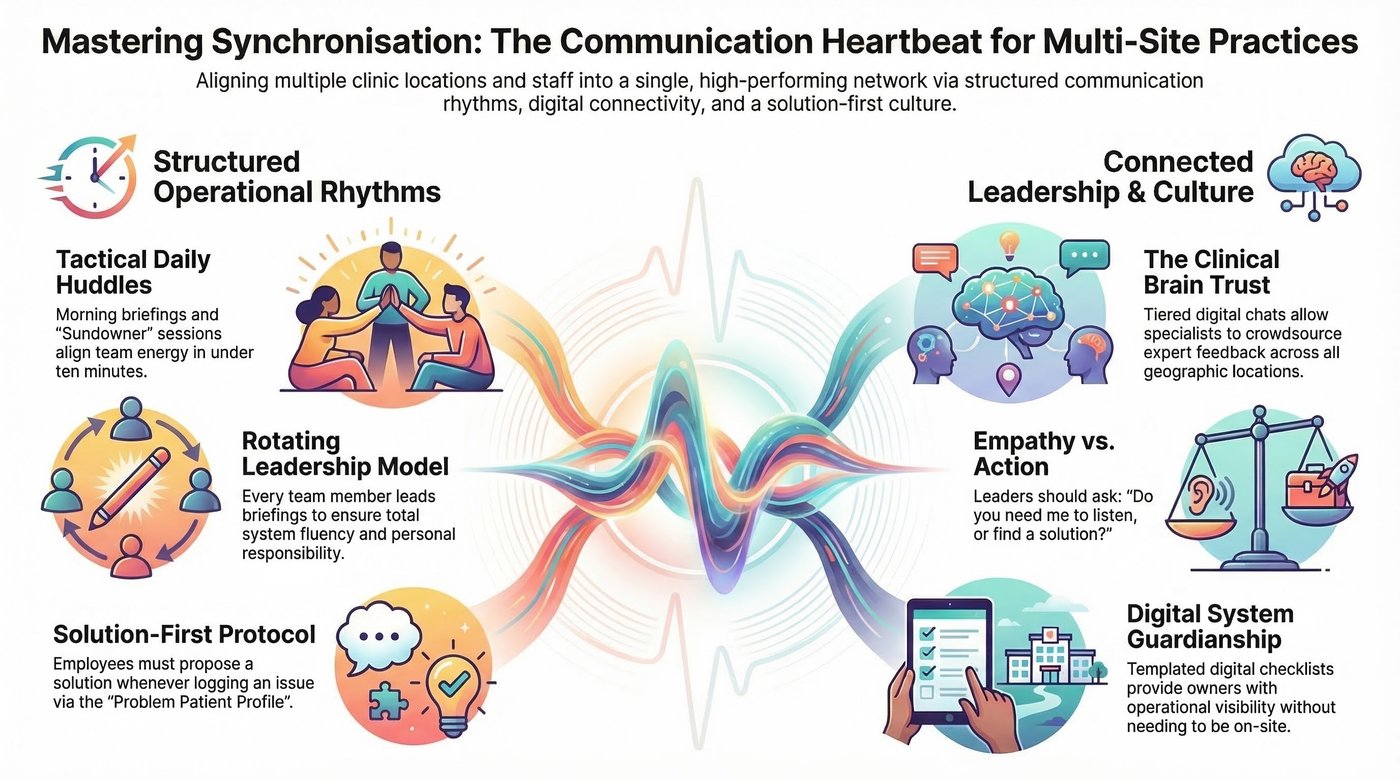
Every location in a high-performing network needs a standardized opening and closing ritual. We utilize a morning briefing and a “sundowner” session. These are not lengthy meetings; they are five-to-ten-minute tactical huddles designed to align the team’s energy for the day.
The key to dental team performance in these sessions is the “Rotating Leadership” model. We do not have a permanent manager lead these briefings. Instead, the responsibility rotates through the entire team—including our first-year trainees. This forces every team member to understand the system and take personal responsibility for the day’s “Value Stream.” By documenting these briefings with a templated digital checklist, the owner can see at a glance that the day is settled without needing to be on-site.
The “Solution-First” Culture: The Problem Patient Profile
Complaining is a form of operational waste. In many practices, the “back office” becomes a theater of grievances where problems are discussed without ever being solved. To eliminate this energy drain, we implement a “Solution-First” protocol for process issues.
Using an internal tool—which we call a “Problem Patient Profile”—any employee can log a process failure or a suggestion for improvement. However, there is a strict rule: No problem can be logged without a proposed solution. This shifts the team’s mindset from passive complaining to active problem-solving. It empowers the staff to act as “sensors” for the system, identifying friction points in the patient journey and providing the forensic data needed for continuous improvement (Kaizen) during our monthly strategy sessions.
Tiered Digital Connectivity: The Clinical Brain Trust
In a multi-site network, clinical standards can easily drift if the doctors are isolated. To prevent this, we utilize a tiered digital chat system that acts as a live “Clinical Brain Trust.”
Specific groups are created for lab orders, management, and—most importantly—Clinical Live Assistance. If a specialist at a satellite location encounters an unusual biomechanical challenge during treatment, they can instantly upload a clinical photo and receive feedback from a pool of five or six other specialists in the network. This ensures that every patient, regardless of location, receives the combined expertise of the entire organization. It is a “Cloud-Based” clinical standard that maintains the integrity of your brand across any geographic distance.
The Human Element: Empathy vs. Action
As systems become more digital and structured, the danger is losing the human connection that defines excellent healthcare. Leadership at scale requires a nuanced understanding of when to be a “System Guardian” and when to be a “Coach.”
When a team member brings a personal worry or professional frustration to you, it is an act of trust. A common mistake is immediately jumping into “problem-solving” mode. Instead, a sophisticated leader asks: “Do you need me to just listen right now, or do you want me to find a solution?” This simple distinction allows you to provide the necessary empathy while protecting the clinic’s workflow from becoming bogged down in unresolved emotions.
Conclusion: Creating a Sustainable Practice Heartbeat
A synchronized multi-location practice is a resilient practice. When you move beyond the “emergency mode” of a solo doctor and implement structured rhythms, digital peer support, and a solution-oriented culture, you create an organization that can breathe.
The goal of your communication infrastructure is to ensure that the practice remains stable even when the leader is absent. By acting as the “Guardian of the System” rather than the master of every task, you build a sustainable organization that provides freedom for yourself and elite excellence for your patients. Take a fresh look at your daily communication today: is it a source of noise, or is it the rhythm that drives your success?