

The Straight-Line Communication Framework: Building Unshakeable Patient Trust
Published on: Jun 13, 2026
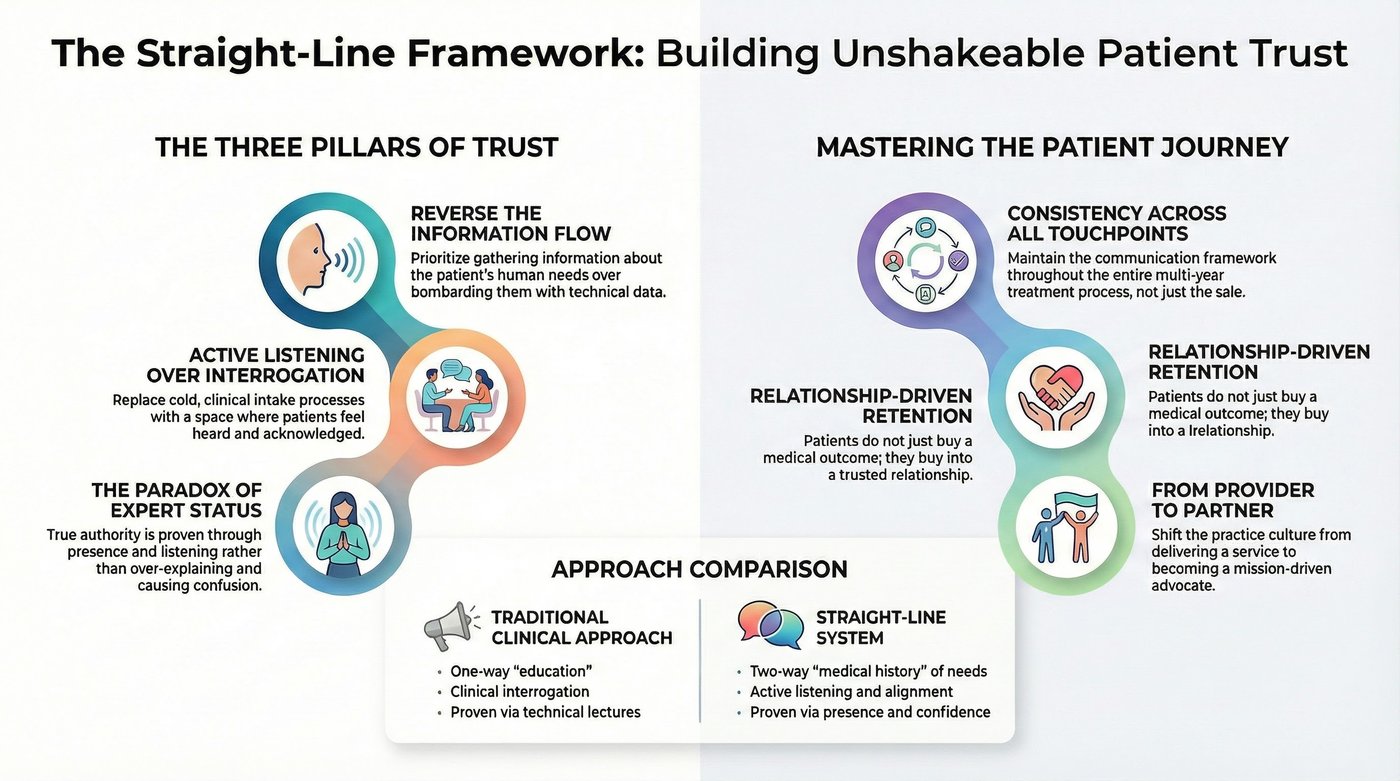
In the high-stakes world of orthodontics, many practitioners operate under the assumption that clinical excellence is the sole driver of patient retention. While a “perfect finish” is undoubtedly the foundation of our medical duty, it is rarely the primary reason a patient remains loyal for a lifetime. True loyalty is not built with brackets and wires alone; it is engineered through a sophisticated communication structure that transforms a standard clinical encounter into a partnership based on deep-seated trust.
As leaders in orthodontic practice management, we must realize that patients do not just buy a medical outcome—they buy into a relationship. To master this, I utilize a framework called the “Straight-Line System” for communication. This approach moves away from the chaotic, unfocused interactions common in busy clinics and instead focuses on three essential pillars: information flow, relationship building, and the preservation of expert status.
Pillar 1: Reversing the Information Flow
The most common mistake in dental leadership communication is viewing information flow as a one-way street. We often feel an immense pressure to “educate” the patient, bombarding them with facts, technical data, and treatment mechanics. In an entrepreneurial practice, the most effective communication is actually the opposite.
Think of the most successful sales professionals: they don’t start by talking; they start by taking a “medical history” of the patient’s needs and desires. As doctors, we must remember that our primary job during the consultation is to gather information about the patient as a human being. This requires asking the right questions and, more importantly, listening to the answers. When you stop talking and start understanding the person sitting across from you, you stop being a salesperson and start being a trusted advisor.
Pillar 2: Relationship Building Beyond the “Interrogation”
There is a vast difference between gathering data and building a bond. Many clinical intake processes feel like a police interrogation—bright lights, rapid-fire questions, and a cold, clinical atmosphere. This environment is anathema to loyalty.
To create a loyal advocate, we must utilize active listening to meet the patient where they are. Every human has a fundamental need to be seen and acknowledged. Whether a patient is sharing their dreams of a new smile or their anxieties about the cost, our first task is to provide a space where they feel heard. This satisfies two goals simultaneously: you obtain the vital diagnostic information you need, and you lay the first brick in a lasting relationship. In lean management, this is about removing the friction of misunderstanding and replacing it with the efficiency of alignment.
Pillar 3: The Paradox of Expert Status
One of the most surprising aspects of patient psychology is that we start with a massive amount of “trust credit.” By the time a patient walks through your door, they have usually done their research. They trust the title of “Doctor,” the professional environment, and the authority of the clinic. You do not need to work hard to prove your expertise; the patient has already conceded it.
The real danger, particularly for younger practitioners, is the urge to over-explain. In a misguided attempt to prove their value, they talk until they inadvertently sow seeds of doubt or confusion. This “information overload” can overwhelm a patient, causing them to seek a second opinion simply to clear the mental fog. True expert status is proven through presence and listening, not through a lecture. When you listen deeply and confirm the patient’s needs with confidence, you solidify your status as the authority they were looking for.
Integrating Communication into the Patient Journey
Mastering the patient journey in orthodontics means ensuring these three pillars are present at every touchpoint. It is not enough to be a great communicator during the initial “sale.” If the information flow stops or the relationship building fades once treatment begins, the trust you built will evaporate.
Consistency is the hallmark of dental leadership. Your team must be trained to maintain this straight-line communication throughout the multi-year treatment process. Every appointment is a chance to gather a little more information, strengthen the bond, and reconfirm your expertise. This systematic approach ensures that the patient feels like a valued partner from day one until the day the braces come off.
Conclusion: Becoming a Trusted Partner
Moving from a service provider to a trusted partner is a deliberate leadership choice. It requires the discipline to stop talking, the empathy to start listening, and the confidence to let your presence speak for your expertise. By implementing the Straight-Line System, you create a practice culture where trust is the primary currency.
When you master this framework, you don’t just get patients who show up for appointments; you get advocates who believe in your mission. Your clinical skill provides the result, but your communication provides the reason for them to stay—and to bring others with them.