

The Selective Specialist: Why “Qualification” is the Foundation of a Successful Practice
Published on: Jun 2, 2026
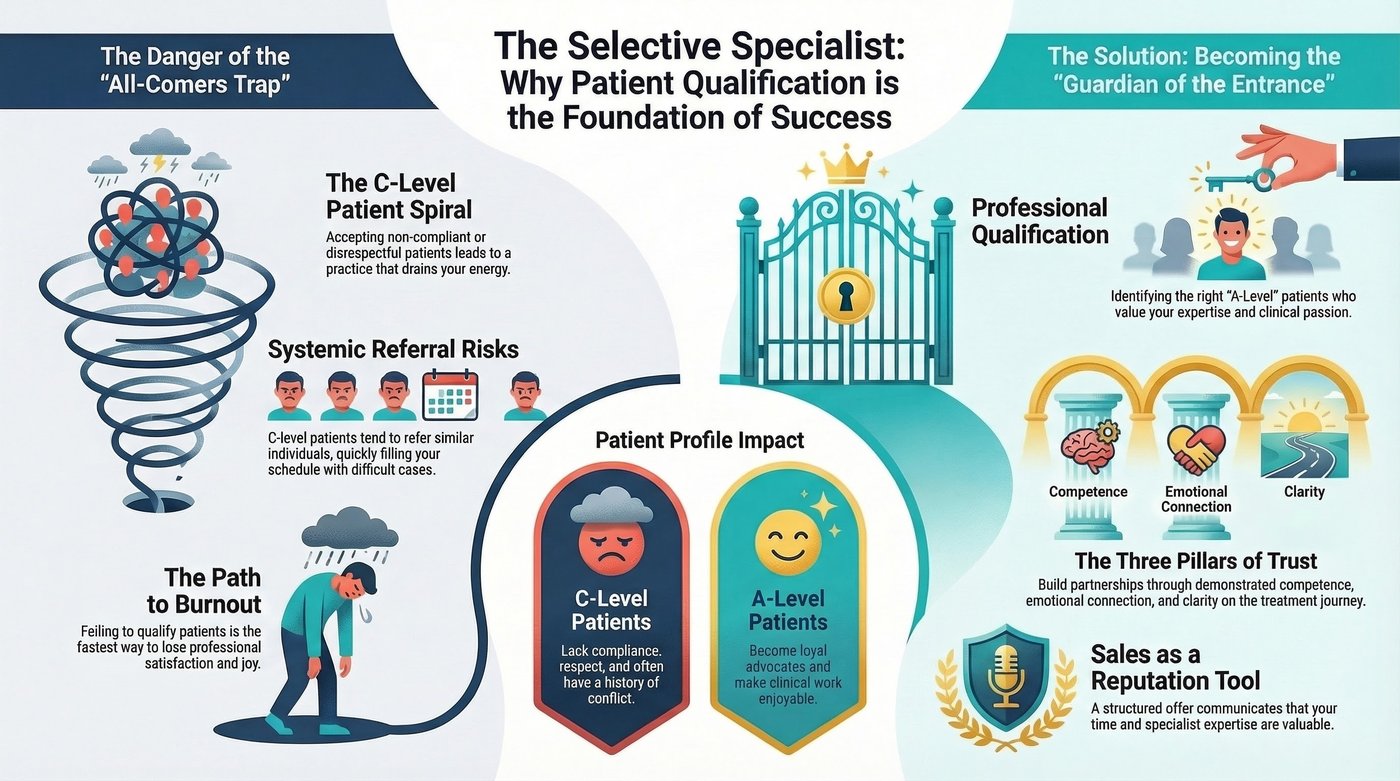
In the early years of a practice, financial pressure can be overwhelming. With equipment loans, rent, and staff salaries looming, many orthodontists fall into the “All-Comers Trap”. They believe that every new patient is a “good” patient. However, as Dr. Martin Baxmann warns, failing to qualify your patients is the fastest way to build a practice that drains your energy and eventually leads to burnout. The pursuit of volume over value inherently compromises the quality of both clinical outcomes and professional life. Practice growth should be measured by net profit and schedule efficiency, not merely by case acceptance rate.
This qualification process is not about gatekeeping; it is a strategic business decision. It involves defining an ideal patient profile (IPP) and implementing systems that attract, identify, and retain individuals who are ready to commit to the clinical process, respect the financial agreement, and adhere to compliance requirements.
Professional sales in orthodontics isn’t about convincing everyone to say “yes”; it is about identifying the right people who value your expertise and clinical passion. It shifts the focus from aggressive persuasion to genuine service for those who truly need and appreciate premium care.
Avoiding the “C-Level” Patient Spiral
If you are not selective during the initial consultation, you will inevitably attract “C-Level” patients. These are individuals who often have a history of conflict with previous dentists, lack compliance, or do not respect the clinical process. A key indicator is a patient primarily focused on price shopping or demanding immediate, unrealistic outcomes without full adherence to the treatment plan.
The danger is systemic. C-level patients tend to refer other C-level friends. This phenomenon, known as negative practice compounding, means that the energy drain from one difficult case is multiplied by future referrals of similar profiles. Within two years, you may find your schedule filled with difficult cases that offer little professional satisfaction. This density of challenging cases dramatically increases staff turnover and reduces overall clinic morale.
To lead an elite practice, you must be the “Guardian of the Entrance”. This responsibility involves training your entire front-office team to screen inbound calls and initial inquiries, gently guiding incompatible prospects toward other providers. It is critical to establish objective metrics for disqualification early on, such as a pattern of missed appointments or an unwillingness to engage in the necessary pre-treatment diagnostic steps.
Directing your patient management allows you to qualify the right “A-Level” patients who become loyal advocates and make your clinical work enjoyable. A-Level patients are characterized by high motivation, excellent compliance, and a readiness to refer others who share their values, leading to positive, exponential growth.
The Professional Offer: Trust over Tactics
“Sales” is simply the art of making a service offer that carries a fair price and leads to a mutual agreement. In a lean system, this is a structured process, not an ad-hoc event. The initial consultation should be viewed as a formal, educational process that elevates the perceived value of the treatment plan, not a negotiation session. Every step, from the patient’s arrival to the presentation of the proposal, must be consistently refined and executed.
The goal of this process is to establish a high-trust relationship from the first touchpoint. This structure eliminates hesitation and buyer’s remorse by making the clinical solution feel like the only logical next step. When trust is firmly established, the financial conversation becomes secondary to the pursuit of health and aesthetic goals.
This high-trust relationship is built on three pillars:
Competence: Demonstrating you have the solution. The patient must see tangible evidence of your expertise. This includes showcasing before-and-after case studies that reflect similar complexity to their own situation, clearly articulating the science behind the proposed treatment, and ensuring the entire team speaks the same clinical language. Competence removes doubt about the desired outcome.
Trust: Building a social and emotional connection. Trust is established through active listening and authentic empathy, moving beyond the clinical diagnosis to understand the patient’s underlying motivations, fears, and lifestyle constraints. The doctor and staff must consistently demonstrate that they are invested in the patient’s overall well-being, not just their teeth. This emotional alignment is what converts a prospect into a committed partner.
Information: Providing clarity on the journey ahead. A professional offer demands total transparency regarding the treatment timeline, financial structure, and compliance expectations. Patients need a clear, easy-to-digest roadmap of what their experience will look like, including potential pitfalls and contingency plans. Reducing ambiguity is essential; a fully informed patient is a compliant patient.
By professionalizing this journey, you ensure that the patient feels like a partner in their own care rather than a target of a sales pitch. The offer then transitions from a transaction to a collaborative decision, cementing their investment in the process. This rigorous approach to the consultation process acts as a final qualification filter, ensuring only highly engaged patients move forward.
Conclusion: Engineering Your Reputation
Your sales process defines your reputation. It serves as a public declaration of your standards, your clinical philosophy, and the type of relationship you expect to have with those you treat. When you are selective and structured, you communicate that your time and expertise are valuable.
Stop seeing “sales” as a dirty word and start seeing it as the mechanism that protects your professional joy and ensures you are treating the patients you were meant to serve. An optimized qualification system is the ultimate form of self-preservation for the practice owner. It guarantees that you spend your valuable time delivering complex, fulfilling clinical work to grateful, compliant individuals, thereby solidifying your status as an elite specialist in your field. This dedication to quality over quantity is the single most effective strategy for engineering a world-class, referral-driven reputation that sustains long-term profitability and professional satisfaction.