

The Science of Lifelong Stability: Engineering Sustainable Retention
Published on: Jul 1, 2026
The Silent Enemy of the Perfect Smile
Relapse is the silent enemy of every orthodontic success. We invest months, often years, into achieving the perfect Class I relationship and an aesthetic smile, only to see that work undone by biological memory or a lack of compliance. In lean orthodontics, clinical sustainability is about ensuring that the function and aesthetics we achieve remain for the rest of the patient’s life.
The biological reality of stretched periodontal ligaments and active muscle memory means that teeth are always attempting to revert to their original, genetically predisposed positions. This inherent instability requires a proactive, engineering-minded approach to retention, rather than a passive reliance on patient adherence. It is a long-term risk mitigation strategy.
A common pitfall is thinking about stability only once the braces are removed. True dental leadership requires a “start with the end in mind” philosophy, integrating retention planning from the initial diagnosis stage. This means selecting mechanics that promote stable outcomes, such as minimizing proclination or performing appropriate interproximal reduction (IPR).
Since we lack a definitive way to predict which patients will remain stable and which will relapse, the only responsible clinical standard is to provide a lifelong retention strategy. Practices must communicate this reality clearly to patients, framing retention not as an optional add-on, but as the critical final phase of treatment that protects their significant time and financial commitment.
The Multi-Layered Protocol
Efficiency in retention is not about doing less; it is about doing what is necessary to prevent the “waste” of a retreatment case, which consumes valuable chair time and erodes patient trust. The principle of multi-layered protection is borrowed from engineering redundancy, ensuring system survival even upon component failure.
A robust protocol typically involves a combination of fixed and removable elements, tailored to the unique biomechanical challenges of the completed case. This personalization is key to moving beyond a one-size-fits-all model and achieving superior long-term results.
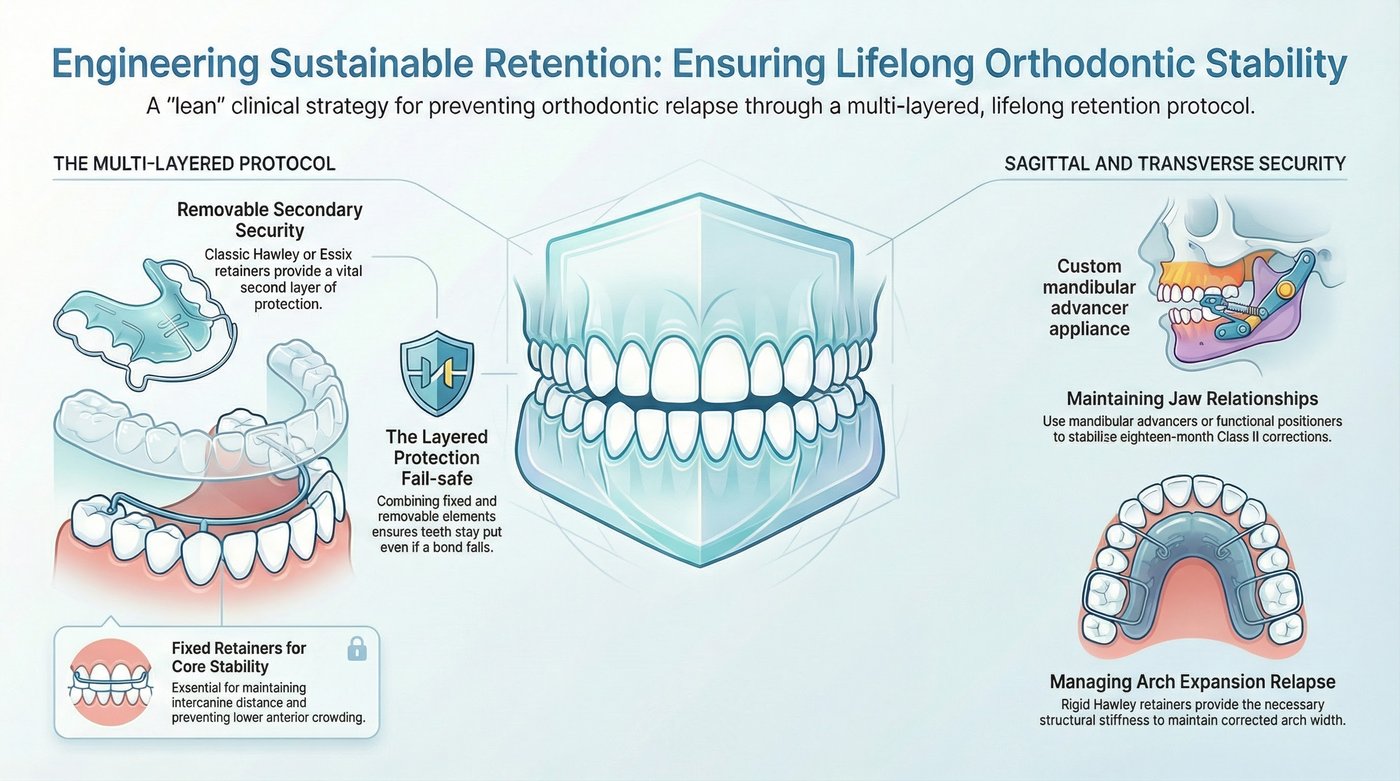
Fixed Retainers: Essential for maintaining intercanine distance and preventing lower anterior crowding, especially in cases where significant rotation or diastema closure was performed. The wire should be bonded to key teeth—typically canines and incisors—using a flowable composite for maximum contact and strength.
Removable Appliances: Classic Hawley retainers or Essix (clear) retainers provide a secondary layer of security and are crucial for maintenance in the posterior segments. The Hawley, with its acrylic coverage, offers superior occlusal stability and durability, while the Essix provides high patient aesthetics and ease of wear.
Layered Protection: Combining a fixed wire with a removable overnight appliance ensures that even if a bond fails, the teeth do not move before the patient can reach the clinic for a repair appointment. This dual approach provides mechanical retention while also serving as an early diagnostic tool, as a poor fit in the removable appliance signals movement.
Effective practice leadership mandates regular retainer checks, especially in the first two years post-treatment. Establishing a clear protocol for maintenance appointments transforms the retention phase from a passive wait-and-see approach into an active clinical management system.
Maintaining the Correction: Sagittal and Transverse Security
One of the most frequent causes of relapse is a failure to maintain the corrected jaw relationship, particularly in dentoalveolar Class II and Class III corrections. The forces exerted by the musculature and soft tissue envelope are relentless, constantly attempting to push the occlusion back toward the original malocclusion.
If you have spent eighteen months correcting a Class II overjet, the stability of that correction must be managed through specific, active retention mechanics. The goal is to solidify the new skeletal and occlusal position until bone remodeling fully adapts to the change.
Mandibular Advancers: Using aligners with lateral wings or precision cuts to keep the jaw in the corrected position. This technique ensures continuous gentle pressure that discourages the mandible from returning to its habitual, retruded position, effectively stabilizing the joint and muscle complex.
Functional Retention: Continuing with a positioner or a modified Twin Block to stabilize the sagittal change. These appliances are specifically designed to guide the eruption and intercuspation of teeth while actively holding the new Class I relationship, offering more dynamic control than passive retainers.
Transverse Support: Recognizing that massive arch expansion, especially non-surgical expansion in adults, has a high relapse rate due to the memory of the alveolar bone. A simple Essix may not be rigid enough to maintain arch width; a Hawley retainer often provides the structural “stiffness” required, particularly when incorporating a bonded wire across the palatal aspect. The clinician must analyze the transverse dimension as critically as the sagittal.
To achieve superior stability, clinic leaders should standardize the measurement of inter-molar and inter-canine widths at debonding. Comparing these measurements to the original diagnostic records provides a vital benchmark for long-term monitoring and justifies the choice of a rigid retention device.
Conclusion: Protecting the Patient’s Investment
Sustainability in orthodontics is about protecting the patient’s investment, which is a direct reflection of your clinical and financial stewardship. It is also fundamentally about preserving your own clinical reputation and the long-term value proposition of your practice.
By implementing a structured, multi-layered retention system, you ensure that your practice delivers excellence that lasts a lifetime, moving your focus from reactive care to proactive, preventative management. This shift allows you to standardize outcomes, improve predictability, and elevate the overall patient experience.
You move away from the “firefighting” of relapse cases, with their associated patient dissatisfaction and unplanned chair time, and toward a state of operational excellence. A robust retention protocol transforms clinical sustainability from an ideal concept into a daily standard of care, solidifying your practice as a leader in predictable, lifelong results.