

The Practitioner-Patient Match: Leveraging Team Diversity for Growth
Published on: Jul 4, 2026
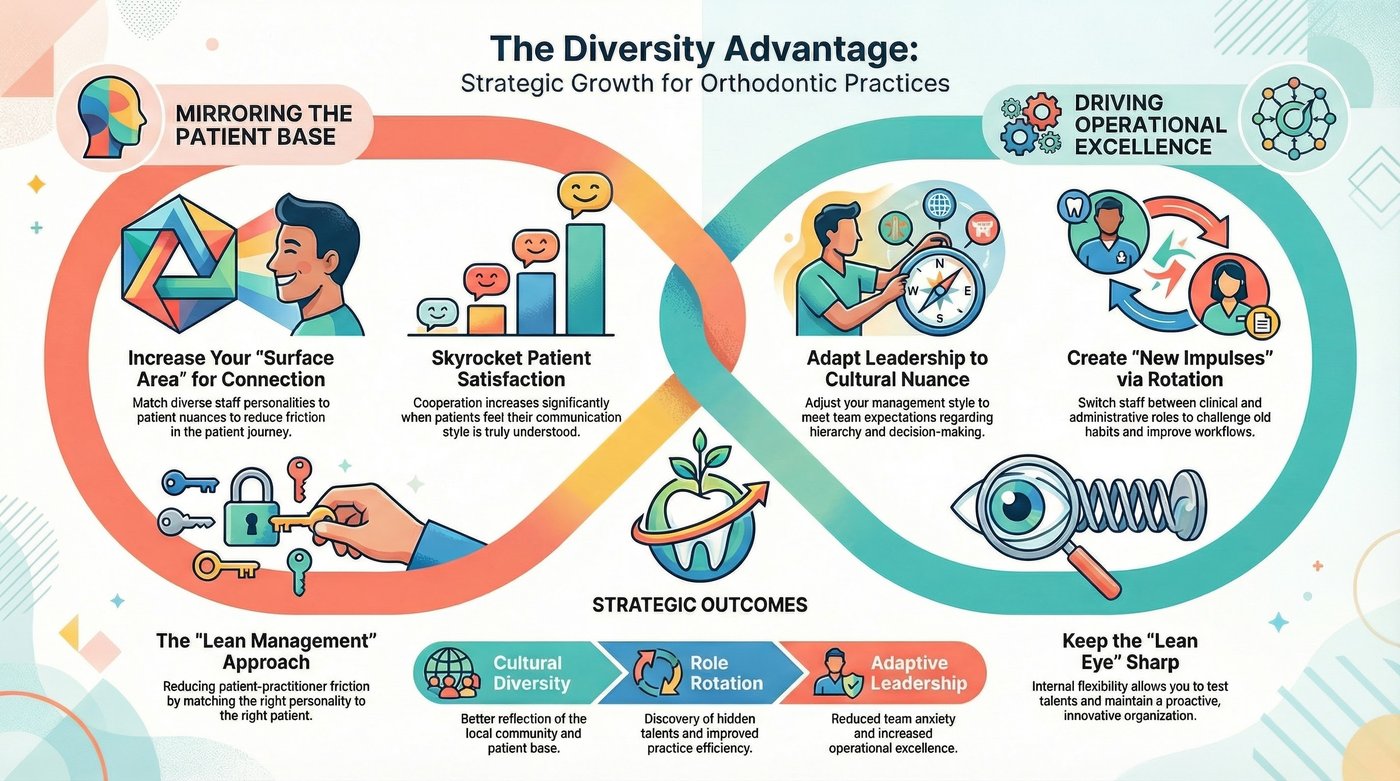
Mirroring Your Patient Base
A practice is only as successful as its ability to connect with its patients. Success depends on recognizing that patient comfort is a primary driver of case acceptance and compliance. In a diverse world, a “one-size-fits-all” personality approach at the front desk or chairside is a missed opportunity.
Some patients prefer a practitioner who is very similar to them—someone who shares their cultural nuances or communication style. For example, a Spanish-speaking patient may feel immediate trust with a clinical assistant who shares their native language, reducing anxiety about complex procedures. Other patients thrive on the dynamic energy of someone different, valuing a contrast in perspectives.
By strategically assembling a diverse team, you increase your “surface area” for patient connection. This is a core part of lean management in dentistry: reducing the friction of the patient journey in orthodontics by matching the right personality to the right patient. When a patient feels truly understood, their cooperation and satisfaction skyrocket, leading to better clinical outcomes and higher retention. This intentional matching turns a simple appointment into a customized, high-trust experience.
Hierarchy and Cultural Nuance
Diversity goes beyond what we see; it includes how we communicate and how employees expect to be managed. In an urban clinic, you may have staff members from cultures that favor flat hierarchies and open dialogue, alongside those used to a patriarchal style where the “boss” makes every decision.
A team member from a highly structured professional background may expect detailed, written protocols for every task. Conversely, a team member from a more entrepreneurial culture might prefer broad objectives and the autonomy to innovate the method of execution. A “Lean Leader” adapts their style to these backgrounds, understanding that leadership is not a fixed template.
If you try to lead a team that expects firm direction with a purely autonomous “hands-off” approach, you will create anxiety and inefficiency. The team may interpret the lack of clear instruction as a failure of leadership, resulting in decision paralysis and process slowdowns. Recognizing these cultural nuances allows you to provide the specific type of dental leadership each team member needs to reach operational excellence.
This flexible approach means knowing when to offer mentorship and when to enforce a strict policy, ensuring every team member feels secure and empowered within their role, maximizing their contribution to the practice’s goals.
Creating “Impulses” Without New Hires
Teams are dynamic organisms. Adding or removing a single person changes the entire structure. However, you don’t always need to hire to change the energy of your practice or break cycles of stagnation. As a leader focused on optimization, you can give a stagnant team a “new impulse” by strategically switching people between work areas. This cross-training is an internal audit tool.
Moving a clinical assistant to the lab or an administrative person to a coordination role for a few weeks challenges “set-in-the-ways” thinking. The administrative team member, for instance, might instantly identify redundant forms or unnecessary handoffs from the patient’s perspective, simply because they are viewing the process with fresh eyes. This temporary reassignment forces the team to articulate, question, and ultimately improve old habits and workflows.
This flexibility is a hallmark of practice efficiency, allowing you to test talents and keep the team’s “Lean Eye” sharp. It serves a dual purpose: it upskills employees, making them more valuable and resilient, and it instantly exposes bottlenecks that incumbent team members had become blind to. The resulting cross-functional insight drives profound, low-cost process improvement.
The Goal: A Practice That Reflects Its Community
As an entrepreneur and leader, your task is to ensure that diversity results in excellence rather than confusion. Diversity, when managed correctly, is the engine of adaptability. It prevents the organization from developing a single, narrow perspective that fails to see incoming market shifts or patient needs. When you have a broad group of personalities, experiences, and backgrounds, you can serve a wider range of the community more effectively.
This variety ensures that your practice isn’t just a clinical office but a vibrant, adaptable organization that can handle any challenge—from language barriers to complex financial situations. A practice that actively mirrors its community becomes deeply rooted, making it recession-proof and a preferred destination for both talent and patients. This proactive engagement transforms the practice into a true community health asset.
Conclusion: From Conflict to Creativity
Diversity is not just a buzzword; it is a competitive advantage in orthodontic practice management. It provides a constant, healthy tension that, when channeled by effective leadership, sparks superior solutions. By intentionally composing your team to include a variety of ages, backgrounds, and perspectives, you create a resilient practice.
You move from a state of simply repeating old patterns to a state of constant, proactive innovation. Diversity is the raw material for creativity; the friction between different viewpoints is the polish that perfects your processes. Use the differences in your team to benefit the patient, and you will find your practice reaching its highest potential and sustaining long-term, ethical growth.