

The Practice Assessment: Diagnosing the Health of Your Business
Published on: Jun 28, 2026
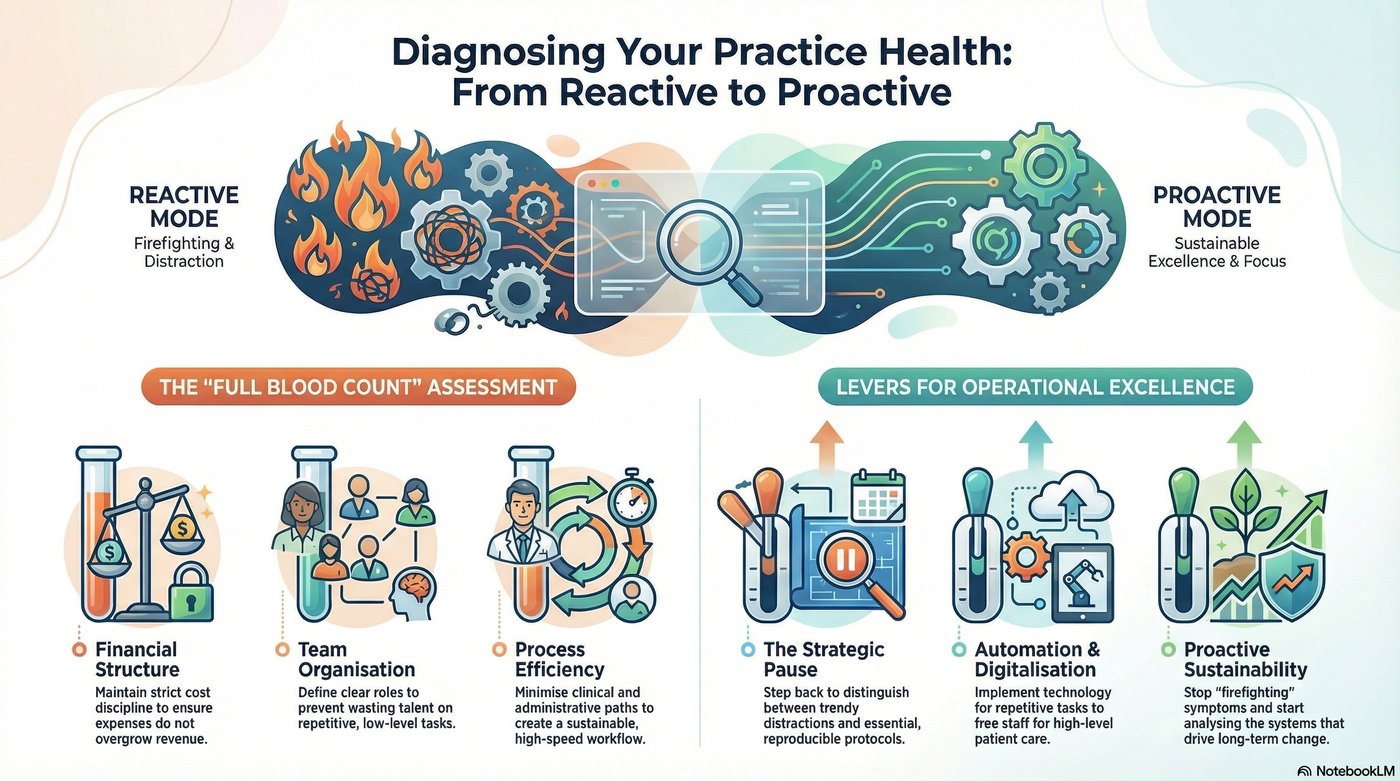
Moving from Reactive to Proactive
Managing a modern orthodontic practice often feels like a constant sprint. Between rising patient expectations, complex regulatory requirements, and the search for skilled talent, many practitioners find themselves in a reactive role. When you are constantly “firefighting” administrative tasks, such as managing insurance claims or chasing down incomplete patient forms, you lose the time and energy for the clinical work you actually love. This constant state of reaction burns out key team members and compromises the quality of patient interaction.
A reactive operational model is often characterized by chronic understaffing in critical areas or a reliance on outdated analog systems. For clinic leaders, this translates into unplanned overtime, high staff turnover, and an inability to scale the patient base effectively. Successfully transitioning from this reactive state requires a commitment to structural evaluation, not just symptomatic relief.
In lean orthodontics, we recognize that this feeling of distraction is a symptom of a system that lacks sustainability. Sustainability isn’t a quick win; it’s the result of building a practice that remains efficient and successful for the long term. It means designing protocols that withstand changes in personnel and market dynamics, ensuring consistent profitability. This provides the stability needed to invest in advanced clinical technologies and staff education.
To achieve operational excellence, you must stop running faster with “blinders on” and start analyzing the levers that actually create change. The true measure of excellence is not how busy you are, but how effortlessly you handle peak patient loads while maintaining consistent outcomes and patient satisfaction scores. This shift requires adopting a leadership mindset focused on data-driven practice management rather than clinical volume alone.
The Full “Blood Count” of Practice Health
Just as you wouldn’t prescribe a complex treatment plan without a diagnosis, you cannot fix a practice without a thorough assessment. You must look at the “fundamental health” of your business across three dimensions:
Financial Structure: Are you maintaining cost discipline, or is your “hedge” overgrown with unnecessary expenses?
The financial health check goes beyond simple revenue tracking. It involves detailed analysis of Cost of Goods Sold (COGS) for clinical supplies and scrutinizing overhead, particularly fixed costs like rent and equipment leases. For instance, an overgrown “hedge” might manifest as excessive inventory from bulk ordering without considering product expiration, or continuing a high-cost software subscription whose features are only partially utilized. Mastering cost discipline allows leaders to establish healthy profit margins that support long-term investment.
Team Organization: Are roles clearly defined, or is talented staff being wasted on repetitive tasks?
Poor organization often results in highly skilled Registered Dental Assistants spending significant time on scheduling or administrative follow-up that could be handled by a dedicated front office coordinator. A well-defined organizational chart ensures every team member knows their Key Performance Indicators (KPIs) and their scope of authority. This clarity not only boosts individual productivity but also significantly improves team morale and reduces friction between departments.
Process Efficiency: Are your clinical and administrative paths as short as possible?
In an orthodontic context, process efficiency focuses on minimizing chair time without sacrificing treatment quality. A common example of inefficiency is a lack of standardized tray setups, leading to assistants constantly searching for instruments. Assessing administrative paths means mapping out the entire patient journey, from initial inquiry and consent forms to final retention checks. Every handoff between team members is a potential point of error or delay that must be streamlined.
By looking at the numbers and truly listening to your team, you can identify where the bottlenecks are. Implement regular, anonymous surveys and brief daily huddles to capture staff feedback on workflow frustrations. This qualitative data, when combined with quantitative metrics like case acceptance rates and patient throughput, provides a powerful diagnostic profile of the practice.
One of the most significant levers is automation and digitalization. Using technology to handle repetitive tasks isn’t just a trend; it’s a necessity that frees up your staff to focus on high-level patient care. Consider automating tasks like recall reminders, patient intake form completion via tablets, or using AI-driven scheduling software to optimize appointment books. These digital assistants manage high-volume, low-value work, allowing the team to dedicate more time to complex clinical support and building patient relationships.
The Art of the Strategic Pause
When we feel overwhelmed, our intuition tells us to work harder and faster. We are driven to add more hours or hire more people to manage the workload, often compounding the underlying inefficiencies. However, efficiency is often counterintuitive. Think of an escalator: when everyone rushes and pushes, the flow actually slows down. The same principle applies when staff members bypass established protocols in an effort to save a few minutes, inadvertently creating errors that take much longer to fix later.
Taking a step back or “to the side” allows for reflection. This deliberate, strategic pause is where leadership is truly exercised. It might involve dedicating one hour per week purely to systems review, away from patient flow, or engaging an external consultant to gain an unbiased viewpoint. This outside perspective is essential for identifying deeply ingrained habits.
This pause gives you the outside perspective needed to distinguish between what the practice wants (the latest shiny trade trend, like a new, unproven intraoral scanner) and what it actually needs (a reproducible clinical protocol, such as a standardized bonding procedure). Often, the biggest need is not new equipment, but the rigorous documentation and training necessary to ensure consistent clinical quality across all operators. Focusing on the need provides a higher return on investment and guarantees scalable quality. This reflection is the fuel that allows you to eventually take three steps forward with renewed momentum. By pausing, analyzing, and standardizing, the practice transforms from a chaotic environment into a predictable, highly efficient engine for patient care and profitability.
Conclusion
Diagnosing the health of your business is not a one-time event but a continuous commitment to operational clarity and strategic growth. By transitioning from a reactive “firefighting” mode to a proactive, data-driven leadership style, you create a practice that is both sustainable and exceptionally efficient. Embracing the strategic pause to evaluate your financial structure, team organization, and process efficiency ensures that your practice remains a high-performing engine for clinical excellence and patient satisfaction. Ultimately, a healthy business provides the stable foundation necessary for you to focus on what matters most: delivering world-class orthodontic care.