

The Power of Subtraction: Why Lean Thinking is the Ultimate Leadership Strategy for Orthodontists
Published on: Jun 15, 2026
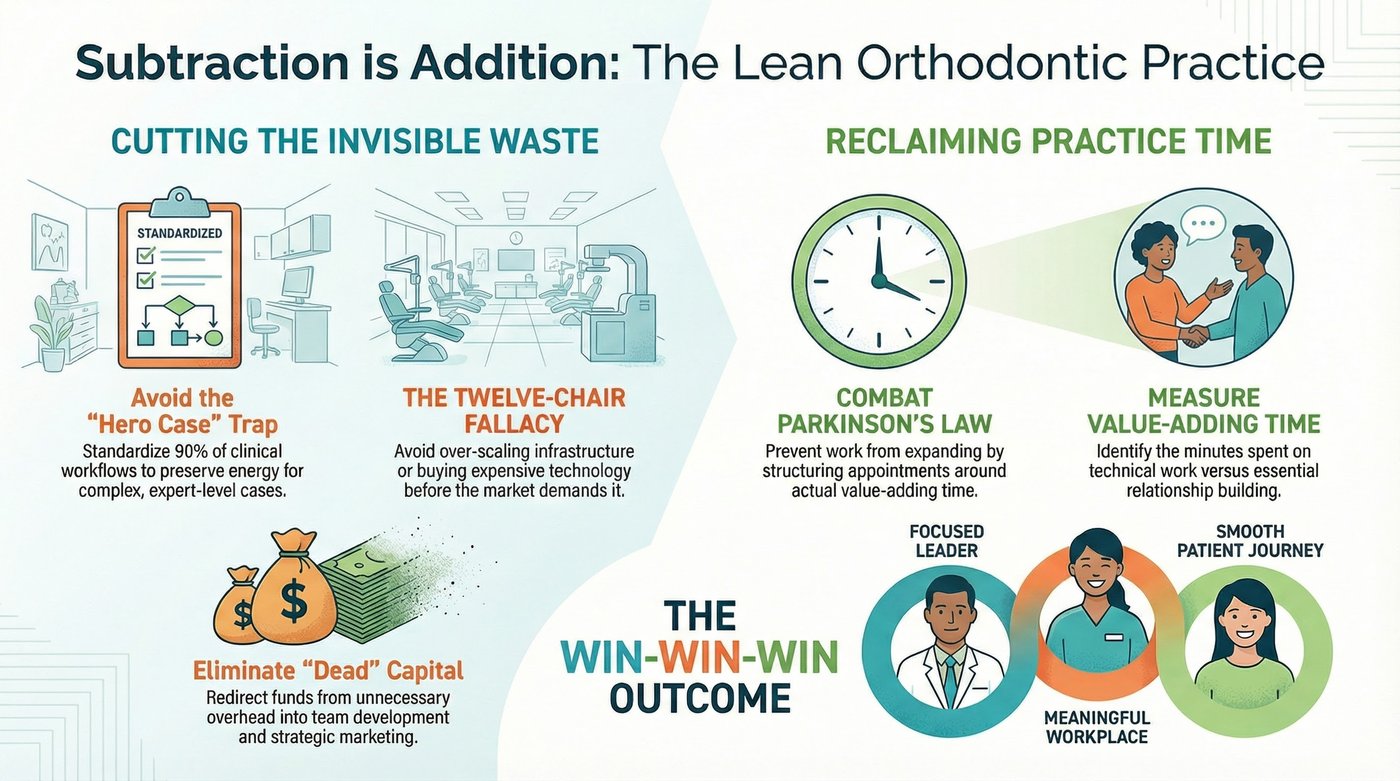
In the relentless pursuit of growth, many orthodontic practice owners fall into the trap of “more.” More equipment, more chairs, more complex cases, and more administrative meetings. However, true leadership in modern practice management is often found in the opposite direction: subtraction. By embracing Lean thinking, a clinic owner can shift from being a reactive firefighter to a focused strategist, eliminating the “invisible waste” that drains profitability and team morale.
Lean management in dentistry is not merely a cost-cutting exercise; it is a philosophy of energy preservation. It focuses on identifying and removing anything that does not add direct value to the patient or the practice. When you prune away the unnecessary, you restore “flow”—that state where the practice runs smoothly, and the leader remains in control rather than in chaos.
Identifying the Invisible Drains: Wasted Human Energy
In an orthodontic clinic, the most dangerous forms of waste aren’t found in the trash bin; they are found in the exhaustion of the staff and the owner. We often mistake “being busy” for “being productive.” A prime example is the “hero case” trap. If your schedule is packed with high-complexity, unpredictable cases, your cognitive energy is depleted by midday.
Strategic leadership involves standardizing the majority of your clinical output. By ensuring that 90% of your cases follow a standardized, lean workflow, you protect your energy reserves. This allows you to bring your full empathy and problem-solving skills to the 10% of cases that truly require your high-level expertise. A leader who is constantly “putting out fires” is a leader who has failed to implement a lean system.
Avoiding the “Twelve-Chair” Fallacy: Overinvestment as Waste
A common error in dental leadership is over-scaling before the market or the systems are ready. Opening a massive, twelve-chair facility in a small town might seem ambitious, but if the local population cannot support that volume, it is pure waste. That capital is “dead,” tied up in infrastructure that provides no return.
The same principle applies to technology. Buying a €45,000 scanner when a €10,000 model fulfills the clinical requirement perfectly is a form of waste. Lean leadership requires the wisdom to invest only in what adds tangible value to the patient journey or the clinical outcome. Every euro tied up in unnecessary overhead is a euro that cannot be used for team development or strategic marketing.
Reclaiming Time Through Parkinson’s Law
Time waste is perhaps the most insidious drain on practice efficiency. According to Parkinson’s Law, work expands to fill the time available. If an assistant is given twenty minutes for a task that actually takes five, the task will inevitably take twenty minutes.
Lean practitioners measure the “value-adding” time of every procedure. If an archwire change takes less than two minutes of technical work, the rest of the appointment should be dedicated to relationship building or providing a buffer for the day’s schedule. By structuring appointments around actual value rather than arbitrary time blocks, you create a calm, efficient environment where the team never feels rushed, yet the practice remains highly productive.
Conclusion: Working with Focus, Not Just Harder
Lean thinking creates a “win-win-win” scenario. The practice owner enjoys a more relaxed, focused life; the team finds more meaning in their work because the “busy work” has been eliminated; and the patient experiences a smooth, high-quality journey.
As a leader, your job is to constantly ask: “What can we cut?” Whether it is a bloated morning briefing or a redundant administrative step, every subtraction is an addition to your practice’s health. Start looking at your practice through the lens of subtraction, and you will find the freedom to lead with true impact.