

The Pizza Rule: Layering Communication for Dental Team Performance
Published on: Jul 5, 2026
Scaling Communication Without the Chaos
As an orthodontic practice grows, communication often becomes more difficult and disorganised. What worked for a team of three becomes a chaotic mess for a team of twelve. To maintain practice efficiency, leadership must implement a layered communication strategy that scales effectively.
The transition point, often around 8-10 staff members, demands formalising communication flows. Relying on casual hallway conversations and verbal hand-offs introduces significant risk, leading to scheduling errors, supply shortages, and inconsistent patient messaging. A layered approach ensures information is disseminated reliably across operational, clinical, and strategic domains.
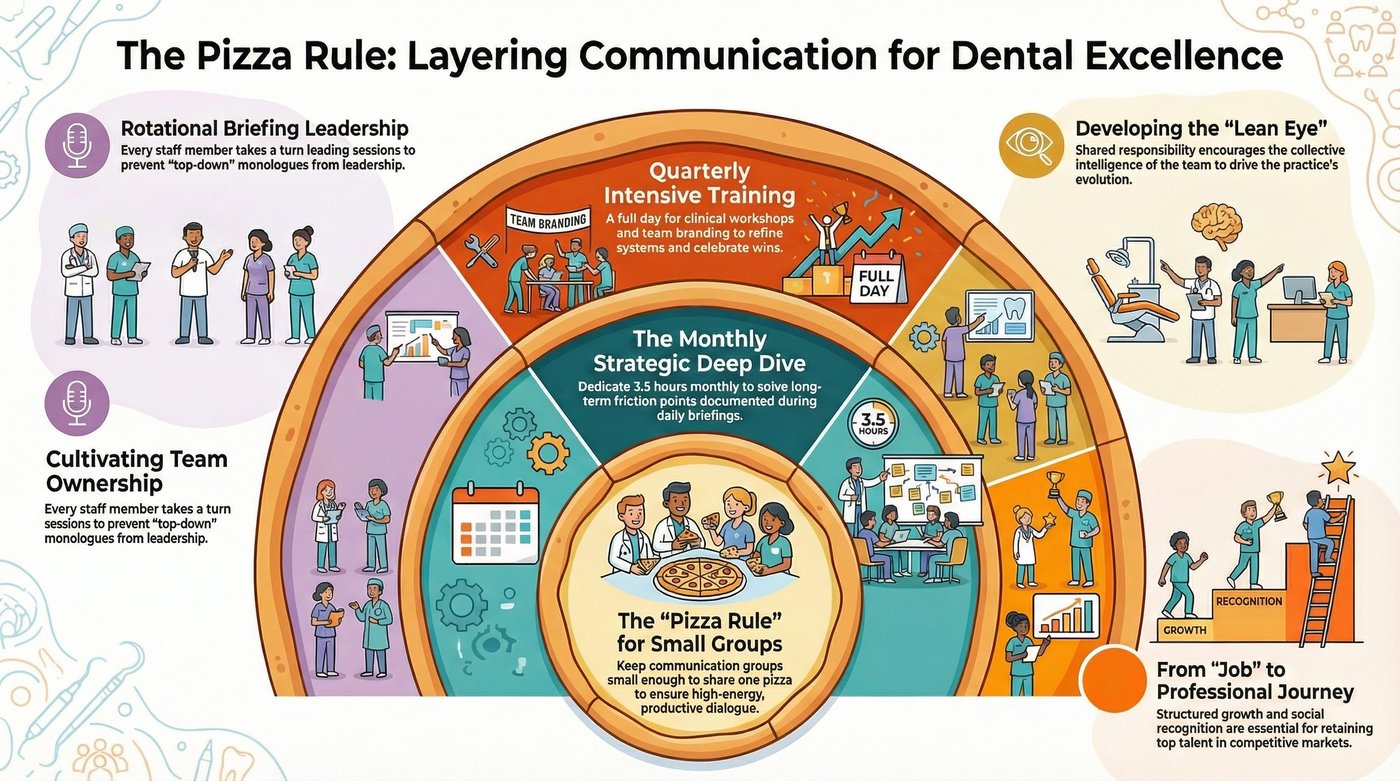
A core principle of lean management in dentistry is keeping communication groups small enough to be productive. I follow the “Pizza Rule”: a team should be small enough to share a single pizza (ideally 5-8 people). If a group is larger than that, communication often breaks down into a boring monologue, with key individuals dominating the discussion while others disengage.
For a large multi-doctor practice, this means establishing “huddles” within distinct service areas—for instance, a clinical operations group and a patient flow/front desk group. This departmental structure allows for concentrated problem-solving on high-frequency, low-impact issues specific to that team, such as refining the sterilization process or optimizing appointment recall scripts. By keeping groups lean, leaders foster psychological safety and promote more vocal participation from every team member.
The Monthly Deep Dive
While daily briefings handle tactical execution, a practice also needs time for strategic evolution. We dedicate one morning a month—roughly three and a half hours—to a deep-dive session. During this time, the entire team gathers to work on the long-term problems we’ve documented throughout our daily briefings.
This dedicated time is non-negotiable and should be scheduled outside of core clinical hours to eliminate the pressure of patient flow. The agenda is not a backwards-looking review but a focused attack on persistent systemic friction points. Examples include developing a standardised process for managing third-party financing approvals or revising the new-patient onboarding experience.
This is where the real “work on the practice” happens. We carry out specific exercises designed to solve recurring friction points. These are often cross-functional workshops using tools like process mapping or root cause analysis, like the “Five Whys.” The objective is to move beyond temporary fixes and institute permanent, documented operational protocols.
Because this time is scheduled and structured, it doesn’t feel like an interruption to clinical work; it feels like a necessary investment in our future operational excellence. Treating this strategic time as a mandatory professional development opportunity reinforces its value, driving engagement and reducing staff cynicism about unproductive meetings.
Rotation: Building Leadership at Every Level
To keep these communication layers from becoming stale, we rotate the leadership of our briefings. Every staff member, regardless of their role, takes a turn leading and documenting the sessions. This is a powerful tool for dental team performance.
Rotation is essential for democratizing leadership and revealing hidden talent within the organization. When staff members prepare and run a meeting, they are forced to synthesize complex information, manage a timeline, and practice constructive facilitation—skills vital for professional growth. This shifts accountability from the doctor/owner to the collective team.
When an assistant or receptionist leads a briefing, they take ownership of the practice’s success. This exercise often highlights critical pain points that may be invisible from the management level, such as inefficiencies in tray setup. This prompts the creation of photo-documented standard work guides for the entire clinical team.
It prevents the sessions from becoming a “top-down” lecture from the boss and encourages everyone to develop a “lean eye”—the ability to proactively identify waste and propose solutions. This shared responsibility ensures that the practice’s evolution is driven by the collective intelligence of everyone involved, resulting in protocols that are more practical and widely adopted.
The Quarterly Training and Branding
Every three months, we take the final step in our layered structure: a full day of intensive training. This might involve bringing in an expert or holding on-site workshops to refine our clinical and administrative systems. The frequency aligns with natural business cycles and major practice goals, ensuring the focus remains timely.
While monthly dives focus on internal process refinement, quarterly days elevate expertise and reinforce brand consistency. A training day might focus on a new clinical technique, such as integrating intraoral scanners, or an advanced customer service module covering high-conflict resolution. These events must be deliberate, measurable, and tied back to specific practice key performance indicators (KPIs).
These days are not just about education; they are about team branding. Consistent training ensures that every patient interaction, from the initial phone call to post-treatment follow-up, reflects the practice’s singular standard of care and core values. This internal alignment is critical for market differentiation and sustained growth.
We often finish early on a Friday to share a drink and celebrate our wins. This shared social experience is a powerful non-monetary incentive that strengthens the community bond and ensures that the team feels recognized and valued. This turns a “job” into a professional journey, which is essential for retaining top talent and drastically reducing the high cost of staff turnover.
Conclusion: The Proactive Path to Excellence
A high-performing orthodontic practice is built on a foundation of structured communication. By layering your interactions—from daily huddles to deep dives and quarterly trainings—you create a management system that evolves constantly and predictably. This intentional approach eliminates the chaos of unorganised meetings and allows you to lead your practice with clarity and purpose, maximising both patient satisfaction and profitability. Start small with the “Pizza Rule” and watch your team’s performance reach new heights.