

The Patient’s Internal Compass: Navigating the Hierarchy of Needs
Published on: Jun 28, 2026
Beyond “Selling Braces”
A common mistake in modern orthodontics is the belief that we are simply selling hardware—brackets, wires, and aligners. The transactional mindset views treatment solely as an exchange of services for fees, completely missing the opportunity to build a long-term, referral-generating relationship. In reality, a medical practice can no longer survive just by existing.
This shift from product-centricity to patient-centricity is what separates a commodity service from a trusted healthcare partner. To achieve operational excellence and long-term loyalty, we must understand the psychological drivers behind patient satisfaction. It elevates the practice brand beyond mere technical skill by focusing on human needs.
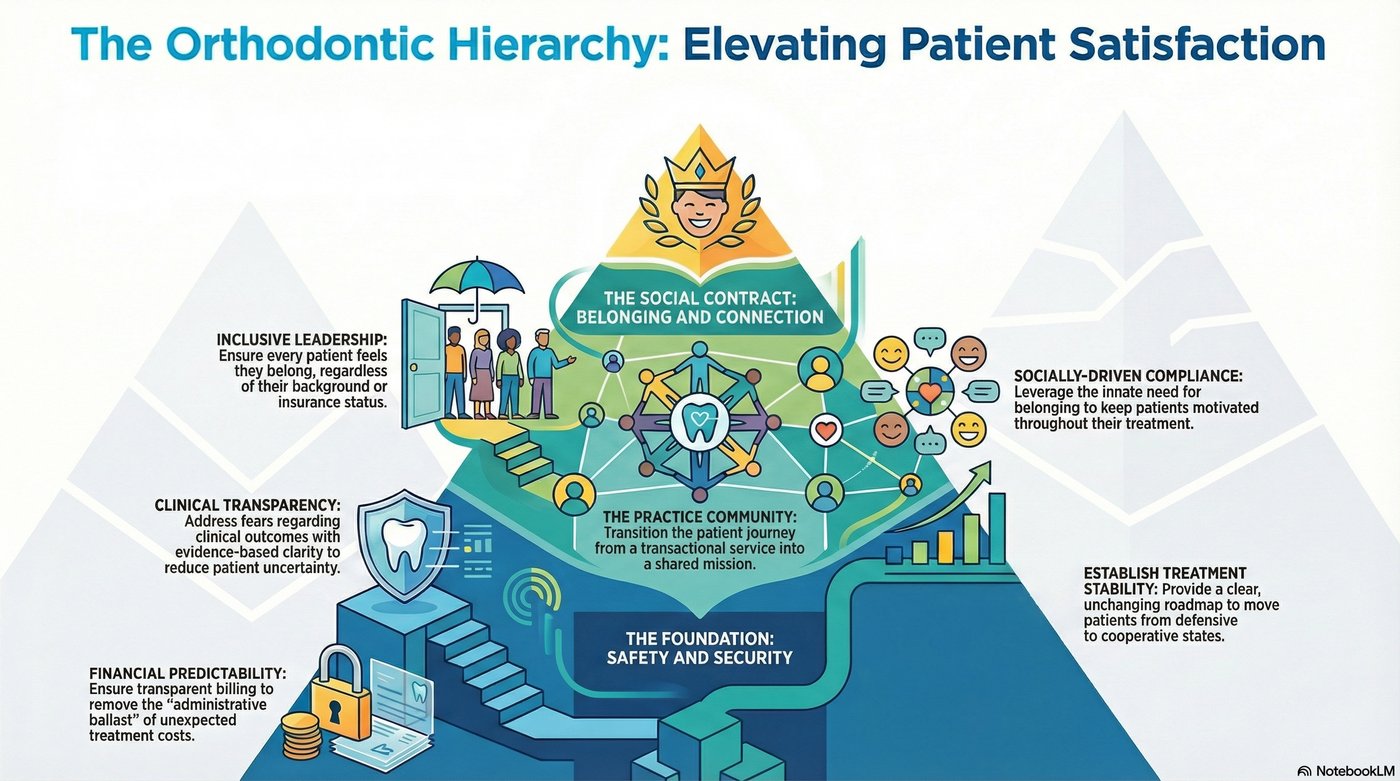
Satisfaction is fundamentally the fulfillment of a need. By applying Maslow’s Hierarchy of Needs to the orthodontic journey, we can identify where we are merely meeting basic expectations and where we are creating the “legendary” status that defines a top-tier practice. This framework provides clinic leaders with a structured approach to analyzing every patient touchpoint, from the initial consultation to the retention phase.
The Foundation: Safety and Security
While physiological needs are the base of the pyramid, the journey in our clinic begins with safety. A patient in a state of uncertainty is a dissatisfied patient. Their primary focus is on risk mitigation, which severely impairs their ability to trust and cooperate fully with the treatment plan. Leaders must recognize that true security extends beyond infection control protocols.
This level of the pyramid is fulfilled through:
Clinical Transparency: Addressing fears about root resorption or extractions with evidence-based clarity. This involves proactively discussing potential risks and complications, not just the benefits, and backing all advice with verifiable clinical experience.
Financial Predictability: Ensuring the billing process is transparent to avoid the “administrative ballast” of unexpected costs. Every payment schedule, insurance claim, and potential fee for forgotten aligners must be clearly outlined and signed off on to guarantee there are zero monetary surprises.
Stability: Providing a clear, unchanging roadmap for the treatment journey. This means setting accurate timelines, managing expectations for appointment frequency, and ensuring that every clinical staff member communicates a unified, consistent message about the patient’s progress.
When you satisfy the need for security, you move the patient from a defensive state to a cooperative one, laying the groundwork for high practice efficiency. Security is the currency of trust; without it, compliance suffers, appointment cancellations increase, and case acceptance rates stagnate, creating unnecessary friction in the workflow.
This requires leadership to establish rigorous internal communication protocols so the patient experiences a profound sense of institutional stability across all encounters. Cultivating this atmosphere of reliability is essential for maintaining the psychological contract between the provider and the patient during long-term clinical care.
The Social Contract: Belonging and Connection
Humans are social creatures with an innate need for belonging. Once a patient feels safe, their attention shifts to whether they are accepted and valued by the organization. We see this clearly in patient compliance. If a patient feels like a valued member of the “practice community,” they are far more likely to stay motivated and adhere to complex instructions.
A powerful sense of belonging combats the isolation that some patients feel during long-term treatment. Simple gestures, like staff remembering a patient’s hobbies or using personalized communication, can transform a sterile environment into a welcoming community and foster deep emotional ties.
Conversely, the threat of being “excluded”—perhaps by having to stop treatment due to non-compliance—often triggers a change in behaviour because they do not want to be an outsider. Practices can leverage this social motivation by creating patient appreciation events or fostering an online group where patients share their smile progress and feel connected to a common mission.
In dental leadership, we must ensure our patients feel they belong, regardless of their background or insurance status. This requires training the team to actively listen, validate concerns, and treat every interaction as an opportunity to reinforce the patient’s status as a respected individual, not just a case file.
When the clinic feels like a community, the patient journey in orthodontics becomes a shared mission rather than a transactional service. This shared identity translates directly into a powerful word-of-mouth referral engine. The ascent of the hierarchy does not end with community; the next critical stage for the dental patient is the need for esteem.
The Ascent to Self: Esteem and Achievement
This is the patient’s desire for achievement, competence, and respect. In the clinical setting, Esteem is fulfilled not just by the aesthetic result, but by the acknowledgement of their consistent effort throughout the compliance process. Clinic systems must provide regular, specific recognition for patient milestones, such as successful retainer wear or consistent oral hygiene, reinforcing their identity as a competent and successful participant.
The Pinnacle of Confidence: Self-Actualization
The final, most aspirational level is Self-Actualization, the realization of one’s full potential. For the patient, this is achieved when their beautiful, functional smile fully integrates with their self-image, allowing them to live life more confidently and without hesitation. By intentionally shepherding patients through each level of Maslow’s pyramid—from safety to belonging to esteem and, finally, self-actualization—the practice transforms its service from a necessary expense into an investment in a higher quality of life, cementing its status as an undisputed market leader.
Conclusion: The Compassionate Business Model
The intentional fulfillment of Maslow’s hierarchy within the orthodontic journey is more than just a psychological exercise; it is a blueprint for operational excellence. By moving beyond transactional care to address deep-seated human needs, dental practices foster unparalleled patient loyalty and clinical compliance. This compassionate approach transforms the patient experience, driving sustainable growth and establishing the practice as a visionary leader in the modern healthcare market.