

The Over-Optimization Trap: Balancing Profitability with Risk Management
Published on: Jun 18, 2026
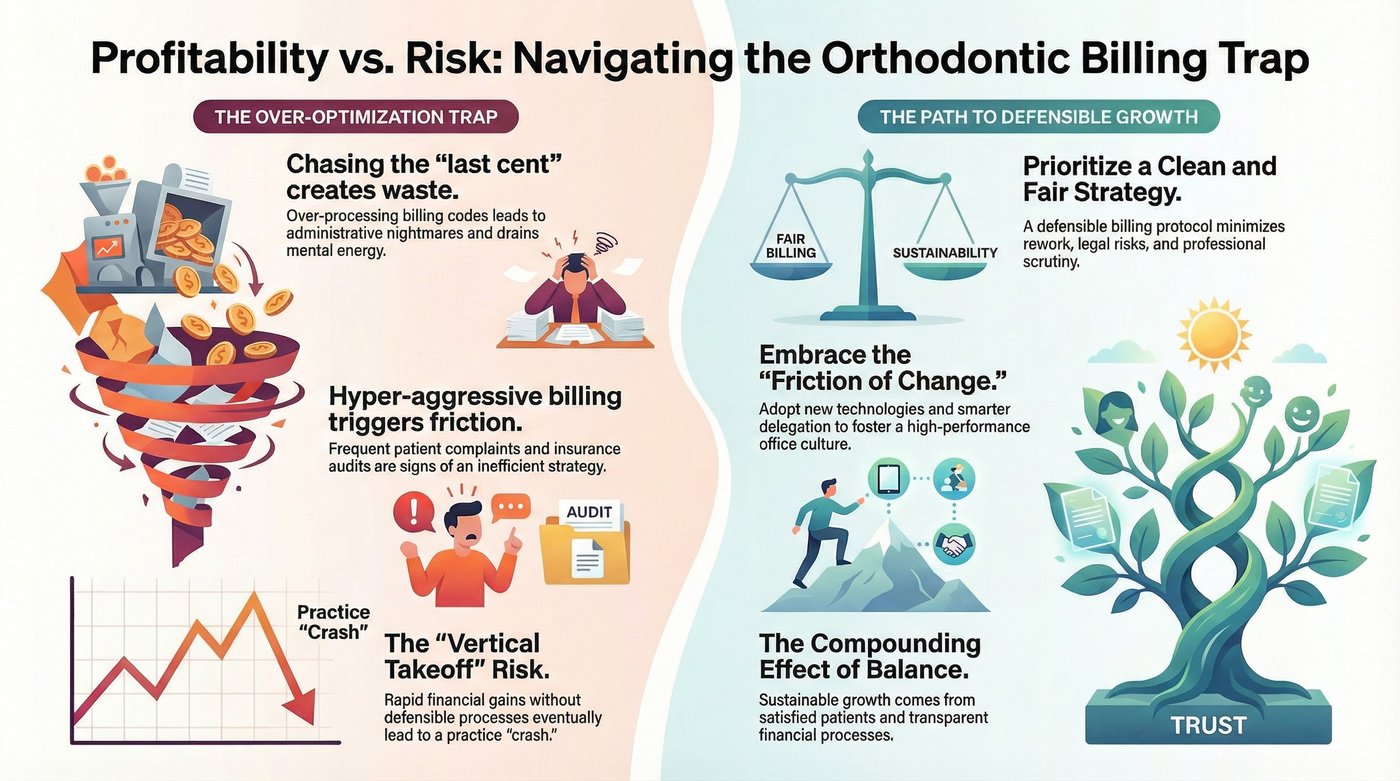
In the world of orthodontic leadership, it is easy to get “hyped up” after a billing seminar. You return to the clinic with ten new ideas on how to maximize fees and utilize obscure codes. However, as an experienced orthodontist, I must issue a serious warning: the pursuit of the “last cent” often leads to the highest amount of waste. If your billing strategy triggers constant patient complaints and insurance audits, you are not being efficient—you are creating conflict.
The immediate financial gain from aggressively coding every procedure is quickly negated by the hidden costs of friction. Consider the time spent responding to payer requests for documentation, managing patient dissatisfaction on unexpected charges, or the intensive legal fees associated with a full-scale insurance audit. These activities severely erode your net profitability and damage the practice’s most valuable asset: its reputation and patient trust.
A lean billing strategy is one that is clean, fair, and defensible. To achieve long-term practice growth, you must find the balance between maximizing your revenue and protecting your practice from the “friction” of professional scrutiny and expert reviews. True profitability stems from minimizing administrative drag and ensuring every claim can withstand scrutiny without argument.
Avoiding the “Over-Optimizer” Mindset
If you attempt to bill for every single minor activity, you create an administrative nightmare. This micro-coding obsession, which includes separate documentation for routine adjustments or minor supply fees, demands excessive clerical work. You end up spending hours of your valuable time justifying invoices to patients and fighting with insurance providers. In lean management, this is “over-processing”. It drains your mental energy and damages the patient journey.
We must recognize that the most profitable practices focus on high-value clinical services, not on intricate billing schemes. A real-world example is the trend toward offering bundled fees for comprehensive treatment, which simplifies patient communication and eliminates hundreds of micro-transactions and associated documentation. This standardized approach reduces the chances of errors that trigger audit flags, converting potential “rework” into productive clinic time.
It is far better to have a robust, standard billing protocol that flows without problems. A defensible strategy is a profitable strategy because it minimizes “rework” and legal risks. Your goal is to achieve your financial targets without a vertical takeoff that eventually leads to a crash. You want a steady, continuous upward line of growth that is built on clinical integrity and transparent financial processes.
The Growth Mindset: Overcoming the Friction of Change
Resistance to new systems is a common bottleneck in dental practices. Whether it is a doctor who feels “too old” for new software or a team with a “nine-to-five” mentality, a lack of growth mindset stalls progress. To optimize your practice, you must embrace the friction of change. This means committing to the upfront investment in staff training and process redesign necessary to implement powerful systems like a new electronic health record (EHR) platform or automated claims processing.
Growth often hurts, much like physical training in sports. If you aren’t feeling the “sweat” of learning a new system or restructuring your delegation, you aren’t growing. For leaders, this friction might involve transferring the full responsibility for financial oversight to a highly trained financial coordinator, which requires trust and significant internal process documentation. While this delegation creates temporary discomfort, it permanently frees the clinician to focus exclusively on clinical excellence.
A successful practice owner fosters a culture where learning is non-negotiable. We face something new every day, and our attitude toward that novelty—whether it is an updated compliance rule or a new patient financing option—determines whether we lead a high-performance machine or a stagnant office. Leadership must model the belief that overcoming operational friction is essential for sustainable competitive advantage.
Advice for the Next Generation: The Balanced Path
For young orthodontists starting their first practice, the backend financial process is often a total mystery. My advice is to avoid the extremes. Do not aim for the highest possible fees immediately, but do not sell yourself short. Pricing should reflect your clinical expertise and market standards, allowing for reliable patient acceptance and clean insurance reimbursement.
Find the stable middle ground that allows your practice to grow through the compounding effect of satisfied patients and clean billing. The “stable middle ground” involves benchmarking your fees against regional averages for common codes and ensuring your fee schedule is reviewed annually. This minimizes the likelihood of being flagged as an outlier while still securing fair compensation for your specialized services.
By combining smart delegation with a willingness to embrace new technology and a balanced approach to risk, you protect your practice’s future. Smart delegation, for instance, means empowering a cross-trained administrative team to manage daily billing submissions and follow-ups using technology for automatic verification and claim scrubbing. You free yourself from administrative chaos, allowing your team to focus on what matters most: the patients. Stay lean, stay defensible, and build a practice that serves your life, not the other way around.
Conclusion
The pursuit of excellence in dental practice management is not about aggressive maximization; it is about intelligent optimization. By prioritizing transparent processes, investing in team capacity to manage change, and maintaining a defensible billing strategy, clinic leaders create a foundation for continuous, stress-free growth. Adopt the mindset of a sustainable marathon runner, not a sprinter, to ensure your financial health mirrors your clinical integrity for decades to come.