

The Orthodontic Toolbox: A Lean System for Error-Proof Treatment Planning
Published on: Jun 24, 2026
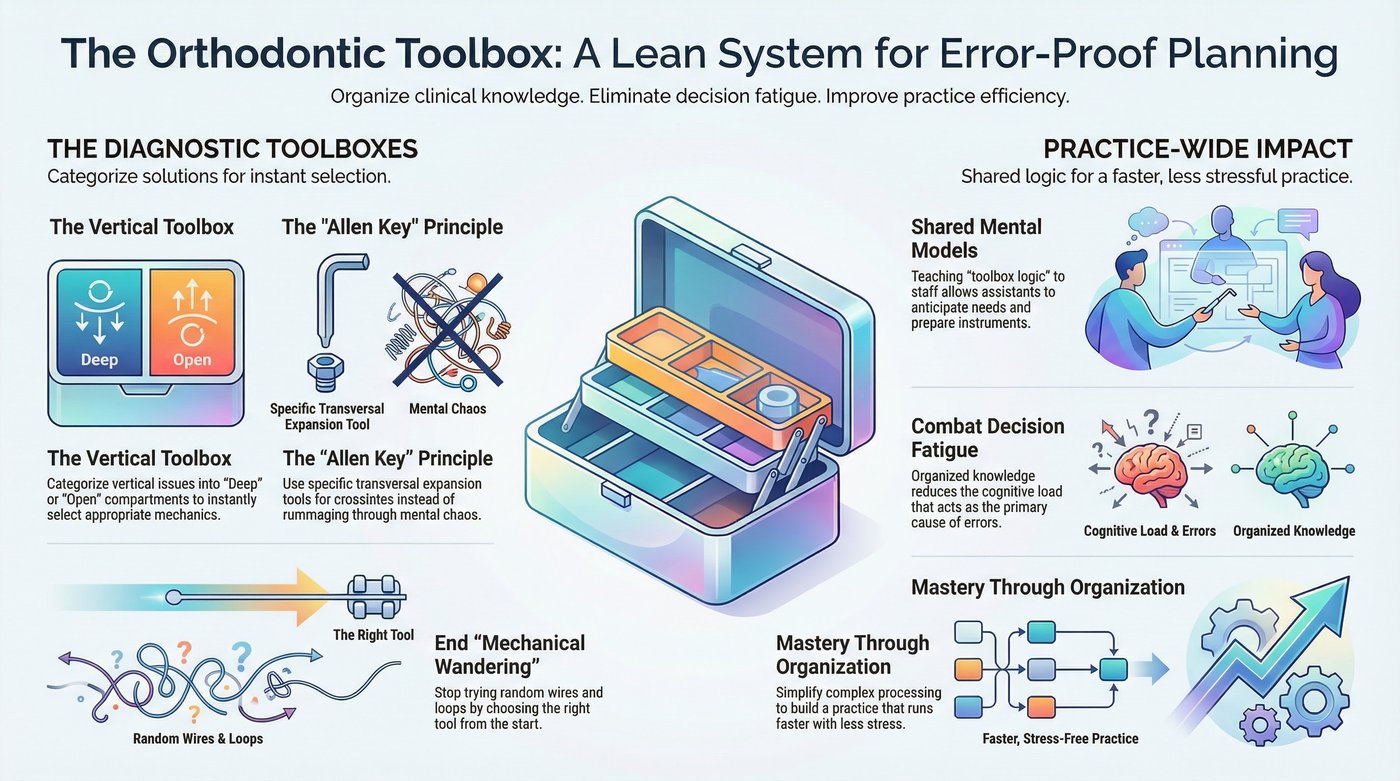
In the fast-paced environment of a modern orthodontic clinic, the sheer volume of data we process for every patient is staggering. Between digital scans, cephalometric values, and patient expectations, it is easy for even a seasoned expert to experience “decision fatigue.” This fatigue is the enemy of efficiency and the primary cause of clinical errors.
To achieve operational excellence, we must move away from “random symptom attacking” and toward a system of Toolboxes. This is the practical application of lean management to the diagnostic process. Just as a master mechanic knows exactly which drawer holds his Allen keys, a lean orthodontist should have a mental toolbox for every vertical, transversal, and sagittal challenge they encounter.
The “Vertical Toolbox”: Solving Deep and Open Bites
When you identify a vertical problem, you should immediately open your Vertical Toolbox. This chunk of knowledge contains two clear compartments: “Deep” and “Open.” Within the “Deep” compartment, you don’t have to reinvent the mechanics every time. You simply select the tool that fits the patient’s biology.
Do you need intrusion arches? Bite plates? Molar extrusion? Or perhaps mini-implants (TADs)? By having these tools pre-organized in your mind, you avoid the waste of “mechanical wandering”—trying one rubber band, then a different wire, then a loop, hoping something works. You choose the right tool from the start because your mental inventory is organized and accessible.
Transversal Alignment and the “Allen Key” Principle
Consider the “Transversal Toolbox.” If you see a crossbite, you don’t panic. You check the “Crossbite” compartment, determine if it is unilateral or bilateral, and select the appropriate expansion method from your pre-defined set of solutions.
This is the “Allen Key” principle of lean orthodontics. When the instructions for a complex case say you need to expand the arch, you don’t rummage through a mental pile of saws, hammers, and pipe wrenches. You go directly to the transversal section of your kit and pick the specific tool you need. This precision prevents you from attacking symptoms randomly, which often results in “breaking” one part of the occlusion while trying to fix another.
Improving Team Performance Through Shared Logic
The beauty of the “Wardrobes and Toolboxes” system is that it is highly teachable. If your treatment planning is a “black box” that only exists in your head, your team will always be dependent on you for every minor decision. However, if you share this chunking logic with your staff, they can begin to anticipate your needs.
A well-trained assistant will see a Class II patient and already be thinking about which “Drawer” you might choose. They will see a deep bite and know which instruments from the “Vertical Toolbox” to have ready. This shared mental model skyrockets team performance and reduces the friction of the daily clinic routine. You are no longer the only person thinking; you have a team of “problem-solvers” who understand the structure of your excellence.
Mastery is organized knowledge.
Mastery in orthodontics is not just about knowing a lot of facts; it is about knowing where those facts are and how they relate to one another. Whether you are planning a complex surgical case or organizing your clinic’s marketing strategy, the principle of chunking is your most valuable asset.
Group your ideas. Organize your toolboxes. By simplifying the way you process complexity, you build a practice that runs faster, generates better results, and operates with significantly less stress. Stop rummaging through the chaos and start commanding your toolset.