

The “One Kick” Principle: How to Start Implementing Lean Systems Today
Published on: Jun 10, 2026
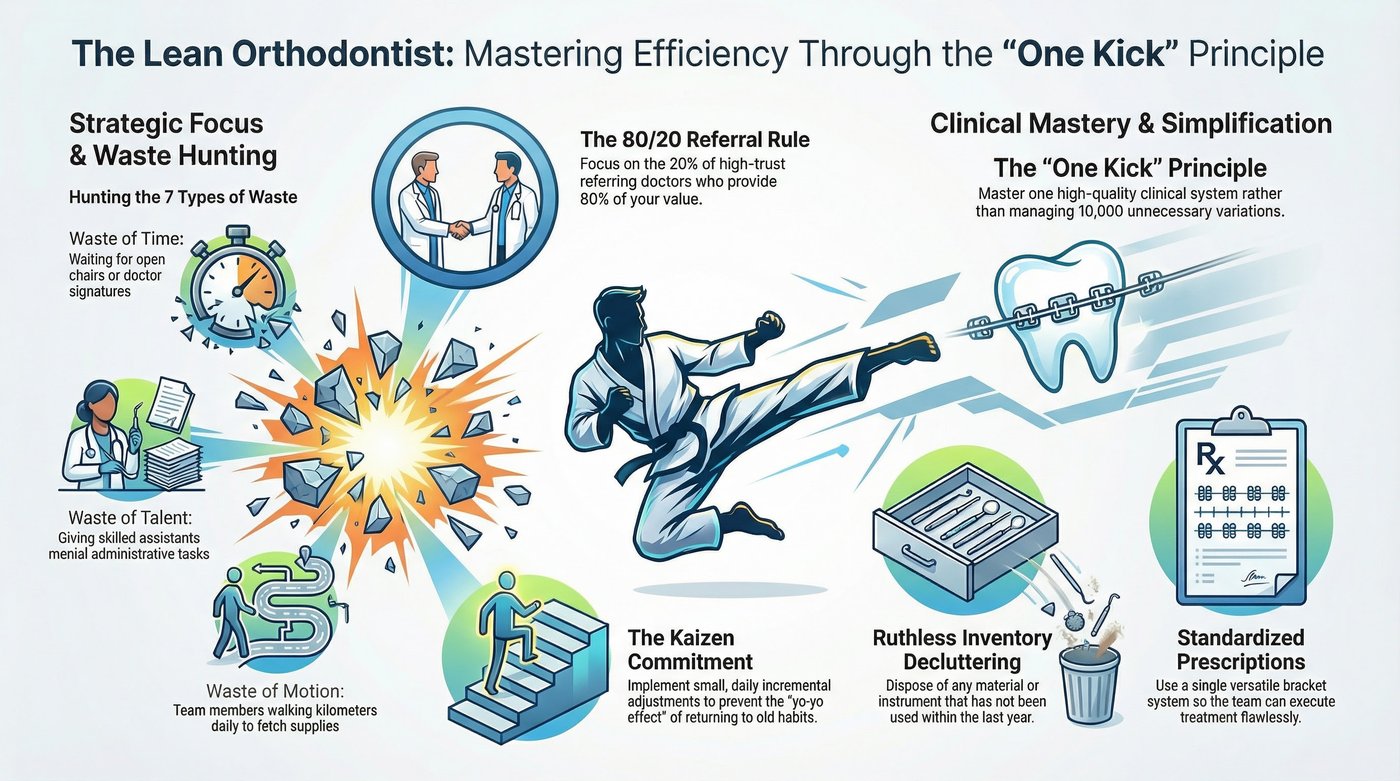
Many orthodontists and dental leaders feel trapped under a mountain of “to-dos.” We are surrounded by cluttered inventory, fragmented clinical systems, and a referral list that feels more like a burden than a blessing. This feeling of being overwhelmed often leads to the flawed conclusion that to “fix” the practice, we need a massive, expensive revolution—a complete technological overhaul or a total office remodel.
But according to Dr. Martin Baxmann’s Lean Orthodontics philosophy, the most powerful and sustainable transformations don’t come from giant leaps; they come from the quiet, disciplined removal of the unnecessary. Lean is not about working harder or pushing staff to maximum capacity; it is about “tidying up” your professional house by refining processes and eliminating steps that don’t add value.
It is a sustainable process that anyone can start today, regardless of whether you are a new associate or a seasoned practice owner. By focusing on the essential and ruthlessly eliminating the excess, you create a practice that flows with effortless precision, leading to higher morale and better patient outcomes. This operational philosophy shifts the focus from managing complexity to mastering simplicity.
Focusing Your Clinical Force: The Bruce Lee Approach
In our desire to be prepared for every clinical eventuality, we often inadvertently overcomplicate our inventory. We stock five different bracket prescriptions, dozens of archwire types, and ten thousand different “specialty” instruments that sit in drawers gathering dust, tying up valuable capital and space. This “just-in-case” mentality creates complexity that slows down clinical flow and increases training time for new team members.
Dr. Baxmann often cites the martial arts legend Bruce Lee, who famously said: “I fear not the man who has practiced 10,000 kicks once, but I fear the man who has practiced one kick 10,000 times.” True perfection and clinical performance in orthodontics come from the mastery of a core, reliable system, not from the sheer breadth of your inventory. This approach is about achieving predictable excellence through repetition and standardization.
Declutter your drawers and digital inventory: If you haven’t touched a material or instrument in over a year, dispose of it or donate it. Apply this same ruthless standard to your digital files and patient communication templates, ensuring only the most effective, current versions remain. Every stored item, physical or digital, requires management time. Eliminating unused stock frees up cash flow and reduces the time spent searching for supplies.
Standardize your prescriptions and protocols: You do not need a separate system for every minor facial structure variance. A lean practice finds the most versatile, high-quality appliance system and masters it until the team can execute every step in their sleep. Standardization reduces chair time and errors because the team always knows the next step, turning complex treatment plans into repeatable, efficient protocols.
The Pareto Principle in Referral Management
When Dr. Baxmann first started his practice, he followed the traditional, exhausting advice of trying to maintain a personal relationship with over 200 referring doctors. This scattershot approach required constant effort but yielded minimal returns on average. He soon realized this was a recipe for exhaustion and mediocrity for his entire team.
By applying the Pareto Principle (the 80/20 rule), he discovered a critical insight: typically, 20% of those referring doctors provided 80% of the practice’s total value and most engaged new patients. This elite group are the true advocates who understand and trust the quality of your specific expertise.
The courage to let go of the low-impact 80% of relationships allowed him to double down on the high-trust, high-value 20%. This didn’t just make the marketing budget more effective; it shifted the team’s focus to providing exceptional, personalized service to the key partners who drive consistent growth. Lean leadership is fundamentally about having the courage to stop being everything to everyone, so you can be extraordinary for the few who truly value your differentiated work. Invest your limited time and resources only where the deepest trust and mutual value exist.
Hunting the Seven Types of Waste
To effectively implement lean systems, the entire clinical team must become a collective “waste hunter.” In a dental or orthodontic clinic, waste isn’t solely discarded plastic or expired materials; it is anything that consumes resources—time, money, and effort—but does not add perceived value for the patient. Identifying and eliminating these non-value-added activities is the core task of continuous improvement.
We look for the universally recognized Seven Types of Waste (often remembered by the acronym DOWNTIME), including
1. Waste of Time (Waiting): This occurs when clinical or administrative flow stops, such as when a patient is waiting for an open chair, an assistant is waiting for a doctor’s signature or check, or an operatory is left empty due to poor scheduling. Implementing huddle boards or visual controls can rapidly signal bottlenecks.
2. Waste of Talent (Non-Utilized Resources): This is the strategic mistake of giving a highly skilled assistant menial administrative tasks that could be automated or handled by a less clinically trained team member. Utilizing advanced clinical training fully is crucial; for example, ensuring EFDAs are performing expanded functions rather than just sterilization.
3. Waste of Motion (Excess Movement): This involves unnecessary movement by people, such as using a “Spaghetti Diagram” to realize your team is walking kilometers every day just to fetch supplies that should be organized closer to the point of use. Reducing steps taken during a procedure minimizes fatigue and maximizes chairside efficiency.
4. Waste of Defects (Rework): The ultimate waste is doing the wrong thing or doing something twice, such as taking a poor-quality impression that requires a retake or a bonding failure that necessitates a premature emergency visit.
5. Waste of Overproduction: Producing more than immediately needed, such as printing excessive charts that are never referenced, or over-preparing supplies for appointments that are later canceled or postponed.
6. Waste of Inventory (Excess Stock): Holding too much inventory beyond what is necessary to meet immediate demand, as detailed in the Bruce Lee section, which ties up capital and expires.
7. Waste of Transportation: Unnecessary movement of materials, equipment, or patient charts between locations, rather than having everything organized at the point of care.
Conclusion: The Journey of a Thousand Small Steps
Implementing lean systems is a lifelong process of continuous improvement, known in Japanese philosophy as Kaizen. It is far better to make small, incremental adjustments every single day—a 1% improvement—than to attempt a massive, practice-paralyzing overhaul that inevitably leads to a “yo-yo effect” of returning to old, comfortable habits.
Start today with one simple, behavioral commitment. Perhaps it is a rule that every operatory must be left 5S-ready (Sort, Set in order, Shine, Standardize, Sustain) or a rule that every room must be left in a better state than it was found. These tiny actions set the necessary tone for a pervasive culture of excellence and accountability. When the internal clutter is gone and the clinical path is clear, you and your highly efficient team can finally enter a state of deep, productive flow, making every day in the clinic a meaningful, profitable success.
The goal of the “One Kick” Principle is not just efficiency; it is the establishment of a mindset. It is about leadership providing the clarity and focus for the team to master the essential tasks. This mastery translates directly into higher quality care, reduced stress, and the capacity for sustainable growth, defining true practice mastery in the modern era.