

The Mechanics of Influence: Practical Leadership Tools for the Modern Orthodontist
Published on: Jun 11, 2026
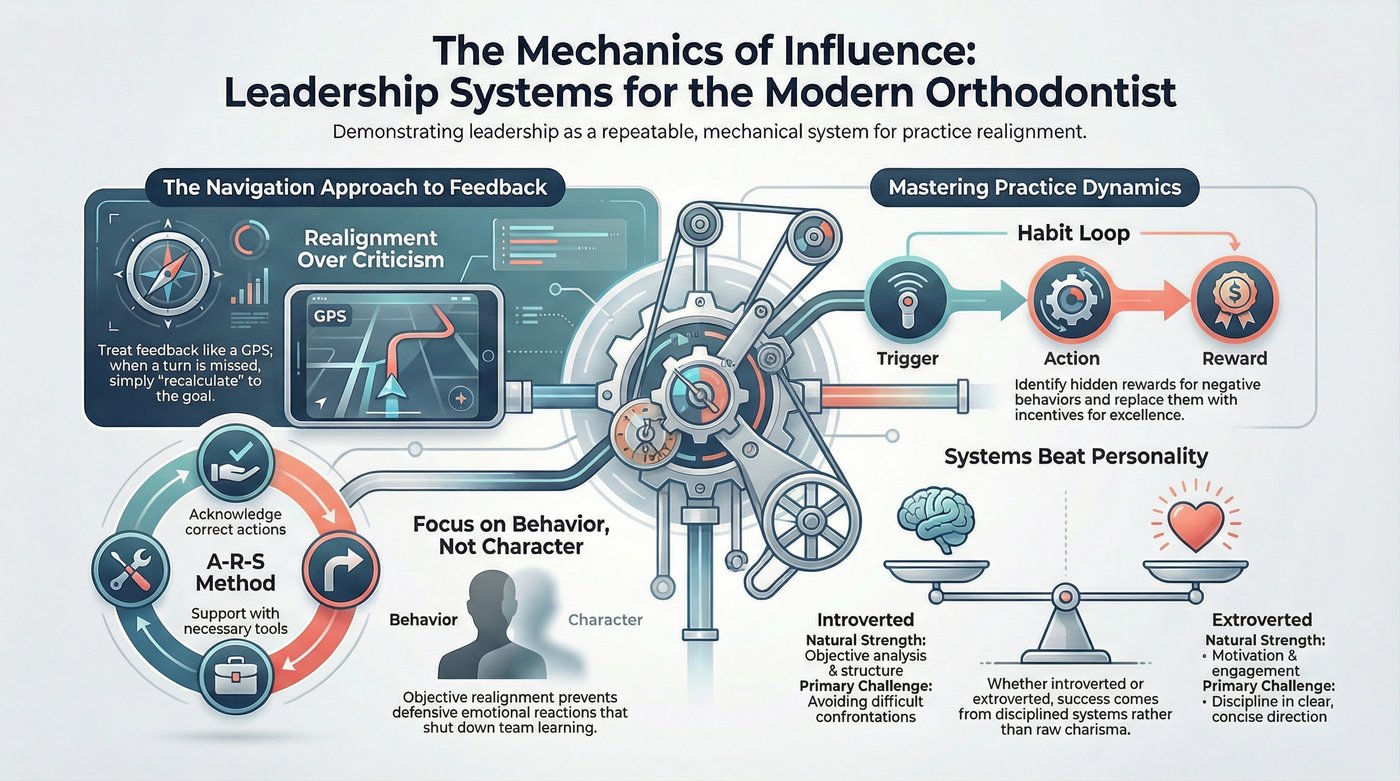
For many orthodontists, the idea of “personal growth” sounds too soft or academic. We prefer the hard data of cephalometrics or the tangible results of a finished case. However, leadership is as mechanical and objective as any clinical procedure you perform daily. If your team is drifting, if communication is failing, or if you feel like you are constantly “putting out fires,” it isn’t a character flaw—it’s a system failure.
In a clinical setting, we don’t accept unpredictable results in tooth movement; we shouldn’t accept them in our team dynamics either. Leadership requires the same precision as bracket placement. When the “torque” of your office culture is off, the entire practice suffers from inefficiency and stress. Recognizing that management is a technical skill allows you to approach it with the same diagnostic mindset you use for a Class II malocclusion.
Dr. Martin Baxmann’s philosophy of Lean Orthodontics treats leadership as a series of repeatable processes. By applying structured systems to how you interact with your “internal customers” (your staff), you can transform a chaotic office into a synchronized, high-output organization. This shift moves the doctor from a micromanager to a visionary orchestrator of practice success.
Lean principles suggest that any activity that doesn’t add value to the patient or the team is waste. In leadership, “waste” often manifests as repetitive instructions, unresolved conflicts, or ambiguous expectations. By implementing clear protocols for internal communication, you reduce the cognitive load on your staff. This allows them to focus on clinical excellence rather than trying to guess what the doctor wants.
Realignment Over Criticism: The Navigation Approach
One of the most vital shifts in leadership development is moving from “criticism” to “realignment.” Think of your feedback as a GPS navigation system. When a driver misses a turn, the GPS doesn’t yell or question the driver’s intelligence; it simply says “recalculating” and finds a new route to the same goal. This objective approach preserves the professional relationship while fixing the technical error.
In an orthodontic practice, high-stress moments—like a broken appliance or a scheduling mishap—often trigger emotional responses. A “navigation” leader stays calm. Instead of saying, “Why did you forget this?” they ask, “How does our current system allow this to happen, and how do we recalculate?” This keeps the team focused on the solution rather than the shame of the mistake.
In the clinic, if an employee fails at a specific step in a process, use this three-part approach to ensure the correction sticks without damaging morale:
Acknowledge: Validate what they did correctly in the previous steps. For example, “I noticed how well you handled that patient’s anxiety during the bonding procedure.”
Redirect: Identify the exact point of deviation without attacking their character. “However, the cleanup of excess adhesive didn’t meet our standard on the lower molars.”
Support: Provide the tool or nudge needed to get back on track. “Let’s use this specific scaler next time to ensure we get into those tight interproximal spaces.”
This framework keeps the focus entirely on the behavior and the desired outcome. It prevents the defensive emotional reaction that usually shuts down the learning process. Over time, your team will begin to mirror this behavior with one another, creating a culture of constructive peer-to-peer accountability.
Understanding the Habit Loop in Practice Management
Every behavior in your practice—both positive and negative—follows a psychological cycle: Trigger, Action, Reward. If an employee is consistently negative or “checking out,” it is likely because they are receiving a hidden reward. This might be extra attention, the ability to avoid difficult tasks, or even sympathy from colleagues that reinforces the “victim” mentality.
As a leader who understands these psychological mechanics, you can disrupt these loops. If the “reward” for a mistake is that the doctor steps in and finishes the work, you are accidentally training your staff to be helpless. Your task is to replace these negative loops with healthier incentives. Reward efficiency and clinical excellence with public recognition or autonomy, making the positive “Action” the most rewarding path for the employee.
The Introvert vs. Extrovert Leadership Myth
A common misconception in the dental world is that you must be a charismatic, “big room” extrovert to be a great leader. In reality, leadership is a technical skill that can be mastered regardless of your baseline personality. Successful practices aren’t built on the doctor’s “vibe,” but on the clarity of the doctor’s expectations.
The Introverted Leader: May find direct confrontation difficult, but excels at objective analysis. Their strength lies in creating structured, written systems that allow the practice to run without constant verbal interference.
The Extroverted Leader: May excel at initial motivation and patient rapport but needs to learn the discipline of concise direction. They must avoid “talking the team’s ears off” and focus on measurable instructions.
Both types succeed by applying the same rational tools. In leadership, as in sports, hard work and structured systems beat raw talent when talent doesn’t work hard. Whether you are naturally quiet or outgoing, your team needs the same thing: a consistent, predictable leader who provides a stable environment for them to perform their best work.
Conclusion: Investing in the Nucleus
If you want a high-performing practice, you must start by being a high-performing leader. This means treating your own behavioral and business training with the same respect you give to your medical residency or continuing education. By mastering the mechanics of influence, you stop being a passenger in your practice and start being the architect of its growth and culture.
Investing in the “nucleus”—the doctor’s mindset—has the highest ROI of any practice expense. New scanners or marketing campaigns are useless if the internal leadership is fractured. When the doctor improves, the team improves; when the team improves, the patient experience reaches a level of excellence that transcends simple clinical outcomes.
The most successful orthodontic practices are not those with the most expensive brackets but those with the best systems and a leader disciplined enough to maintain them. The transition from a busy clinician to a true leader requires a commitment to lifelong learning in the “soft sciences” that drive hard profits.
Start working on the doctor behind the desk today. Identify one process this week that is causing “friction” and apply the navigation approach or the habit loop analysis to it. As you master these leadership mechanics, you will watch as your practice reaches heights of efficiency and profitability you previously thought were impossible. True leadership isn’t about being the boss; it’s about creating a system where everyone can win.