

The Legacy Blueprint: Transitioning from Practitioner to Professional Founder
Published on: Jun 9, 2026
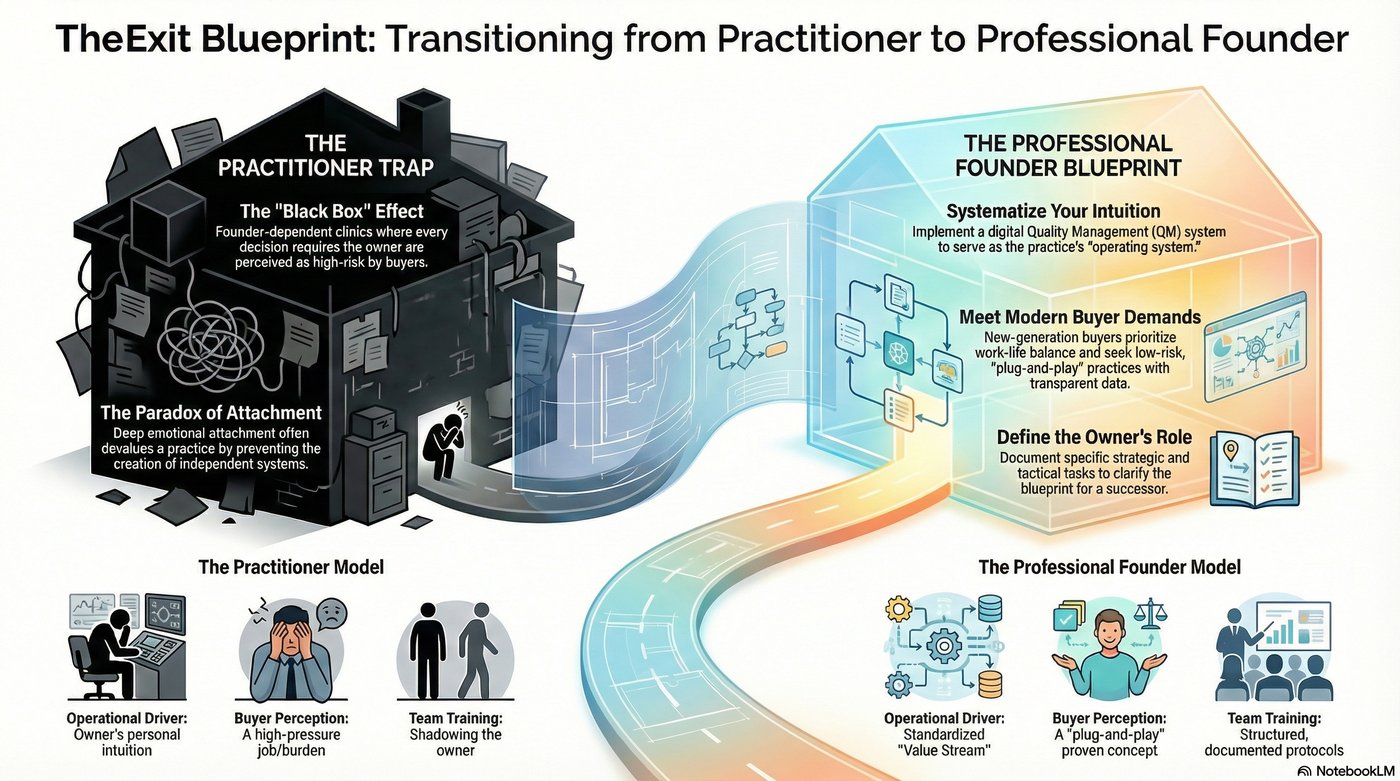
Selling an orthodontic practice is often the most emotionally charged transition a professional will experience. For many, the clinic is not just a business; it is a second home where they have navigated decades of clinical challenges and celebrated thousands of patient milestones. This professional investment creates a profound sense of ownership that extends far beyond financials.
However, as Dr. Martin Baxmann points out, this deep emotional attachment is frequently the very thing that devalues the practice during a handover. A buyer is not interested in the seller’s history; they are focused solely on future profitability and operational continuity.
The critical moment for any selling founder is the realization that personal brilliance does not translate into transferable value. To ensure a smooth and profitable transition, you must shift your perspective from being the “heart and soul” of the operation to being the architect of a transferable system. Your role must change from being the indispensable technician to the system creator. A practice that relies on your personal intuition is a high-pressure job; a practice that relies on documented, repeatable systems is a valuable, scalable asset. This systematic approach is the foundation of a successful exit strategy.
The Paradox of Attachment
It is a common paradox in our profession: practitioners spend years complaining about the daily grind of management, yet they struggle to detach when the time comes to sell. This reluctance often masks a fear that the practice will fail without their hands-on supervision. This friction usually stems from a lack of “entrepreneurial distance”. Entrepreneurial distance is the ability to view the clinic objectively as a product, not a passion project.
In the startup world, founders often build companies with the explicit goal of an “exit”. They focus on creating a business model and value that is independent of their own presence or clinical reputation. Their processes are documented and scalable from day one, which maximizes their eventual valuation.
In stark contrast, many orthodontists build “founder-dependent” clinics. This dependency is revealed when critical processes—like treatment planning consistency, billing protocols, or even critical equipment maintenance schedules—are stored only in the doctor’s head. If you are the primary motor for every clinical decision and administrative solution, your practice is a “black box” to a potential buyer. This high-risk opacity immediately lowers the valuation because the buyer perceives an unnecessary operational risk.
To significantly increase the value of your legacy, you must begin the process of “systematizing your intuition” long before you intend to leave. This means defining your standard diagnostic protocols, documenting your preferred appliance systems, and creating clear decision trees for staff to follow when you are absent. Systematization transforms proprietary knowledge into standard operating procedures (SOPs) that anyone can follow.
Creating a Transferable Value Stream
A successor or an investor is not just buying your patient list; they are buying your Value Stream. This Value Stream represents the entire mechanism that generates revenue and maintains quality of care, regardless of who is performing the primary clinical role. They are looking for a blueprint that can be followed without the risk of the infrastructure collapsing once you walk out the door. This ensures operational stability and minimizes the critical first-year challenges for the new owner.
The Value Stream must be transparent and documented through specific, professional systems:
Define the Owner’s Role: Most practices have job descriptions for assistants but nothing for the boss. Documenting your specific strategic and tactical tasks is essential. This includes setting quarterly operational goals, managing key vendor relationships, and overseeing financial health metrics and capital planning. When these high-level tasks are defined, the buyer can easily integrate a new executive layer or a managing partner.
Quality Management (QM): A comprehensive, digital QM system acts as the “operating system” for the new owner. This system goes beyond state compliance; it includes documentation for patient flow efficiency, consistent clinical outcomes, and robust risk mitigation strategies. It reduces the buyer’s risk and shortens their learning curve by providing immediate clarity on best practices.
Standardized Onboarding: If your team is trained through structured, documented protocols rather than “shadowing” you, they become a stable asset that adds value to the sale. A formal, multi-module onboarding manual ensures every new hire understands their role, reducing reliance on tribal knowledge and demonstrating that the staff can execute consistently under new leadership. This structured training is a powerful signal of stability to any prospective investor.
Adapting to the New Generation of Buyers
The demographic of potential buyers is shifting. The new generation of orthodontists—many of whom are prioritizing work-life balance and family integration—are distinctly risk-averse. They are not looking for projects; they are looking for established, well-oiled operations. They seek practices that are truly “plug-and-play,” minimizing the need for significant initial overhaul and time spent on integration.
A “plug-and-play” practice leverages modern technology and transparent metrics. This means adopting cloud-based practice management software, utilizing advanced digital imaging systems, and maintaining a robust, modern digital patient communication platform. Technology integration signals forward-thinking management.
If your clinic lacks modern marketing, structured workflows, or transparent data, it represents a “fixer-upper” project that many modern doctors want to avoid. For example, a practice relying solely on word-of-mouth with no consistent SEO strategy, no digital patient review management, and outdated equipment will be immediately discounted in the negotiation process. Buyers want immediate traction, not required maintenance.
By professionalizing your structures now, you make your practice the most attractive option in a competitive market. This strategic preparation moves you from selling a “burden”—a collection of responsibilities that requires your constant physical presence—to selling a “proven concept”—a systematized model ready for immediate, profitable execution. A clean, modern infrastructure signals immediate return on investment for the purchaser, justifying a higher price tag.
Conclusion: The Ultimate Entrepreneurial Choice
Preparing for a handover is the ultimate act of leadership. It requires the discipline to stop being a “hero” who solves every problem personally and start being a mentor to your own systems and staff. The transition from practitioner to professional founder is fundamentally about replacing yourself with a system that is stronger, more resilient, and more valuable than any single individual. This systemic strength is what guarantees enduring worth.
When your practice functions efficiently, whether you are physically present or not, you have achieved true entrepreneurial success and maximized your enterprise’s market value. The Legacy Blueprint is more than an exit strategy; it is a long-term commitment to quality that protects the patient experience, secures the livelihood of your loyal team, and ensures your reputation of excellence continues long after your final day at the chair. This proactive, systematic step guarantees a financially successful and professionally satisfying transition that honors the legacy you built.