

The Lean Schedule: Engineering a Stress-Free Practice through Radical Time Blocking
Published on: Jun 24, 2026
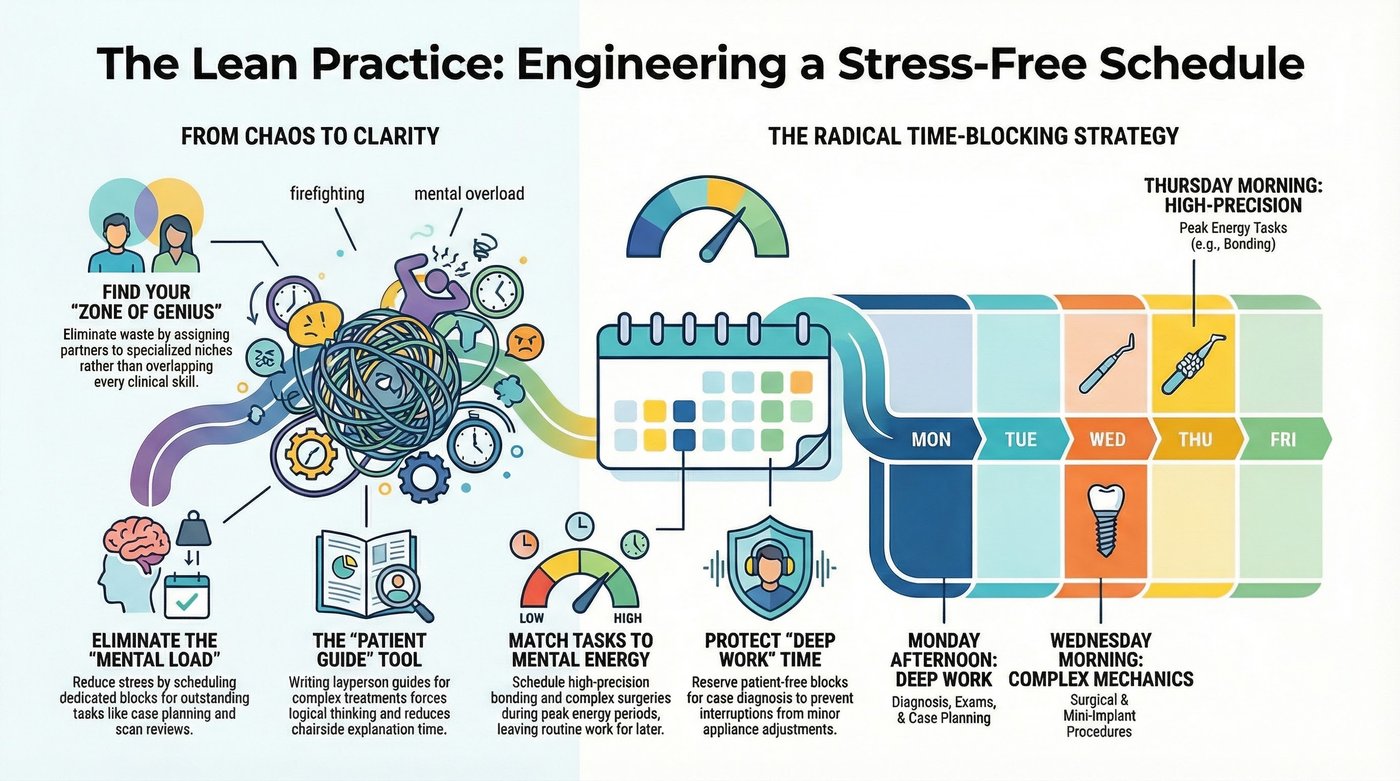
In the fast-paced environment of a busy orthodontic clinic, many practice owners feel like they are constantly “firefighting.” They try to be the lead clinician, the business manager, and the team mentor all in the same hour. This lack of structure leads to a chaotic atmosphere where the mental load becomes overwhelming. The result is a team that feels rushed, a doctor who feels drained, and a practice that is far from its potential for operational excellence.
The solution to this chaos is not to work harder or see more patients; the solution is to radically restructure how you use your most valuable resource: your time. By applying lean management principles to your schedule and your team structure, you can eliminate the “nagging feeling” of outstanding tasks and create a high-performance environment that runs like a well-oiled machine.
The Division of Labor: Finding Your “Zone of Genius”
For many practitioners, especially those who work in a joint practice with a spouse or partner, the first step toward efficiency is a clear division of labor. Overlapping every skill is a form of waste. If two doctors are both trying to manage the same tasks, you get friction and redundancy.
A lean leadership approach requires each partner to find their “Zone of Genius.” One partner might focus exclusively on the “bloody” procedures—implants, surgeries, and complex extractions—while the other specializes in orthodontics and pediatric cases. This creates two specialized clinics within a single practice. This clarity allows for a much smoother patient journey and enables each clinician to master their specific niche, leading to higher quality and faster treatment times.
Radical Time Blocking: Matching Tasks to Energy Levels
The second pillar of a stress-free clinic is rigid time blocking. A common mistake in orthodontic practice management is trying to perform diverse tasks randomly throughout the week. You cannot be in a “deep focus” state for a complex diagnosis if you are being interrupted by five-minute appliance adjustments.
To achieve practice efficiency, you must designate specific blocks for specific tasks based on your mental energy:
Mondays (Diagnosis and Planning): Reserve a specific afternoon block where no patients are seen for adjustments. This is your “Deep Work” time. You focus only on new patient exams and complex case discussions.
Thursday Mornings (High-Precision Work): Use your peak energy periods for high-focus tasks like bonding appointments.
Wednesday Mornings (Surgical/Complex Mechanics): Dedicate a block for mini-implants or difficult adjustments, while your team handles the routine work like changing aligner attachments.
Eliminating the “Mental Load”
The primary source of stress for most practice owners is not the work they are currently doing, but the work they haven’t done yet. It’s the “I still need to plan that case” or “I still need to review that scan” that haunts your evenings.
When you have a rigid, lean schedule, that nagging feeling disappears. Because you know that Monday at 2:00 PM is your dedicated time for planning, you don’t have to worry about it on Friday afternoon. This discipline allows you to be fully present in whatever you are doing—whether you are at the chairside with a patient or at home with your family.
The Power of the “Patient Guide” Methodology
A lean leader also understands that clarity in communication reflects clarity in the mind. I always encourage clinicians to write or blog for their patients. When you force yourself to explain a complex topic—like the mechanics of the temporomandibular joint or the benefits of early interceptive treatment—to a layperson, you are actually training yourself.
Stripping away clinical jargon forces you to structure your thoughts more logically. This “self-training” makes you a significantly better communicator at the chairside. Writing these guides is not just a marketing exercise; it is an efficiency tool that ensures your patients understand their treatment faster, reducing the time you spend repeating the same explanations.
Conclusion: Performance Without Sacrifice
Success in orthodontics is about organizing your environment so that you can perform at your best without sacrificing your personal life. When you eliminate the unexpected through rigorous time blocking and a clear division of labor, you eliminate stress.
Your practice should be a place where you can express your clinical mastery, not a source of constant chaos. By applying these lean principles to your daily life, you build a structure that supports both professional excellence and personal well-being. Start protecting your “Zone of Genius” today, and watch your practice thrive.