

The Lean Leadership Blueprint: Transforming Your Orthodontic Practice from Reactive Chaos to Proactive Excellence
Published on: Jul 6, 2026
Beyond the Chair: The Role of Dental Leadership
In dental school, we are taught the intricate science of moving teeth and the complex biology of the human jaw. We graduate as experts in clinical care, yet we often feel like beginners when it comes to dental leadership and practice management. Running a private office requires a completely different skill set—one that focuses on systems, team dynamics, and operational excellence.
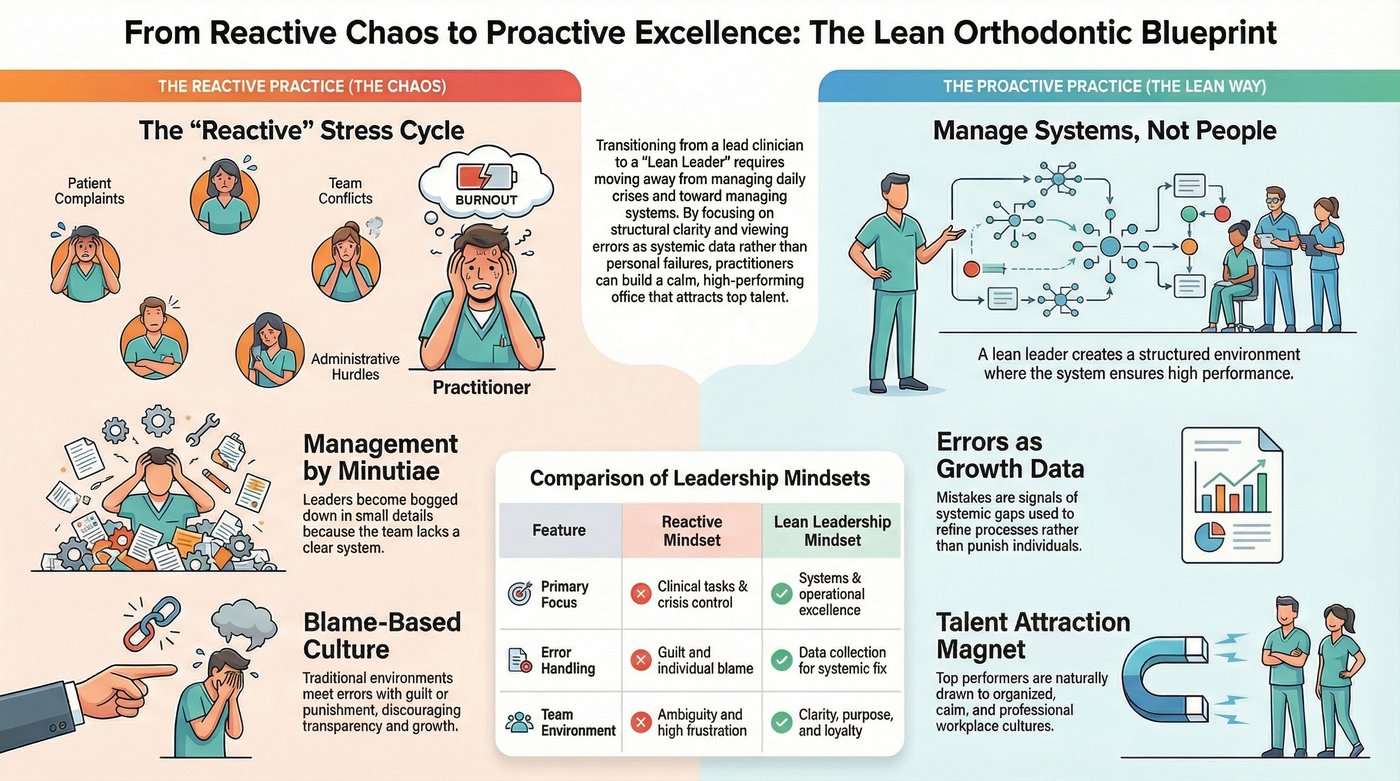
Many practice owners find themselves in a “reactive” mode, constantly responding to team conflicts, patient complaints, or administrative hurdles. This reactive state is the primary driver of stress. To build a sustainable and successful clinic, we must transition from being just the lead clinician to becoming a visionary leader and entrepreneur.
Leading with Structure, Not Stress
The cornerstone of dental team performance is clarity. In many practices, the team is frustrated not because they lack skill but because they lack a clear system. Lean leadership is about creating a structured environment where every team member knows exactly how they contribute to the practice’s success.
When the system is clear, the team becomes more satisfied because they understand their purpose. They no longer have to guess what the “right” way to do something is. This clarity allows the leader to step back from the minutiae and focus on the big picture. A lean leader doesn’t manage people; they manage the system so that the people can perform at their best.
Error Management as a Tool for Growth
One of the most significant shifts in lean orthodontic practice management is how we handle mistakes. In a traditional setting, errors are often met with guilt or blame. In a lean practice, an error is seen as a valuable data point. It is a signal that there is a weakness in the system, not necessarily a failure of the person.
By using errors to find systemic gaps, you create a culture of continuous improvement. This approach removes the fear of failure from your team and encourages transparency. When your staff knows that the goal is to fix the process rather than punish the individual, they become more engaged in finding solutions. This is how you build a resilient practice that evolves with every challenge.
Attracting and Retaining Top Talent
In the current professional landscape, finding and keeping high-quality talent is one of the biggest challenges for clinic owners. Top performers are drawn to environments that are organized, professional, and forward-thinking. They want to work in a clinic where they can see the impact of their work and where they aren’t bogged down by administrative chaos.
By implementing lean management in dentistry, you create a workplace that stands out. A structured practice is a calm practice, and a calm practice is an attractive place to work. When your team sees that you are invested in improving the workflow and reducing their daily stress, their loyalty and performance naturally increase.
The Entrepreneurial Mindset in Orthodontics
To truly grow, you must view your practice through the eyes of an entrepreneur. This means looking at the clinical work as just one part of a larger, interconnected system. It involves staying dedicated to the craft while also constantly asking, “How can we make this better for the team and the patient?”
The goal of lean thinking is to move away from the “reactive” exhaustion that characterizes so many offices. Instead, we aim for the calm of a proactive, structured environment. This shift is what allows you to stay high-performing without sacrificing your personal life or your health. It is about building a practice that serves you, rather than you serving the practice.
Conclusion: Lead with Vision and Purpose
Transitioning to a lean leadership model is not an overnight change, but a series of intentional shifts. Each experience in your clinic is a lesson that helps you refine your systems and strengthen your team. By focusing on structural excellence and team empowerment, you can reclaim your time and your passion. The future of your practice depends not just on your clinical skill but also on your willingness to lead with purpose and clarity. Embracing these principles ensures that your practice will thrive for years to come.