

The Lean Eye: How Identifying Invisible Waste Can Save Your Orthodontic Practice
Published on: Jul 6, 2026
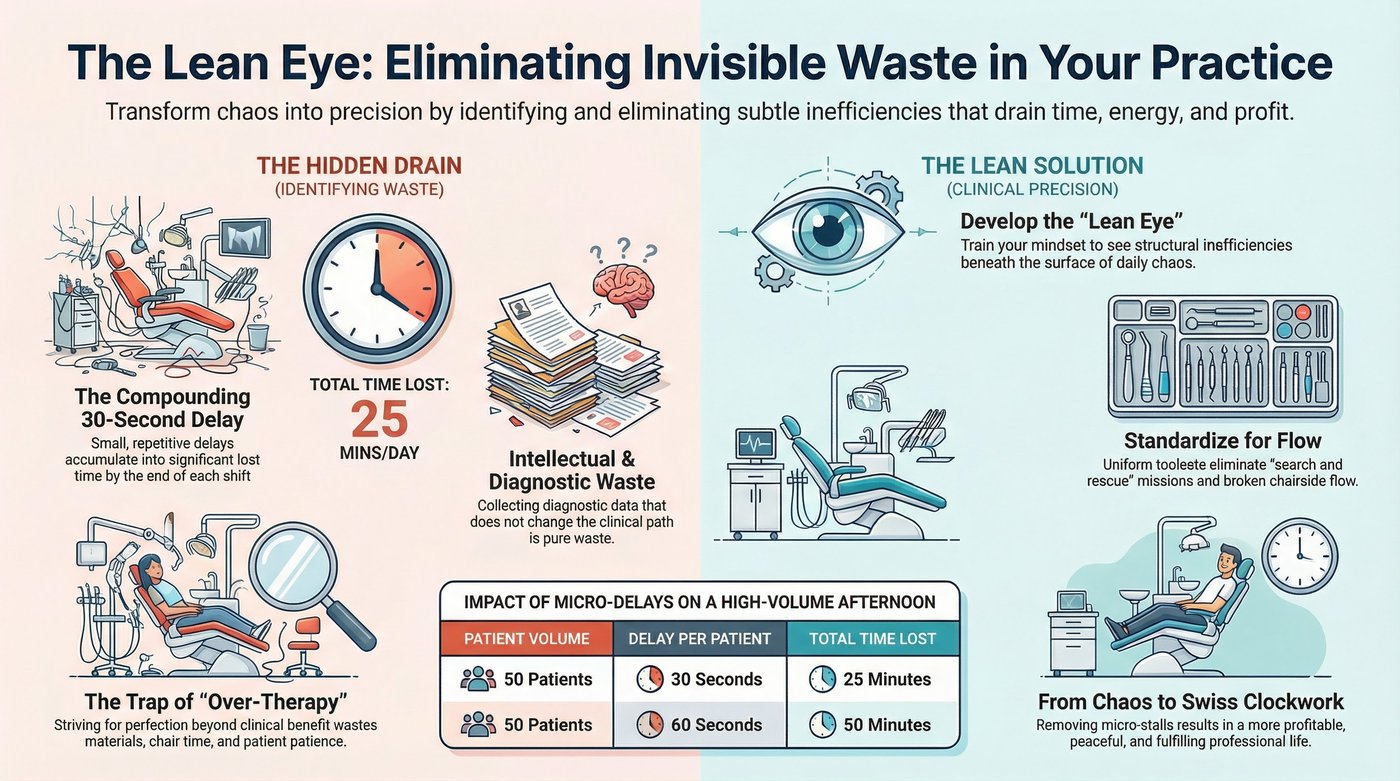
The Hidden Drain on Your Practice Energy
Have you ever finished a long day at the clinic feeling completely drained, even though the patient volume seemed manageable? Many orthodontists attribute this exhaustion to the nature of the profession, but the reality is often different. The primary culprit is “invisible waste”—the friction in our daily routines that steals our time, our focus, and our profit without us even noticing.
In the world of lean orthodontics, waste is the “mother of all evil.” It is any activity that consumes resources—be it time, energy, or money—without adding value to the patient’s treatment or experience. To transform your practice, you must develop what I call a “Lean Eye.” This mindset allows you to see beyond the surface of your daily chaos to identify the structural inefficiencies that are holding you back.
The Cumulative Power of Small Inefficiencies
One of the most dangerous forms of waste in a dental office is the “negligible” delay. We often ignore a 30-second delay because it feels insignificant. However, in a high-volume orthodontic setting, these seconds compound with staggering speed.
Imagine a typical afternoon block where you see fifty patients. If an assistant takes just thirty seconds longer per patient—perhaps due to a disorganized drawer or a slight delay in changing a wire—you have lost 25 minutes by the end of the session. This is why you miss your lunch break, why your schedule runs late, and why your team leaves the office stressed. Efficiency isn’t about rushing; it’s about removing the micro-stalls that disrupt the flow of your day.
Eliminating Data Clutter and Over-Therapy
As orthodontists, we are trained to be meticulous, but this can lead to “intellectual waste.” We often collect massive amounts of diagnostic data, tracing dozens of cephalometric angles and recording endless metrics. But we must ask the critical lean question: Does this data influence the treatment decision?
If a piece of information does not change your clinical path, collecting it is simply waste. It clutters your mind and your digital storage. This principle also applies to the final stages of treatment, where “over-therapy” becomes a trap. Striving for a level of perfection that provides no clinical or aesthetic benefit beyond the current stage wastes materials, chair time, and the patient’s patience. Recognizing when the value has been fully delivered is a hallmark of an expert clinician.
Standardization: The End of Searching and Waiting
Physical waste often manifests as a lack of standardization. When every doctor or assistant in a practice has their own preferred set of instruments or pliers, it creates a logistical nightmare. It leads to excessive stock, cluttered workspaces, and confusion during sterilization.
By agreeing on a standardized, efficient set of tools, you eliminate the waste of motion. We have all seen the “search and rescue” missions in a clinic—the team member who has to leave the chair to find a camera, a specific bracket, or a pair of gloves. Every time a provider leaves the chair, the flow is broken, the doctor waits, and the patient’s experience suffers. A lean practice ensures that everything needed is within reach before the appointment begins.
Conclusion: From Chaos to Swiss Clockwork
Developing a “Lean Eye” is a transformative shift for any practice owner. Once you start seeing the friction in your systems, you gain the power to remove it. By addressing the small delays, the data clutter, and the lack of physical organization, you stop running through your day like a “headless chicken” and start operating like a precise Swiss clockwork. The result is not just a more profitable practice but also a more peaceful and fulfilling professional life.