

The Lean Briefing: Replacing Time-Wasting Meetings with High-Impact Communication
Published on: Jul 5, 2026
Working On the Practice, Not Just In It
One of the most common complaints among orthodontists is the lack of time for team communication. When clinical schedules are packed and administrative demands are high, formal meetings are often the first thing to be cut. However, this is a strategic error. Failing to dedicate time to “work on your practice” rather than just “in it” is the quickest path to stagnation and team burnout.
A practice owner’s highest-leverage activity is improving the underlying systems. Without dedicated, structured time for communication, systemic issues—such as inconsistent sterilization protocols or convoluted patient handoffs—are left unaddressed. These minor inefficiencies compound daily, eroding both profit margins and staff morale.
In a high-performing clinic, communication shouldn’t be a burden that takes you away from patients. Instead, it should be a structural tool that facilitates practice efficiency. By transitioning from long, drawn-out meetings to a lean briefing structure, you can drive your practice forward without sacrificing productive clinical hours. This focused approach transforms communication from a time sink into a continuous process improvement engine.
The “On and Off Switch” for Mental Hygiene
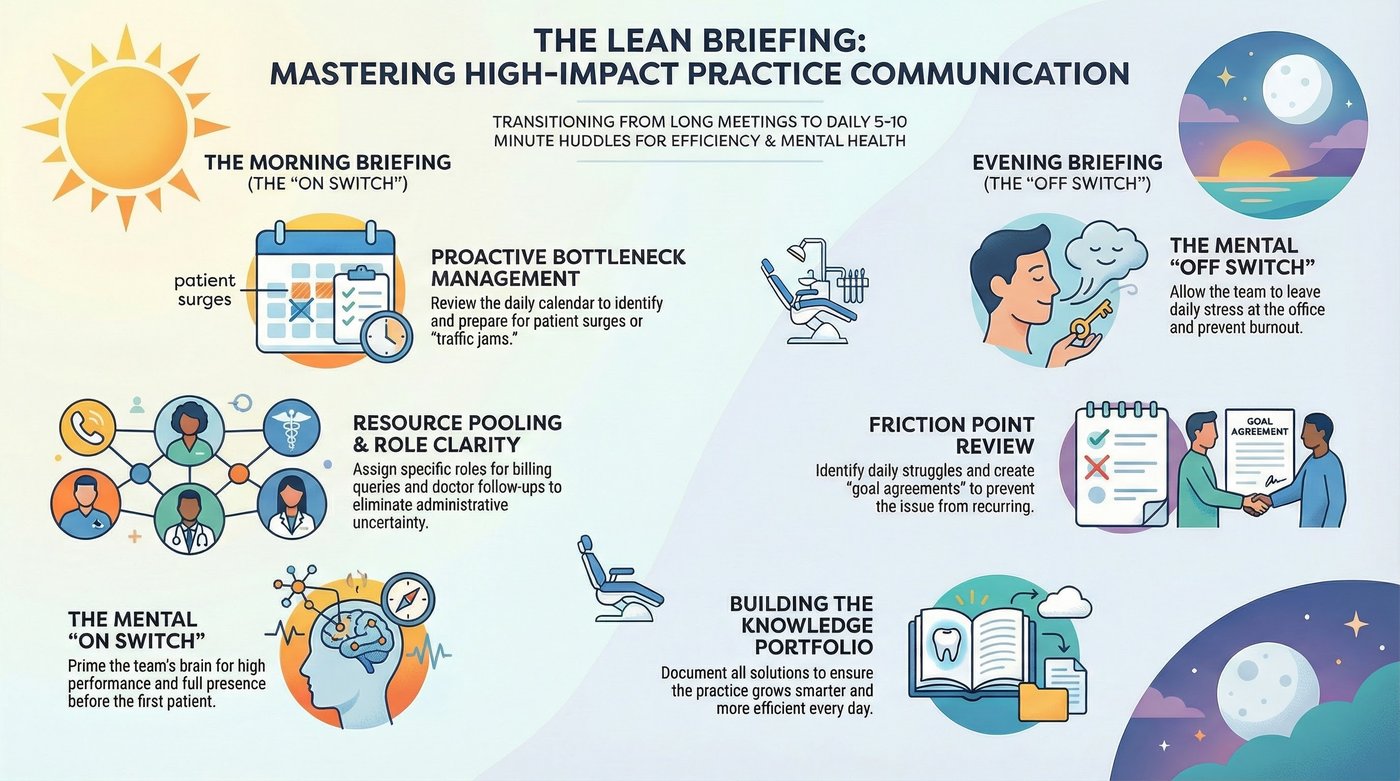
Lean leadership recognizes the psychological importance of transition. In my practice, we utilize a system of morning and evening briefings that last only five to ten minutes. These act as a mental “on and off switch” for the team. The intentional brevity communicates respect for everyone’s time, increasing engagement compared to a quarterly hour-long staff meeting.
The morning briefing primes the brain for work mode, aligning mental focus before the chaos of the schedule begins. Conversely, the evening briefing allows the team to “switch off” and leave the stress of the day at the office. This intentional decompression ritual is crucial for preventing staff from carrying clinical stresses home, which is a major contributor to long-term burnout in dental settings.
This structure is a vital component of dental leadership, as it protects the team’s mental hygiene and prevents the downward spiral toward resignation or burnout. It ensures that when the team is at work, they are fully present and high-performing. A mentally protected team is more resilient, leading to higher patient satisfaction scores and a marked reduction in staff turnover.
Proactive Bottleneck Management
The morning briefing is not just a greeting; it is a tactical session. The first agenda item is always reviewing the daily calendar in detail to identify potential “traffic jams” before they happen. This isn’t about simply reading the schedule; it’s about anticipating clinical friction. For example, identifying the four back-to-back bonding appointments that require simultaneous assistant and doctor presence, or the new patient consult requiring extensive insurance verification.
If we anticipate a surge of patients—what we call “The Bus”—we proactively decide how to pool our resources. This might involve cross-training a front-office coordinator to sterilize instruments during a peak hour, or pre-staging all necessary trays for the morning’s procedures. The goal is to move from reactive troubleshooting to proactive capacity planning.
By assigning specific responsibilities for the day—such as who handles complex billing queries or follow-ups with referring doctors—we eliminate the “administrative ballast” of uncertainty. We clearly define the “owner” of each high-risk task. When the first patient arrives, every team member knows their specific role and exactly what challenges to expect. This clarity is the foundation of operational excellence, allowing the practice to manage complex caseloads, such as same-day start cases, with seamless coordination.
Closing the Loop: The Knowledge Portfolio
A lean practice is an evolving one. During the evening briefing, we gather to review the “friction points” of the day. This retrospective is brutally honest but focused on process, not people. A friction point is a specific event, such as a lab case arriving late or a new team member struggling with the intraoral scanner settings.
If a problem occurred, we don’t just complain; we create a “goal agreement” for the next time that issue arises. This goal agreement is a concrete, actionable step, such as “Next time a lab case is delayed, the lead assistant will immediately call the lab and alert the scheduler”. It immediately shifts the team from problem identification to solution implementation.
These measures are documented and added to our permanent knowledge portfolio. This documentation is the single source of truth for all operational procedures, ensuring that best practices are standardized and repeatable. This turns every daily struggle into a stepping stone for the future. By documenting these solutions, you ensure that the practice grows smarter every single day, turning error management into a competitive advantage. This sustained learning process prevents the team from solving the same problem twice, dedicating saved time to patient care and growth initiatives.
Conclusion: A Structure for Growth
Moving to a lean briefing structure allows you to maintain control of your practice without losing hours to ineffective discussions. It shifts the focus from managing time to mastering productivity. This systemic approach provides the clarity your team needs to thrive and the structure you need to lead with confidence.
By implementing these high-impact interactions, you ensure that your practice remains a calm, proactive, and high-performing environment. The Lean Briefing is not a meeting; it is the framework for sustainable growth and a powerful demonstration of experienced, patient-centered dental leadership.