

The Lean Approach to Continuing Education: Maximising ROI on Professional Mastery
Published on: Jun 27, 2026
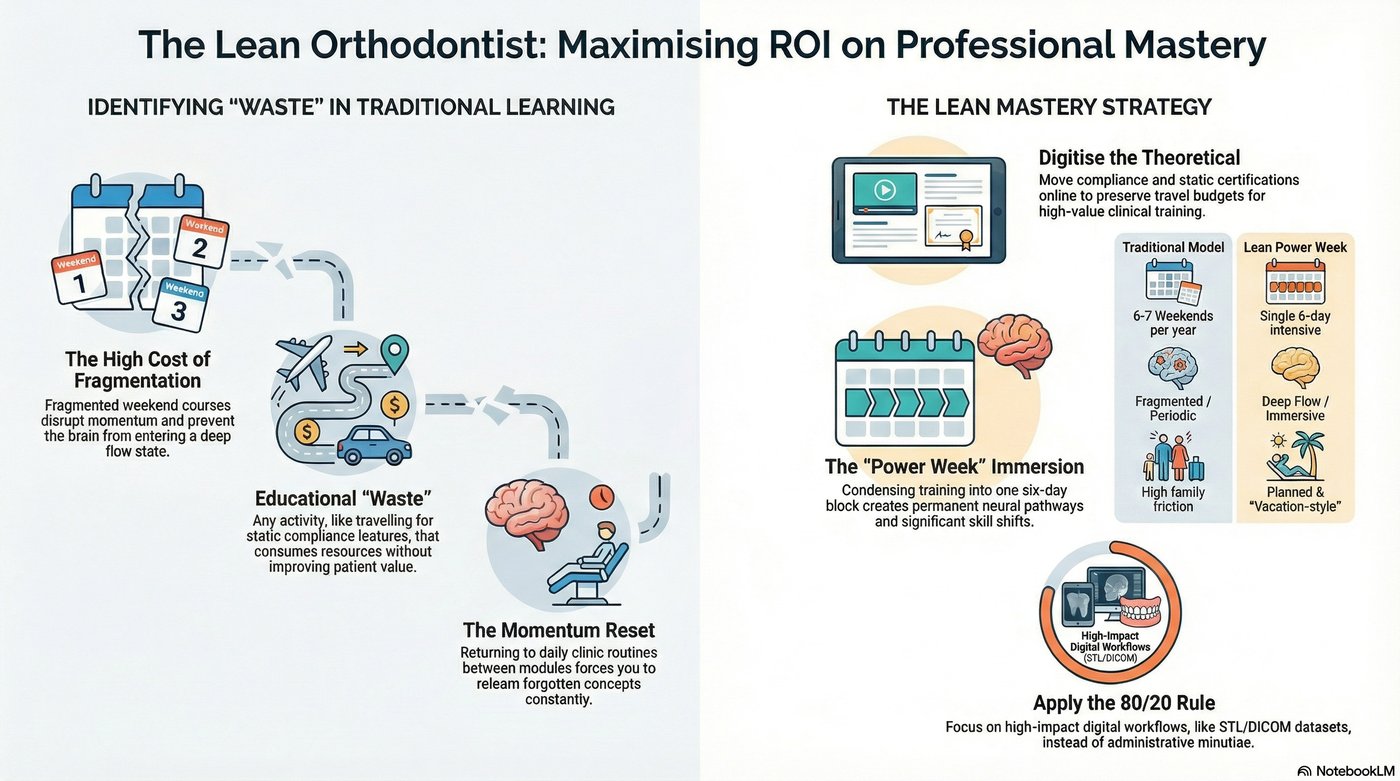
In the high-stakes world of orthodontics, time is our most precious commodity. Yet, for years, the dental profession has treated continuing education (CE) as a bureaucratic obligation—a series of boxes to be checked and credit points to be collected. We endure long flights, expensive hotel stays, and hours of passive lectures just to maintain compliance. From a lean management perspective, this traditional model is riddled with “waste”: wasted time, wasted energy, and a significant lack of immediate clinical application. When a practitioner spends three days away from the chair to attend a seminar where only 10% of the material is relevant to their specific patient demographic, the opportunity cost is staggering. This “over-processing” of information creates a bottleneck in professional growth rather than a catalyst for it.
As practice owners and leaders, we must apply the same rigorous analysis to our learning habits as we do to our clinical workflows. It is time to stop asking which credits we need and start asking which formats actually facilitate the transfer of skills. To build a practice that is both efficient and cutting-edge, we must revolutionise how we acquire knowledge, moving away from “theory for the sake of theory” and toward high-intensity mastery that reaches the chairside immediately. True ROI in education isn’t measured by the certificate on the wall, but by the reduction in refinements, the shortening of treatment times, and the increased confidence of the clinical team.
Identifying the “Waste” in Traditional Professional Development
In lean management, we define waste as any activity that consumes resources but creates no value for the end patient. Much of our current CE landscape fits this description. Think about the mandatory radiation protection refresher, basic health and safety protocols, or local compliance updates. While these are essential for legal operation, they rarely enhance the quality of a finish or the efficiency of a bracket placement. Forcing a highly skilled orthodontist to sit in a physical classroom for these topics is a classic example of “under-utilising talent,” another core lean waste. Every hour spent in a lecture hall listening to information that could have been read in a PDF is an hour stolen from patient care or strategic practice development.
The lean leadership move is to migrate all static, theoretical, and compliance-based topics entirely into the digital realm. These are non-negotiable requirements that do not benefit from a physical, hands-on presence. By digitising these certifications, you allow yourself and your team to complete them during “white space” in the schedule or at a time that suits their personal lives. This preserves your travel budget for high-impact clinical residencies. Imagine the shift in morale when a team member can complete their required units on a quiet Tuesday morning instead of losing a weekend. This strategic separation of “maintenance learning” from “growth learning” ensures that when you do travel, it is solely for the purpose of acquiring transformative skills that move the needle on clinical excellence.
The Power Week: Using Immersion to Achieve Deep Mastery
One of the greatest flaws in current dental education is fragmentation. Many advanced clinical courses are split over six or seven weekends throughout the year. While this might seem less disruptive to the weekly production schedule, it is a psychological nightmare for deep learning. It takes the human brain approximately twenty minutes of uninterrupted focus just to enter a “flow state”—that zone where complex information, such as biomechanical staging or digital clear aligner setup, is truly processed and retained. When you learn in small, disconnected bursts, you never reach the depth of understanding required to innovate at the chairside.
Every time a short module ends, and you return to your daily clinic routine, your momentum is reset. You spend the first half of the next session simply trying to re-acclimate. To counter this, I advocate for the “Power Week” or intensive immersion model. By condensing your training into one six-day block, you stay in the flow state. You eat, sleep, and breathe the subject matter. This intensity creates new neural pathways that a fragmented schedule cannot match. Consider the difference between learning a language via an app for ten minutes a day versus living in the country for a week. The immersion model allows you to move past the “how” and into the “why,” enabling you to return to your practice with a permanent shift in your clinical capabilities rather than just a few new tips.
The 80/20 Rule: Focus Your Brainpower on High-Impact Workflows
As leaders, we often fall into the trap of trying to be experts in everything. We feel we must master tax law, complex HR regulations, and every new administrative software trend. However, the Pareto Principle—the 80/20 rule—suggests that 80% of your practice’s success comes from 20% of your activities. In orthodontics, that 20% is almost always found in your clinical diagnostic accuracy and the efficiency of your digital treatment planning. If you are spending your educational hours on tasks that could be handled by a CPA or an office manager, you are effectively diluting your own value as the primary producer and visionary of the business.
A lean orthodontist focuses on their core competencies: clinical excellence and digital workflows. In the modern era, understanding how to manipulate STL and DICOM datasets to create custom appliances is far more valuable to your patient journey than spending hours on administrative minutiae. For example, mastering in-house 3D printing workflows can drastically reduce the “wait waste” for patients and lower lab fees. Focus your education on the areas that drive these specific results. Mastery over your digital ecosystem will reduce chair time and improve patient outcomes far more effectively than any general billing seminar ever could. By becoming the absolute expert in your clinical niche, you create a moat around your practice that generalist education simply cannot replicate.
Balancing Practice Growth with Leadership Responsibility
Finally, we must consider the logistical and emotional impact of our education on our teams and families. For a practice leader with a family, disappearing for seven weekends a year is a recipe for burnout and domestic friction. It disrupts the rhythm of the home, leads to “professional guilt,” and often results in the practitioner being physically present but mentally absent upon their return. This “switching cost” between roles as a clinician and a family member is a hidden form of waste that degrades your overall performance and long-term sustainability in the profession.
Conversely, a single, well-planned “Power Week” can be organized with the same precision as a surgical schedule. The clinic calendar is blocked out months in advance, patient emergencies are triaged to a colleague, and the team is empowered to handle the absence. This strategic approach respects your work-life balance while delivering a level of professional growth that translates into a more profitable, less stressful practice. When you choose your next educational investment, look for intensity over duration. Seek out formats that prioritise practical implementation—such as live-patient residencies or over-the-shoulder clinical coaching—over theoretical posturing. By refining how you learn, you aren’t just improving your skills; you are optimizing the very engine of your practice, ensuring that every hour of study returns fivefold in clinical efficiency and personal fulfillment.
Conclusion:
The strategic decision to apply lean principles to professional development marks the shift from passive compliance to proactive mastery. By rigorously identifying and eliminating “waste” in traditional CE models, leaders can reclaim valuable time and financial resources, directing them toward high-impact, transformative learning.
Digitalising compliance training and prioritising immersive, intensive formats like the Power Week ensures that the knowledge acquired translates immediately into chairside competence. True ROI is achieved when every hour spent learning shortens treatment timelines, reduces errors, and cements the practice’s reputation for cutting-edge care.
This evolution in educational strategy is not just about staying relevant; it is about building a scalable, profitable, and professionally sustainable practice for the future.