

The Leadership Trap: Why You Might Be Your Practice’s Biggest Bottleneck
Published on: Jun 12, 2026
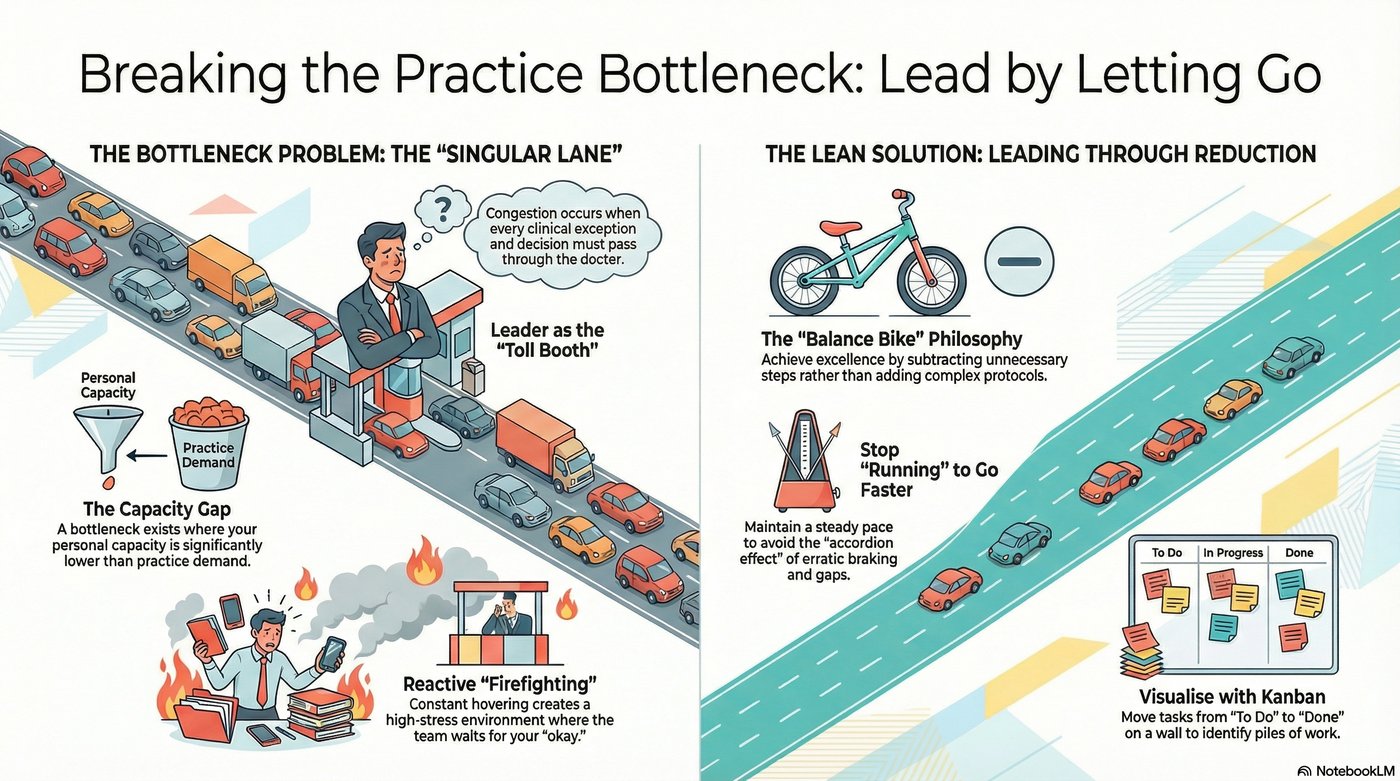
In the high-stakes environment of orthodontic practice management, a common frustration haunts even the most experienced clinicians: the feeling that no matter how much you hire or how many chairs you add, the “traffic jam” in the clinic never truly clears. We often look outward for the cause of these delays—blaming the schedule, the software, or the team. However, true dental leadership requires a more uncomfortable realization. Often, the single greatest bottleneck in an orthodontic practice is the person at the top.
When a practice is in a growth phase, the leader naturally wants to oversee every detail. But when every decision, every patient inquiry, and every clinical exception must pass through a single person, you create a “singular lane” on a busy highway. This leads to a state of chronic congestion that fuels team burnout and diminishes the patient journey. To reclaim your practice efficiency, you must learn the art of subtraction and the discipline of letting go.
The Singular Lane Problem: Complexity vs. Clarity
A bottleneck is essentially a point in your process where the capacity is significantly lower than the demand. In many clinics, the “primary lane” is the doctor’s attention. When you are simultaneously the lead clinician, the HR manager, and the operational supervisor, everything comes to a standstill. In lean management, we strive for a “one-piece flow”—the ability to move a single task or patient through the system without interruption.
When your team is constantly waiting for your “okay” or your presence to move to the next step, you aren’t leading; you are hovering. This creates an environment of stress and reactive “firefighting.” To break this cycle, you must identify the essential tasks that only you can perform and ruthlessly delegate the rest. A leader’s job is to build the highway, not to be the only toll booth operator standing in the middle of it.
Subtraction vs. Addition: The “Balance Bike” Philosophy
When a practice feels overwhelmed, the traditional reflex is to add. We add more chairs, more training wheels, and more complicated workarounds to patch up broken systems. But as every parent knows, training wheels are wobbly, annoying, and actually prolong the time it takes a child to learn to ride. They solve a balance problem by adding more complexity.
Lean management in dentistry teaches us that the better solution is the “balance bike.” By subtracting the pedals and the chain, you allow the child to isolate and master balance first. In your practice, look for ways to subtract complexity. Instead of building a three-page protocol to fix a communication error, identify the root cause and remove the step that allowed the error to happen. Reduction, not addition, is the fastest path to operational excellence.
The Accordion Effect: Why “Running” Slows You Down
There is a fascinating study regarding escalators in metro systems like London and Tokyo. Intuition tells us that in an emergency, people should run up the stairs to exit faster. However, data proves that the highest throughput is achieved when everyone stands on every step and moves at a consistent, steady pace. Running creates an “accordion effect”—erratic braking, gaps, and accidents that actually slow down the total flow.
We see this in dental team performance every day. When a rush hits, the team begins to “run.” They skip protocols, change lanes erratically, and communicate in fragments. This uncooperative behavior leads to a kilometer-long backup of delays and frustrated patients. True leadership is about setting a steady, manageable “process speed.” When everyone follows the same rules and moves at the same pace, the bottleneck at the “construction site” of your busy afternoon disappears.
Visualizing the Flow with Kanban
You cannot manage what you cannot see. Many orthodontists try to manage a complex process chain of twenty steps purely by intuition. This is a recipe for chaos. To improve practice efficiency, you must make the flow visible.
Using a Kanban board—moving tasks from “To Do” to “Doing” and finally to “Done”—allows the entire team to see where work is piling up. It takes the “singular lane” in the boss’s head and puts it on the wall for everyone to manage. When you visualize your bottlenecks, you stop going in circles and start addressing the real obstacles.
Conclusion: Leading Through Reduction
Clearing a bottleneck is rarely about finding a “special exception” or working harder. It is about the discipline of reduction. As a practice owner, your value lies in your ability to control the process speed and create a predictable flow for your team and your patients.
By removing yourself as the sole decision point and stripping away unnecessary complexity, you create a clinic that breathes. A lean practice isn’t just about profit; it’s about restoring the joy of work and ensuring that you are leading a team that feels empowered, rather than a team that is stuck in traffic.