

The Leadership Evolution: Moving from Solo Practitioner to Network CEO
Published on: Jun 8, 2026
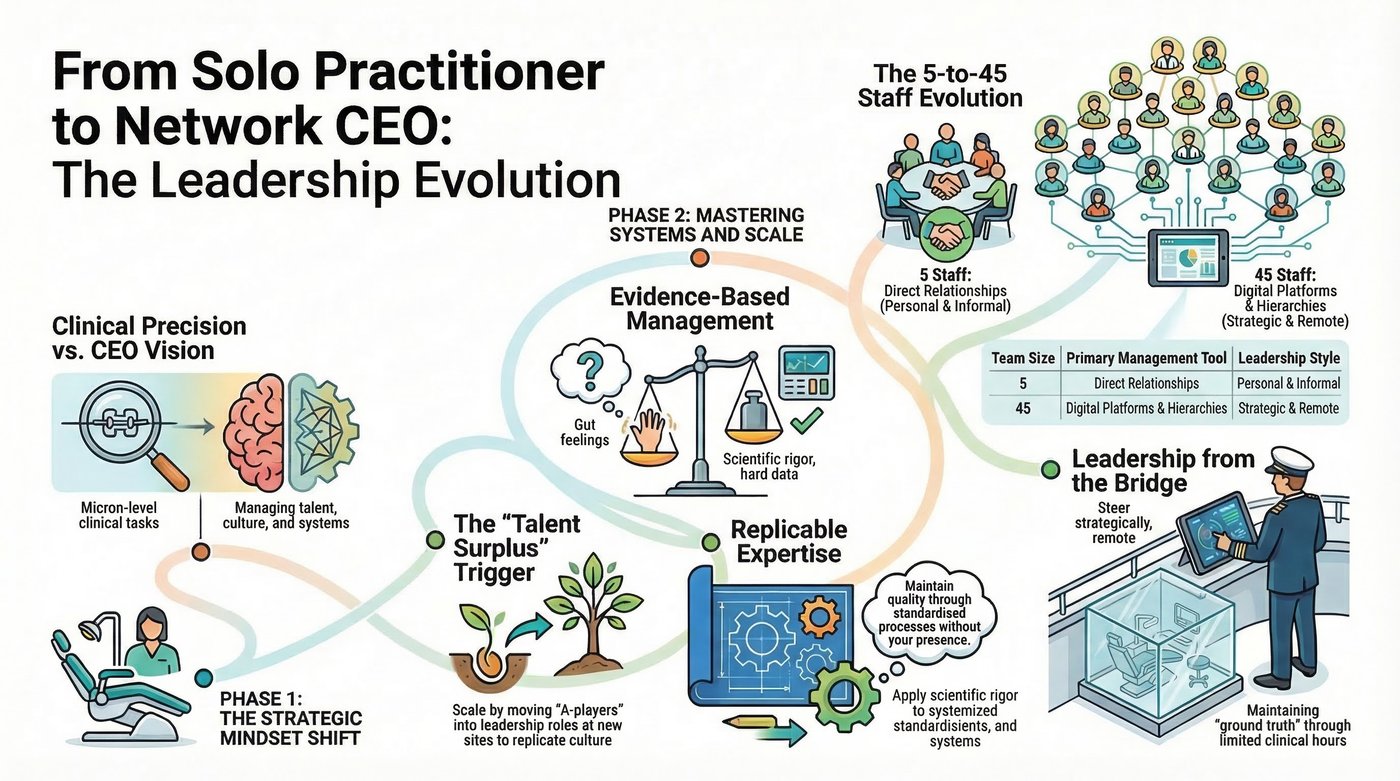
In the world of orthodontics, we are trained to be meticulous clinicians. We focus on the micron, the precision of a bracket placement, and the nuances of a treatment plan. This clinical focus is vital for patient care, but it can become a significant bottleneck when attempting to scale beyond a single location. The skills that make an excellent clinician are fundamentally different from those required to lead a multi-site enterprise.
However, to grow a practice into a successful network, the doctor must undergo a radical leadership evolution. You must stop thinking like a solo practitioner—where personal expertise is the only driver—and start thinking like a CEO who manages talent, culture, and evidence-based systems. This paradigm shift requires moving from a hands-on technical role to a strategic oversight role, focusing on scalable infrastructure rather than individual patient treatment.
The transition from one practice to several is less about clinical skill and more about dental leadership. It is about your ability to replicate your expertise through other people and standardized processes. This replication demands documenting every crucial aspect of the patient journey, from initial consult to retention. If the quality of your practice drops the moment you walk out the front door, you don’t have a network; you have a job that owns you. True expansion means building a clinical and administrative operating system that is resilient and independent of your daily physical presence.
Talent-Led Expansion: Growing Your People to Grow Your Practice
One of the most overlooked triggers for expansion is the “talent surplus.” Often, an orthodontic practice management challenge is not a lack of patients, but a surplus of high-performing, well-trained employees who have hit their own professional ceilings within a single location. Identifying these individuals and preparing them for greater responsibility is key to fueling organic growth.
When you have built a team of outstanding professionals, it is no longer economical to keep them all in one place. Scaling to a second or third location allows you to provide new opportunities for your best people—a crucial strategy for reducing attrition among your top performers. By moving your “A-players” into leadership roles at new sites, such as Lead Orthodontic Assistant or Site Manager, you ensure that your existing culture and systems are implemented one-to-one.
This approach improves dental team performance across the board, as employees see a clear path for career progression within your organization. Practical insight: a well-defined tiered position structure, often formalized through an internal leadership academy, gives employees a reason to stay and grow with your network, rather than looking elsewhere for advancement.
Evidence-Based Management: Taking the Ego Out of Leadership
As clinicians, we pride ourselves on evidence-based practice. We don’t use a specific technique just because a professor liked it; we use it because research and results prove it works. To lead a scaling network, you must apply this same scientific rigor to your management style. This means viewing management decisions not as personal opinions, but as hypotheses to be tested against measurable organizational outcomes.
Evidence-based management means:
Researching Methods: Testing different workflows, patient communication strategies, and scheduling protocols to see which yield the highest efficiency and lowest error rates. For example, piloting a new virtual check-in system at one location before rolling it out network-wide.
Documenting Results: Moving away from “gut feelings” and toward hard data regarding practice efficiency and patient satisfaction. Key metrics include chair time per patient, conversion rates, and patient-reported outcome measures (PROMs).
Removing Ego: If a process isn’t working—perhaps a scheduling system leads to unacceptable wait times—the objective data will show it. This allows the leader to make objective decisions that benefit the entire practice rather than defending “the way we’ve always done it,” which is a common pitfall in single-site operations.
By treating your management protocols as a clinical study, you create a culture of reliability. Your team knows exactly what is expected of them because the systems are documented, continuously refined, and proven. This clarity is the secret to maintaining a high-quality, predictable patient journey in orthodontics across multiple, geographically diverse sites.
The Shift from 5 to 45: Mastering New Levels of Expertise
The complexity of leadership increases exponentially with the size of the team. Managing a small, intimate team of five is a personal endeavor based on direct relationships, where informal communication and proximity suffice. In contrast, managing a team of forty-five or more requires a different set of tools: clear hierarchies, digital communication platforms, and a robust, middle-management leadership structure. You are no longer managing individuals but managing managers.
At this scale, your role is to influence the culture through digital platforms and strategic touchpoints, such as monthly leadership syncs and standardized performance reviews. You must become comfortable with leading remotely, using video chats and project management tools (like specialized dental PM software) to stay connected with your staff every day, ensuring accountability across the network.
This doesn’t mean you lose touch with the clinical side; on the contrary, staying in the treatment room a few days a week is essential to understand the “ground truth” of your practices and maintain clinical credibility. However, your growth as a leader comes from your ability to steer the ship from the bridge—setting the strategic direction, defining the key performance indicators (KPIs), and ensuring all sites are moving in unison—not just pulling the oars.
Embracing the Journey of Constant Learning
Scaling an orthodontic network is a journey of constant refinement. It requires you to seek out coaching from seasoned business leaders, study lean management in dentistry to optimize flow, and embrace the fact that you will always be a student of leadership. Invest in executive education, join peer groups of other multi-site practice owners, and prioritize your strategic planning time over clinical chair time.
The most successful networks are led by doctors who are as committed to their personal development as they are to their clinical excellence. This commitment demonstrates to your team that lifelong learning is a core value, reinforcing the culture of refinement and excellence you are striving to replicate across every location.
When you evolve from a practitioner into a leader, you unlock a level of professional freedom and impact that is impossible within the walls of a single clinic. You create a legacy of quality care that reaches thousands of patients, driven by a team that is empowered by your vision and supported by your systems. The transition is challenging, requiring significant personal and professional adjustment, but for those willing to lead, the rewards are limitless.
Conclusion
The movement from a solo operator to a network CEO is ultimately a transition from being the “doer” to the “designer.” Your enduring legacy will not be defined by the complex cases you personally treated but by the excellence of the systems you designed and the leaders you developed. Embrace the data, trust your scalable processes, and commit to the ongoing education that transforms a talented doctor into a truly impactful healthcare enterprise executive. This is the path to sustainable scale and enduring professional satisfaction.