

The Leadership Diagnosis: Why More Staff Doesn’t Always Mean More Growth
Published on: Jul 1, 2026
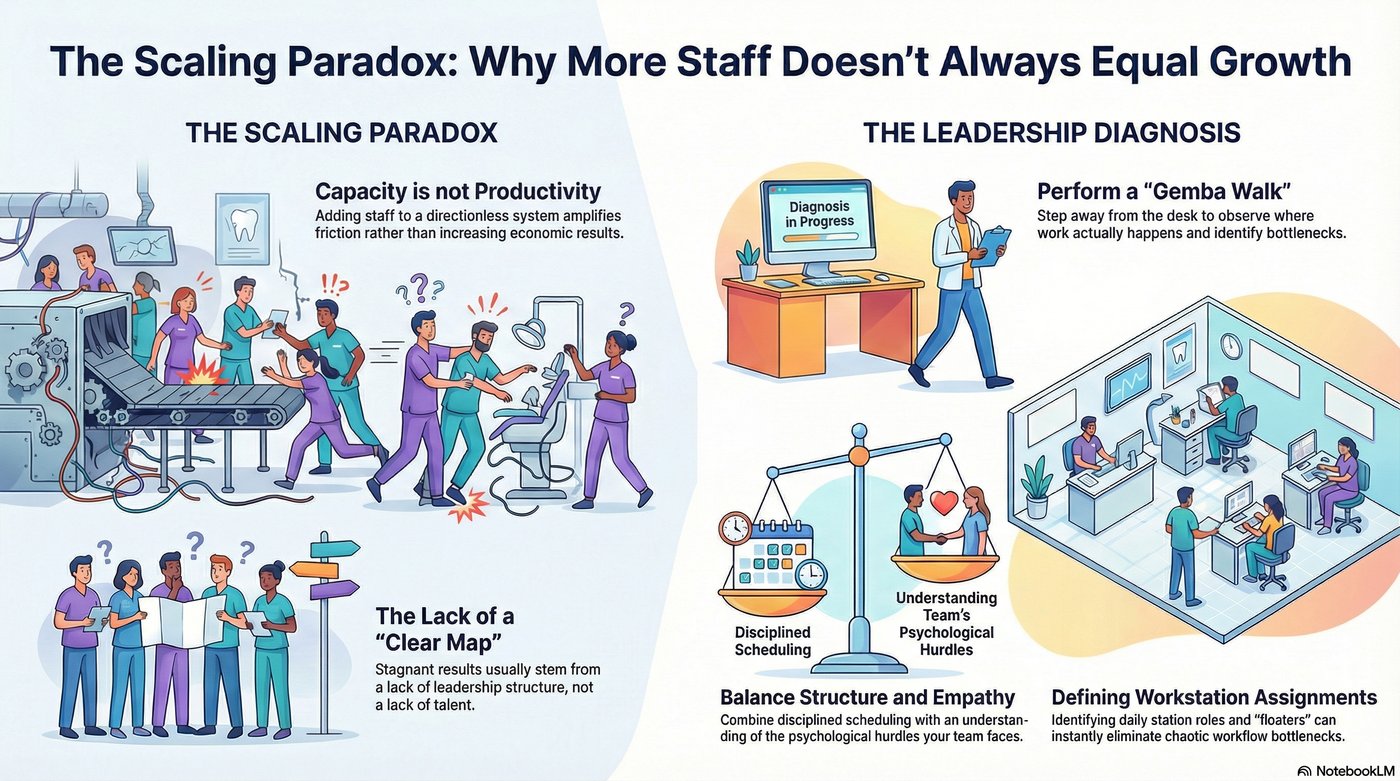
The Scaling Paradox
It is a frustratingly common scenario: you hire new team members to handle an increasing workload, yet your economic results remain flat. On paper, your capacity has grown, but the practice feels like it’s treading water.
In lean orthodontics, we recognize that adding people to a broken or directionless system only amplifies existing friction. More hands don’t always equal more output; often, they just add more layers of communication and potential for error.
The paradox is that as the team grows, the individual efficiency often drops. This is usually because the systems designed for a three-person team cannot support a six-person team. Without scaling your processes alongside your payroll, you create a “growth tax” on your existing profits.
When results stagnate despite a larger team, the problem is rarely the talent of the new hires—it is almost always a lack of dental leadership. You cannot expect a team to find its own way without a clear map or defined objectives.
As a leader and entrepreneur, your primary job is to provide the structure that allows talent to actually produce value. If your assistants are spending half their time searching for supplies or clarifying instructions, that is a leadership failure, not a performance issue.
High-performing teams require high-clarity environments. When leadership is absent, teams default to “busy work” rather than “productive work.” They might look active, but the needle on your practice’s growth remains stuck.
The Gemba Walk: Solving Bottlenecks at the Source
To identify why your scaling efforts are failing, you must perform a Gemba walk. In Japanese, “Gemba” means “the real place.” This means stepping away from your desk and observing where the work actually happens.
You must watch the workflow in the lab, at the front desk, or chairside. Don’t just look for what people are doing; look for what is stopping them from doing more. Are they walking too far for sterilized kits? Are they waiting on signatures?
The goal of the walk is not to criticize, but to learn. When you stand in the shoes of your clinical assistants, you start to see the invisible hurdles that slow down every patient transition and every bracket placement.
In my own lab, a Gemba walk revealed that a lack of daily workstation assignments was causing a massive bottleneck. Staff spent the first twenty minutes of the shift negotiating who would work where and gathering tools from different drawers.
By simply defining who occupied which station and who acted as a “floater” for the day, the chaos vanished. Every person knew exactly where to go and what their specific responsibility was the moment they clocked in.
Just as we diagnose a malocclusion before placing brackets, we must diagnose the workflow before demanding more output. Clarity on the front lines is the only way to intervene effectively and ensure that your new hires are actually helping you grow.
Balancing Structure and Empathy
Many practitioners fall into one of two traps: being the “bossy” micromanager who stifles initiative, or being the “nice guy” who avoids conflict to keep everyone in a good mood. Real management is the sophisticated balance of both.
You need the structural discipline to set a rigorous schedule and hold people accountable to standards. Without this, the practice descends into a culture of mediocrity where “good enough” becomes the ceiling for performance.
Simultaneously, you need the empathy to understand the physical and psychological hurdles your team faces. Are they burnt out because the scheduling is unrealistic? Is the equipment failing them?
When you show that you care about their work environment by being present and proactive, you earn the right to lead. True growth happens when your team feels supported by the systems you build and inspired by the leadership you provide.
Ultimately, your practice’s growth is not a result of how many people you have on the payroll, but how effectively you lead the people you have. Structure creates the freedom for your team to excel.
Conclusion
In conclusion, relying solely on hiring to achieve growth is a managerial shortcut that often leads to organizational drag and diminishing returns. The true engine of dental and orthodontic practice expansion is meticulous leadership focused on refining operational efficiency. By embracing the principles of lean management, conducting regular Gemba walks to solve root-cause friction, and consciously balancing structural demands with team empathy, clinic leaders can ensure that every new hire contributes meaningfully to sustainable success. When the systems are robust and the vision is clear, adding staff becomes an accelerator, not an anchor.