

The LATTE Concept: Recovering Candidates and Resolving Conflict
Published on: Jun 28, 2026
A Framework for Difficult Conversations
Whether you are dealing with a top-tier candidate who has changed their mind at the last moment or a long-term, high-value employee facing a personal crisis, the way a dental leader navigates that pivotal conversation determines the ultimate outcome for the practice.
These interactions, often emotionally charged, are critical touchpoints that define the operational maturity of your clinic. To strategically elevate your dental team performance and solidify your leadership presence, a standardized communication protocol is essential.
Leading orthodontic practices proactively implement the LATTE concept as a cornerstone of internal conflict resolution and candidate recovery strategy.
This framework is specifically designed to enable practice owners and clinic managers to remain a calm, rational, and objective leader, even when the immediate situation feels highly personal or frustrating.
By imposing a methodical structure on emotionally turbulent exchanges, the LATTE concept effectively prevents the common “firefighting” response that leads to impulsive decisions.
Its application ensures that every single interaction, whether with a prospective hygienist or a tenured office manager, is deliberate and moves the entire practice systematically toward verifiable operational excellence.
Breaking Down the LATTE Method
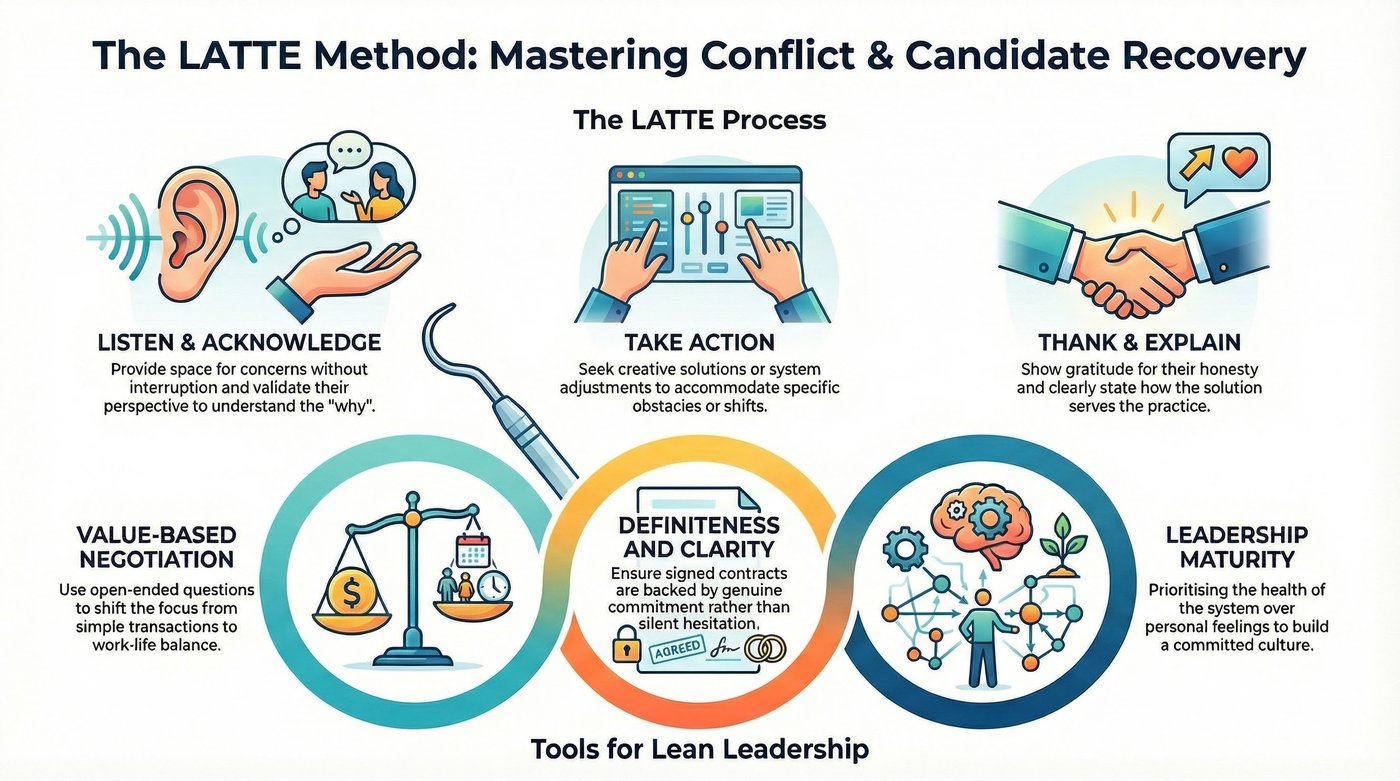
Listen: The first step requires giving the person complete, uninterrupted space to voice the entirety of their concerns. As a leader, you must resist the urge to interject with solutions or defenses.
This focused quietude is necessary because the surface-level problem (e.g., “The commute is too long”) is often merely a vague excuse shielding a deeper, underlying issue (e.g., anxiety about new practice management software). Effective listening uncovers the true root cause, which is essential for resolution.
Acknowledge: Once the full concern is heard, you must immediately validate their perspective. Validation is not agreement; it is the crucial step of showing genuine empathy and ensuring the individual feels understood.
Leaders achieve this by articulating their comprehension of the “why” behind the candidate’s hesitation or the employee’s crisis. For example, stating, “I understand why switching to digital impression software would cause apprehension,” builds immediate rapport and trust.
Take Action: With the real obstacle identified, the focus shifts to finding a creative, system-based solution. This is where lean principles dictate flexibility.
If the obstacle is a rigid start date, a specific shift schedule, or a training requirement, the practice system must be adaptable to accommodate high-potential talent. The action taken must be measurable and should not compromise the practice’s clinical quality standards.
Thank: It is imperative to show genuine gratitude for their candor and honesty. In a competitive labor market, a candidate could simply resign without notice.
Acknowledging that it takes courage for them to admit they are struggling reinforces a non-punitive culture of open communication. This small gesture solidifies the value the clinic places on transparency.
Explain: The final step involves clearly and confidently articulating your practice’s vision and how the proposed solution creates a definitive win-win scenario.
The explanation must connect the dots between the individual’s concern, the action taken, and the greater mission of the practice. Detail how the revised schedule or modified training path benefits both the new team member and the goal of operational excellence for the entire team.
Open-Ended Questions: The Lean Leader’s Tool
To truly uncover the “rough diamonds” and untapped potential, a lean leader must master the art of the open-ended question. The right prompt forces deep reflection and reveals core motivations, moving beyond transactional negotiations.
Instead of the closed query, “Is this salary okay?”, a highly effective leader asks, “What would a perfect workday look like for you in terms of personal fulfillment and work-life balance?”. This transforms the interaction into a profound value-based negotiation about long-term fit and purpose.
In a practice focused on lean management, we demand definiteness and clarity in every agreement. By strategically employing these deep-dive communication tools, you ensure that once a contract is formally signed, it is robustly backed by a genuine, articulated commitment, rather than silent, festering hesitation.
This elevated level of professional organization projects an authoritative brand of dental leadership that consistently attracts high-performing talent, reduces turnover, and secures their commitment for the long haul.
Conclusion: Building a Committed Culture
Successfully winning back a talented candidate or effectively de-escalating a major internal conflict is the definitive, ultimate test of leadership maturity in a clinical setting. It proves that the leader prioritizes the long-term health and stability of the operational system over any immediate, personal feelings of frustration or rejection.
When you apply the disciplined structure of the LATTE method combined with a proactive, relationship-focused sales mindset, you accomplish much more than just filling an urgent vacancy.
You actively build an indispensable culture defined by radical transparency, mutual respect, and high commitment—the absolute foundation of a truly successful, efficient practice that runs on autopilot.