

The James Bond Effect: Why Clinical Calm is the Ultimate Leadership Metric
Published on: Jun 11, 2026
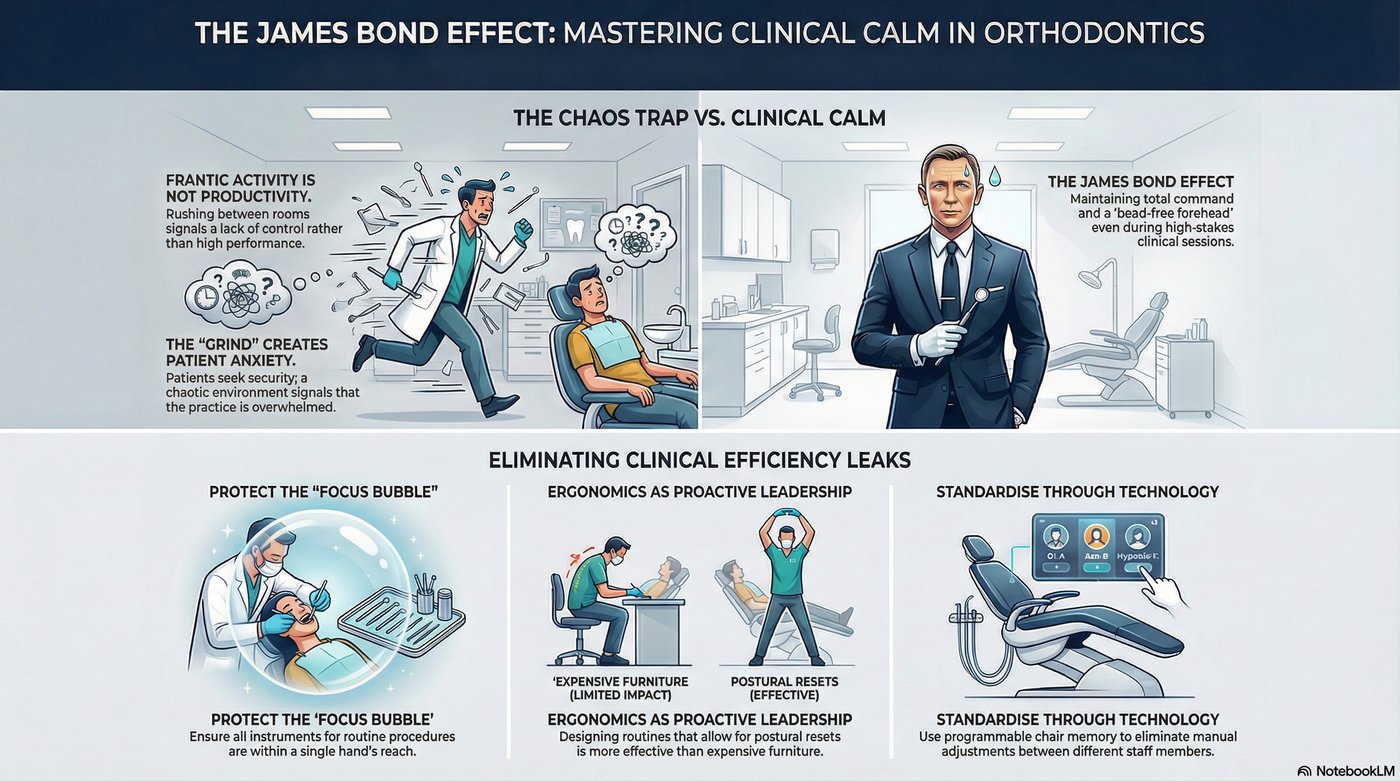
In many orthodontic practices, there is a lingering “old school” belief that frantic activity is a sign of productivity. We see doctors and assistants rushing between rooms, searching for instruments, and sweating through their scrubs as they “grind” through a busy afternoon. This constant state of motion is often worn as a badge of honor among staff.
However, from a leadership perspective, this isn’t high performance—it is a lack of control. Frantic energy is contagious and often masks underlying systemic failures. When the leader is hurried, the team becomes reactive, leading to a higher margin of error and increased stress levels for everyone involved in the patient care cycle.
True excellence in orthodontic practice management is characterized by a coordinated, purposeful calm. It is the ability to handle a high volume of patients while maintaining a steady, unwavering rhythm. This level of poise requires more than just a positive attitude; it requires a commitment to rigorous systems and clear communication.
I call this the “James Bond Effect.” Think of the classic portrayals of 007: he can navigate explosions and high-stakes chaos without a single bead of sweat on his forehead. He is efficient because he has the right tools and a plan for every contingency. In the clinic, patients seek that same level of security and professional confidence.
They want to know that the person treating them is in total command of the situation. When a doctor enters the room calmly, makes eye contact, and performs the procedure with fluid, economical movements, the patient’s heart rate actually drops. They feel safe in the hands of an expert who isn’t rattled by a busy schedule.
Chaos is never a sign of competence; it is a sign of a broken system. If your clinic feels like a fire station where everyone is constantly putting out fires, it is time to evaluate the architecture of your workflow. Leadership is the art of building a stage where your team can perform brilliantly without the distraction of clutter or confusion.
Ergonomics: Making the Environment Adapt to the Body
Most practitioners ignore ergonomics until they start feeling the physical toll of the chair—back pain, neck strain, or repetitive motion injuries. By then, the damage is often cumulative and difficult to reverse. We tend to view physical discomfort as an inevitable part of the profession, but this is a dangerous misconception.
High-level dental leadership involves being proactive about the health of your most valuable assets: your team and yourself. A doctor in pain cannot lead effectively. Chronic discomfort leads to irritability, shorter tempers, and a diminished ability to focus on the fine details of clinical excellence or patient rapport.
A perfectly organized workspace is built on the principle that the body should not have to adapt to the furniture. Instead, the environment must adapt to the body. This means positioning lights, trays, and monitors so they are within the “neutral zone” of movement, where the spine remains aligned and the joints are not overextended.
While many try to “fix” poor ergonomics with expensive saddle chairs or stability balls, the most effective solution is a well-planned routine. These tools are helpful, but they cannot compensate for a workflow that forces you to hunch over a patient for hours on end without a break or a postural reset.
In orthodontics, we have the advantage of short chair times (15–20 minutes), which allows for purposeful movement. Designing your workflow so that you stand up and reset your posture between patients is more beneficial for long-term health than any piece of specialized furniture. It clears the mind and resets the body for the next interaction.
Consider implementing “micro-stretches” into your transition periods. As you move from one bay to the next, a five-second chest stretch or a neck rotation can significantly reduce the build-up of muscle tension. Leadership means modeling these healthy habits so your clinical assistants feel empowered to do the same.
The “Focus Bubble”: Eliminating Efficiency Leaks
To maintain a lean operation, every movement must be meaningful and intentional. The centerpiece of clinical efficiency is the treatment chair, and this is where most “leaks” happen. A leak is any non-value-added movement that takes the provider away from the patient or the task at hand.
If an operator has to stand up or walk across the room to find a specific instrument, they have broken the “bubble of focus.” This break in concentration doesn’t just waste time; it increases the likelihood of forgetting a step or losing the flow of the procedure. It also signals to the patient that the team wasn’t fully prepared for their arrival.
To optimize the clinical floor, I recommend:
The 12 o’clock Position: Setting up behind the head of the chair ensures that both right- and left-handed staff can work with equal efficiency. This universal positioning allows for better visualization and reduces the need for awkward torso twisting during long bonding sessions.
Single Hand Access: Everything required for a routine procedure should be within a single hand’s reach. Use standardized tubs and trays for different appointment types. If you are doing an adjustment, the ligatures, cutters, and mirror should be exactly where you expect them, every single time.
Technology Memory: Much like seat memory in a luxury car, use programmable chair settings for different staff heights. This eliminates the daily waste of manual adjustments. When the environment remembers the user’s preferences, the user can focus entirely on the patient’s clinical needs.
The Psychological Impact of Coordinated Control
When a patient sees a doctor who is “cool, coordinated, and controlled,” their trust in the practice’s expertise is solidified. They interpret clinical calm as a sign of mastery. Conversely, frantic running creates anxiety in the patient and signals that the practice is overwhelmed, which can lead to negative reviews and poor treatment compliance.
By standardizing your workplace and removing the “noise” of unnecessary motion, you create an atmosphere of professional security. This control extends to the auditory environment as well. A quiet, orderly clinic with soft background music and low-volume communication is much more professional than one filled with shouting or the clattering of dropped instruments.
Leading a modern practice means replacing frantic activism with intentionality. It requires the leader to step back and observe the flow of the clinic from a bird’s-eye view. Where are people bumping into each other? Where is the bottle-neck? Solving these physical flow issues is as important as any marketing strategy or clinical technique.
When you invest in workplace organization, you aren’t just buying equipment; you are investing in the satisfaction of your team and the trust of your patients. A team that doesn’t feel rushed is a team that stays longer, works harder, and provides a superior level of care. They appreciate a leader who values their physical well-being and mental focus.
Conclusion: The Legacy of Clinical Calm
The ultimate metric of leadership in an orthodontic clinic isn’t just the number of starts or the speed of the appointments—it is the environment you create for your team and your patients. When you master the James Bond Effect, you move from being a “worker” in the practice to being the true “architect” of its success.
By prioritizing ergonomics, eliminating efficiency leaks, and maintaining a coordinated clinical floor, you ensure that the practice remains a place of healing rather than a place of stress. This intentional approach preserves your longevity as a clinician and builds a lasting reputation for excellence. True leadership is found in the quiet, steady confidence that comes from knowing every detail is exactly where it should be.