

The Invisible Leaks: Why Dental Leadership Requires a War on Practice Waste
Published on: Jun 12, 2026
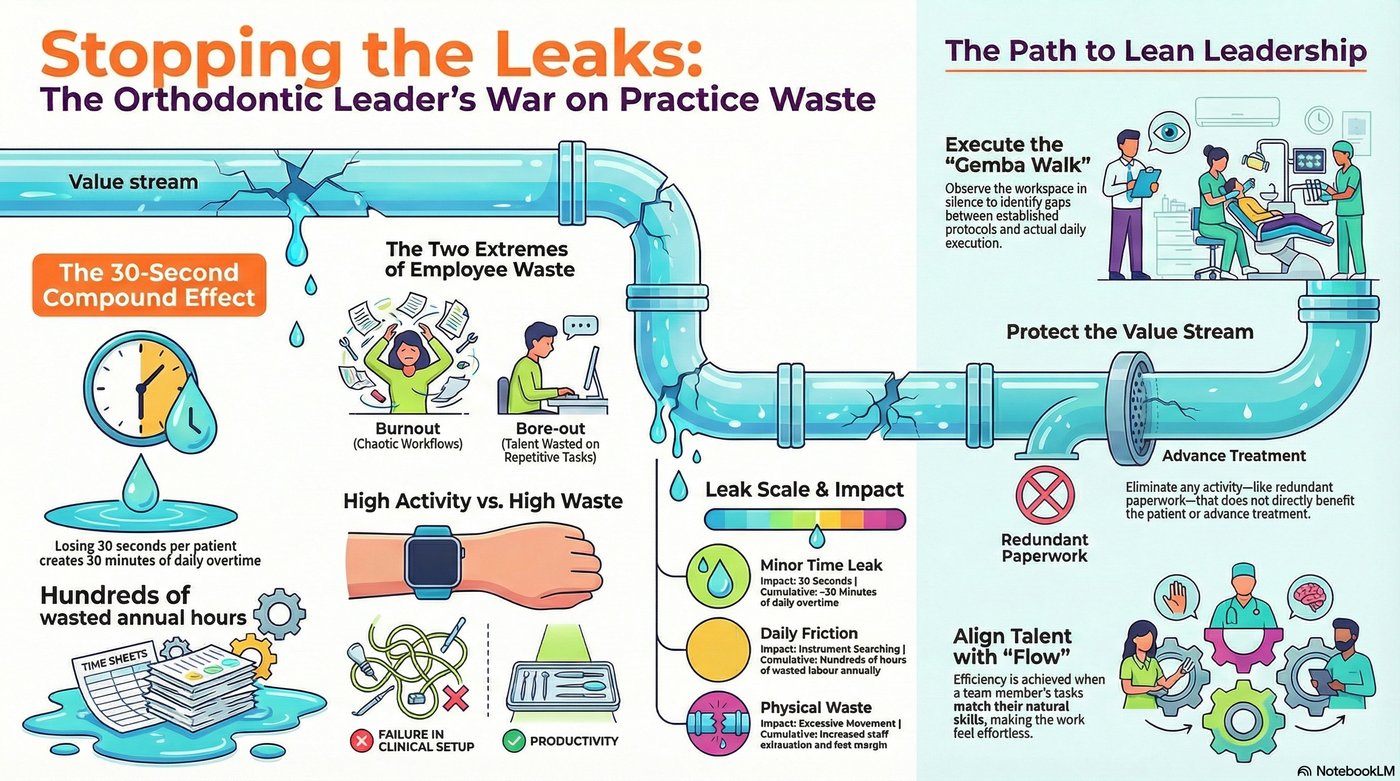
In the high-pressure world of orthodontic practice management, we often look for “big wins” to increase profitability—a new marketing campaign, a revolutionary appliance, or an additional treatment chair. However, true leadership in the modern clinic isn’t found in what you add but in what you eliminate. Most orthodontists are unaware of the microscopic “leaks” in their systems that silently drain the practice of its most precious resources: time, money, and human energy.
Losing just thirty seconds on a routine task might seem inconsequential. Yet, when multiplied by fifty patients a day, that single leak creates nearly half an hour of daily overtime. Over a year, this equates to hundreds of hours of wasted labor and thousands of euros in lost margin. To lead a truly high-performing practice, you must adopt a “Lean” mindset, identifying everything that does not contribute to the value stream.
Defining the Value Stream in Orthodontics
In lean management in dentistry, the “value stream” is the compact flow of value creation. It represents the core activities that directly benefit the patient and move the treatment forward. Anything outside of this stream—redundant paperwork, searching for instruments, or clarifying vague instructions—is, by definition, waste.
As a leader, your primary objective is to protect this stream. When we allow inefficient processes to persist, we create “employee waste.” This doesn’t just mean having too many people on the payroll; it refers to a situation where staff members are literally getting in each other’s way. This lead to two dangerous extremes: “burnout,” where the team is exhausted by chaos, or “bore-out,” where talent is wasted on repetitive, non-value-adding tasks, leading to disengagement and complacency.
Energy as a Quantifiable Practice Resource
We often talk about time as money, but in a clinical setting, energy is just as measurable. Consider the physical movement of the doctor and the team. If a clinician ends a day in a small cluster of treatment rooms with ten thousand steps on their smartwatch, they haven’t been “active”—they have been wasteful.
Excessive movement usually indicates a failure in the clinical setup. If an assistant has to leave the room to fetch a UV lamp because a bracket came off, that is a waste of physical energy, time, and patient trust. These small interruptions act as “frictions” that wear down the nerves of the team and the flow of the day. A lean leader designs the environment so that the work comes to the person, rather than the person chasing the work.
The Gemba Walk: Seeing the Reality of Your Clinic
To eliminate waste, you must first see it. One of the most powerful tools in dental leadership is the “Gemba Walk.” This is a practice where the leader goes to the “place where the work happens” and simply observes.
The key to a successful Gemba Walk is silence. You are not there to correct, instruct, or criticize in the moment. You are there to watch if the reality of the daily workflow matches your established protocols. Often, you will find that employees have developed their own “workarounds.” Sometimes these are wasteful shortcuts; other times, they are brilliant innovations that the rest of the practice should adopt. By observing quietly, you identify the gaps between your vision and the actual execution, allowing for targeted, data-driven improvements.
Solving Talent Waste through Flow
True practice efficiency is achieved when every team member is operating in a “flow state”—a condition where the task at hand matches their natural skills and feels effortless. Wasting talent is perhaps the most tragic form of waste in medicine.
As an employer, it is your responsibility to move people toward roles where they find work “easy.” A senior doctor with decades of experience may find the physical labor of chairside treatment exhausting but could provide immense value in treatment planning or team mentoring. By aligning talent with tasks, you retain your most loyal and experienced staff while maximizing the quality of the patient journey.
Conclusion: The Compounding Effect of Subtraction
Eliminating waste is not a one-time event; it is a continuous leadership commitment. By making tiny adjustments every day—shaving thirty seconds off a setup or removing a redundant administrative step—you create a massive compounding effect on your success.
When you stop the leaks, you don’t just increase profit; you create a more harmonious, relaxed, and professional environment for everyone involved. The goal of a lean leader is to create a practice where only the most effective processes and the most engaged people remain.