

The Invisible Ceiling: Why Your Practice Only Grows as Fast as You Do
Published on: Jun 11, 2026
In the orthodontic world, we are conditioned to value clinical CE above all else. We travel across the globe to master the latest bracket prescription or aligner protocol, yet we often neglect the most critical component of the entire operation: the person behind the doctor’s stool. This oversight is the root cause of stalled growth, high staff turnover, and consistent friction in the daily workflow.
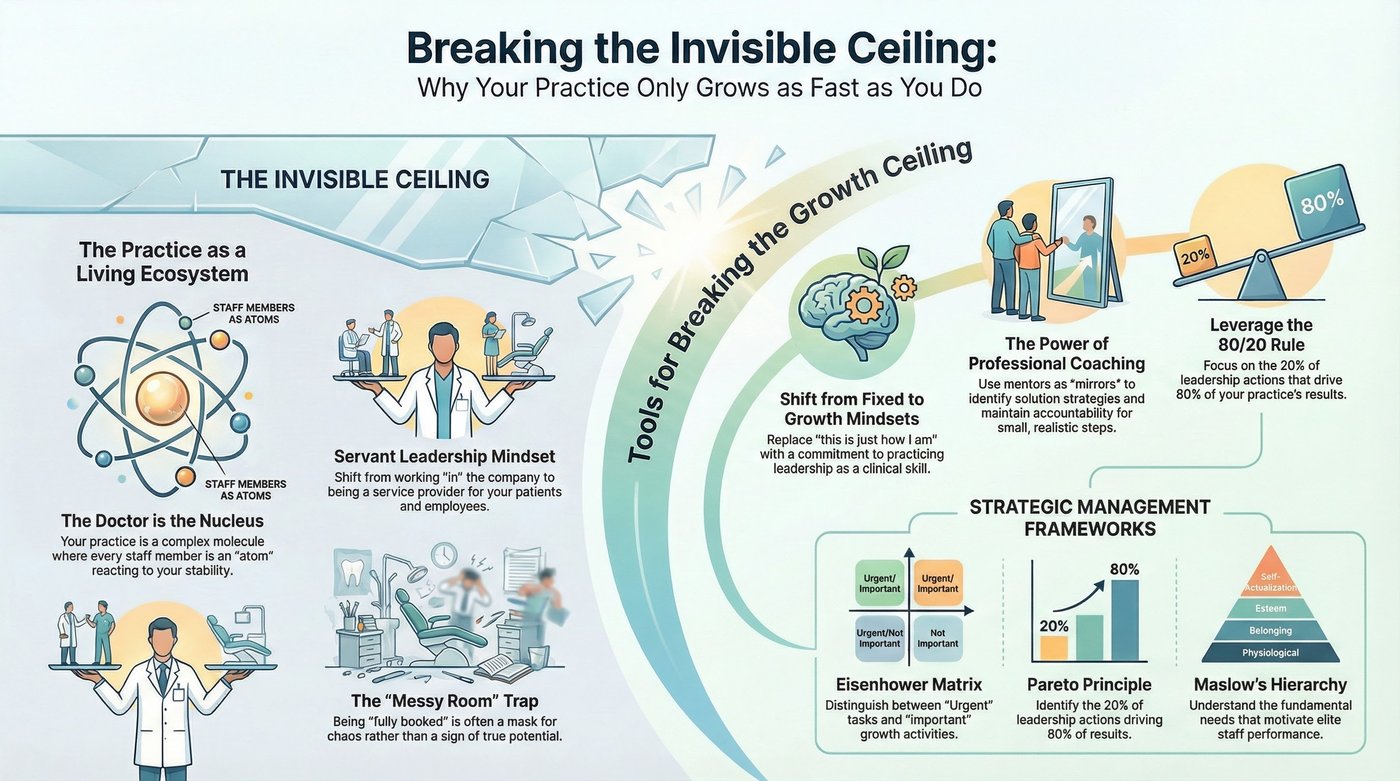
As Dr. Martin Baxmann often emphasizes, your practice is a living system—a complex molecule where every person is an atom in motion. You, as the head of this system, are the nucleus. When the nucleus isn’t stable and growing, the entire structure eventually hits an invisible ceiling, regardless of your clinical skill. The investment in your own psychological and behavioral growth often yields far greater returns than the next purely clinical course.
Leadership is not just an inherent personality trait; it is a clinical skill that must be practiced, refined, and updated just like your bonding technique. When you fail to work on yourself as a boss, you inadvertently become the primary bottleneck of your own success. This failure is often disguised as a “team problem” or a “market issue,” preventing the necessary internal reflection and strategic change.
The Practice as a Living Ecosystem
Every interaction within your clinic contributes to a specific equilibrium. When a team member leaves, a new task is introduced, or a crisis hits, the “atoms” of your practice rearrange themselves to find a new balance. Your personal development and emotional regulation directly determine whether that balance stabilizes at a higher, more efficient level or collapses into reactive chaos.
Consider the metric of Case Acceptance Rate. If you walk into the clinic radiating stress and fatigue, the “atoms” around you react with friction. That tension impacts the coordination between your Treatment Coordinator and the front desk, leading to inconsistent patient experiences and a drop in accepted cases. Conversely, entering with a growth mindset and contagious enthusiasm stabilizes the system and improves key performance indicators (KPIs).
This is the essence of servant leadership: recognizing that you are a service provider for both your patients and your employees. Your role shifts from being the chief technician to the chief strategist. To lead effectively, you must move from working in your company—performing all the procedures—to working on your company—designing the systems and developing the talent. This strategic shift allows you to delegate outcomes, not just tasks, and scale your overall impact.
Working on the company means establishing clear Standard Operating Procedures (SOPs) for every critical process, from new patient intake to inventory management. It means holding structured, purpose-driven daily huddles that focus on solutions rather than merely listing problems. By intentionally structuring the environment, you ensure the practice ecosystem is resilient and can absorb challenges without breaking equilibrium.
Moving Beyond the “Messy Room” Mindset
Many practitioners resist organizational change because their schedules are full. They equate being “fully booked” with being successful. However, being fully booked while struggling with chaos—long wait times, transcription errors, communication breakdowns—is unsustainable. This chaotic state is like a child claiming their room is “fine” despite hundreds of socks littering the floor. You are surviving in the mess, but you are not reaching your true potential, which lies in maximized efficiency and reduced non-clinical stress.
To break through this operational ceiling, you must embrace frameworks often dismissed as “corporate” but essential for sophisticated organizational design.
One is The Eisenhower Matrix: To distinguish between what is urgent (a broken appliance) and what is truly important for growth (revamping the new patient conversion script or developing next-level leaders). High-performing leaders aggressively schedule “important” tasks, blocking time for strategic planning that directly drives future capacity.
Another is The Pareto Principle (80/20 Rule): Identifying the 20% of your leadership actions that drive 80% of your results. For a practice, this means focusing on the core communication patterns that influence team morale or the few strategic services that generate the bulk of your revenue. This principle dictates where to invest your finite leadership energy.
Finally, integrating Maslow’s Hierarchy of Needs helps you understand what actually motivates your staff to perform at an elite level. Moving a team member beyond the base level of ‘safety’ toward ‘esteem’ and ‘self-actualization’ involves empowering them to own their department, contribute to process improvement, and specialize in advanced procedures. This cultivates engaged, loyal, and proactive leaders within your existing team.
The Role of Coaching and Mentoring
Working on yourself requires moving from a fixed mindset—”This is just how I am”—to a growth mindset, embracing the belief that skills, including leadership, can be acquired. This transition is rarely a solo journey; the systems that got you here cannot take you to the next level. Just as an elite athlete needs a personal trainer, a practice owner needs a coach or mentor to ask the difficult questions and challenge foundational assumptions.
A coach acts as a mirror, helping you see the solution strategies and blind spots you wouldn’t discover on your own. They introduce proven behavioral and systemic frameworks and keep you accountable to small, realistic steps, preventing the overwhelm that often accompanies practice-wide transformation. The most crucial function of a coach is forcing clarity on your “tolerations”—the small, persistent inefficiencies you’ve allowed to drain your energy and focus.
This professional development turns leadership from an abstract concept into a rational, objective system that yields predictable results. The return on investment for executive coaching is measurable, realized through decreased managerial stress, improved delegation, and a quantifiable reduction in staff friction. A clinical mentor helps you master a technique; a leadership coach helps you build a scalable practice capable of delivering that technique efficiently and consistently.
Conclusion: Lead with Intention
Personal growth as a leader is the ultimate leverage point for your practice. When you master the psychological cycles of behavior and the mechanics of clear communication, you create a stable, high-performing environment that attracts and retains top talent. This intentional development ensures your practice won’t just be a place where you work; it will be a dynamic, profitable reflection of your commitment to excellence.
The ceiling on your practice’s growth is often simply the distance between the leader you are today and the leader your practice demands you become. Stop waiting for the “perfect team” to arrive and start becoming the leader who can build one. The work starts now: identify your current leadership gaps, embrace these frameworks, and commit to the ongoing, non-clinical CE that will ultimately define your legacy.