

The Inconsistency Trap: Why Standardization is the Backbone of Your Practice’s Brand
Published on: Jul 4, 2026
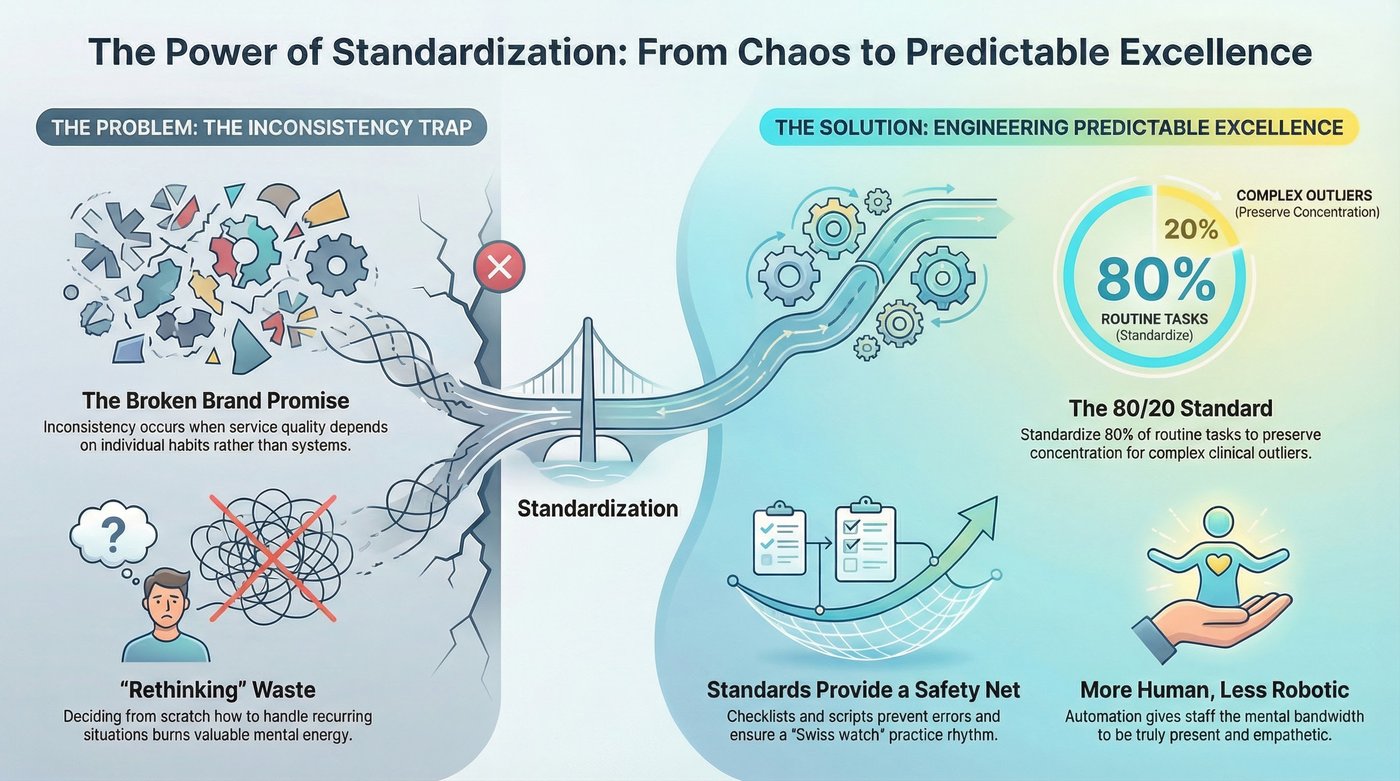
The Broken Brand Promise
Imagine a prospective patient visits your website. They see high-end clinical photography, glowing reviews, and a promise of cutting-edge technology. They are impressed and decide to call based on that digital first impression.
But when the phone rings, they are met with a stressed staff member who provides vague information and a disorganized booking process. In that moment, your brand promise is broken before they even step foot in your clinic.
This misalignment creates a “brand debt.” When the marketing suggests a premium boutique experience, but the administrative execution feels like a chaotic retail environment, the patient begins to doubt the clinical quality they haven’t even seen yet.
A broken promise at the start of the relationship is difficult to repair. It forces the doctor and clinical team to work twice as hard to regain the trust that was lost during a simple thirty-second introductory phone call.
In lean orthodontics, we recognize that inconsistency is the primary enemy of the patient experience. If the quality of your service depends on which staff member picks up the phone, you don’t have a system—you have a collection of individual habits.
To achieve true practice efficiency, you must implement standardization across every touchpoint of the patient journey in orthodontics. This means creating a “signature way” for everything from greeting to financial discussions.
Standardization ensures that whether a patient visits on a quiet Monday morning or a frantic Thursday afternoon, the level of care remains identical. It removes the “luck of the draw” factor from your clinical and administrative operations.
Without these guardrails, your brand is merely a reflection of your team’s current mood. With them, your brand becomes a reliable asset that produces predictable results, allowing you to scale your reputation with confidence.
Standardization vs. Roboticism: The Safety Net
A common misconception is that standardization makes a practice feel “robotic.” Doctors often fear that scripts and protocols will strip away the warmth and personality that built their local reputation in the first place.
In reality, the opposite is true. Standards provide the safety and security that allow your team to be more human. When the routine tasks are automated and predictable, your staff has the mental bandwidth to be truly present.
Consider a New Patient Coordinator who doesn’t have to wonder what forms to send or what questions to ask. Because the process is second nature, they can focus entirely on the patient’s tone of voice and emotional needs.
Standardization actually facilitates empathy. By removing the cognitive load of “what do I do next?” you enable your team to focus on the much more important question: “How is this patient feeling right now?”
Standards act as a safety net. Whether it is a checklist for tray setup or a specific script for handling financial inquiries, these tools ensure that nothing is forgotten during a high-volume afternoon in the clinic.
This structural approach to orthodontic practice management eliminates careless errors. It prevents the “missing instrument” delay that cascades through the entire morning schedule, putting the doctor behind and frustrating every waiting family.
When every team member follows the same operational blueprint, the practice develops a “Swiss watch” rhythm. This synchronicity is felt by the patients, who describe the office as “calm,” “professional,” and “organized” in their reviews.
Reliability is the foundation of luxury. By ensuring the basics are handled with flawless repetition, you create the platform upon which you can layer exceptional, personalized clinical care that truly differentiates your brand.
Eliminating the “Rethinking” Waste
One of the most significant forms of waste in a dental office is “rethinking.” This occurs whenever a highly trained professional has to pause and decide from scratch how to handle a recurring, predictable situation.
Take, for example, a loose bracket or a minor class II correction. If there isn’t a standardized clinical protocol, the assistant must stop to ask the doctor, and the doctor must stop their current task to provide repetitive instruction.
This “switching cost” is an invisible drain on your daily productivity. Every time you are interrupted to answer a question that a standard operating procedure (SOP) could have solved, you lose momentum and focus on the patient in front of you.
Standardization identifies these 80% scenarios and provides predetermined answers. This isn’t about cutting corners; it’s about respecting the value of the doctor’s time and the team’s ability to execute without constant micromanagement.
By having a precise, standardized path for the majority of your daily tasks, you preserve your concentration for the “outliers.” These are the rare, complex cases that actually require deep clinical reflection and your unique expertise.
When the “easy” tasks take up too much mental energy, you arrive at the “hard” cases with decision fatigue. This is when mistakes happen or when clinical creativity is stifled by the sheer exhaustion of managing practice chaos.
Standardization allows the rest of the practice to run on autopilot. It keeps the doctor in the “fast lane,” moving seamlessly between chairs because the environment around them is stable, prepared, and entirely predictable.
Ultimately, your role as the leader is to solve problems that only you can solve. A standardized practice protects your ability to do that, ensuring that your best clinical work is never compromised by administrative or operational friction.
Conclusion: Engineering Predictable Excellence
Implementing standards is the first step toward becoming a proactive leader and entrepreneur. It signals a shift in mindset from being a technician who works in the business to a visionary who works on the business.
This move takes your practice from a state of reactive chaos to one of predictable excellence. It builds a legacy that is based on systems rather than your physical presence at every single micro-decision throughout the day.
By defining exactly how your practice operates, you ensure that your brand promise is kept every single time the phone rings or a patient sits in your chair. You are no longer hoping for a good day; you are engineering one.
Standards are the backbone of a premium brand. They are the invisible force that turns a simple clinic into a local institution, providing the consistency that patients crave and the efficiency that allows your practice to thrive.