

The Implementation Gap: Why Your Training Fails and How to Fix It
Published on: Jun 21, 2026
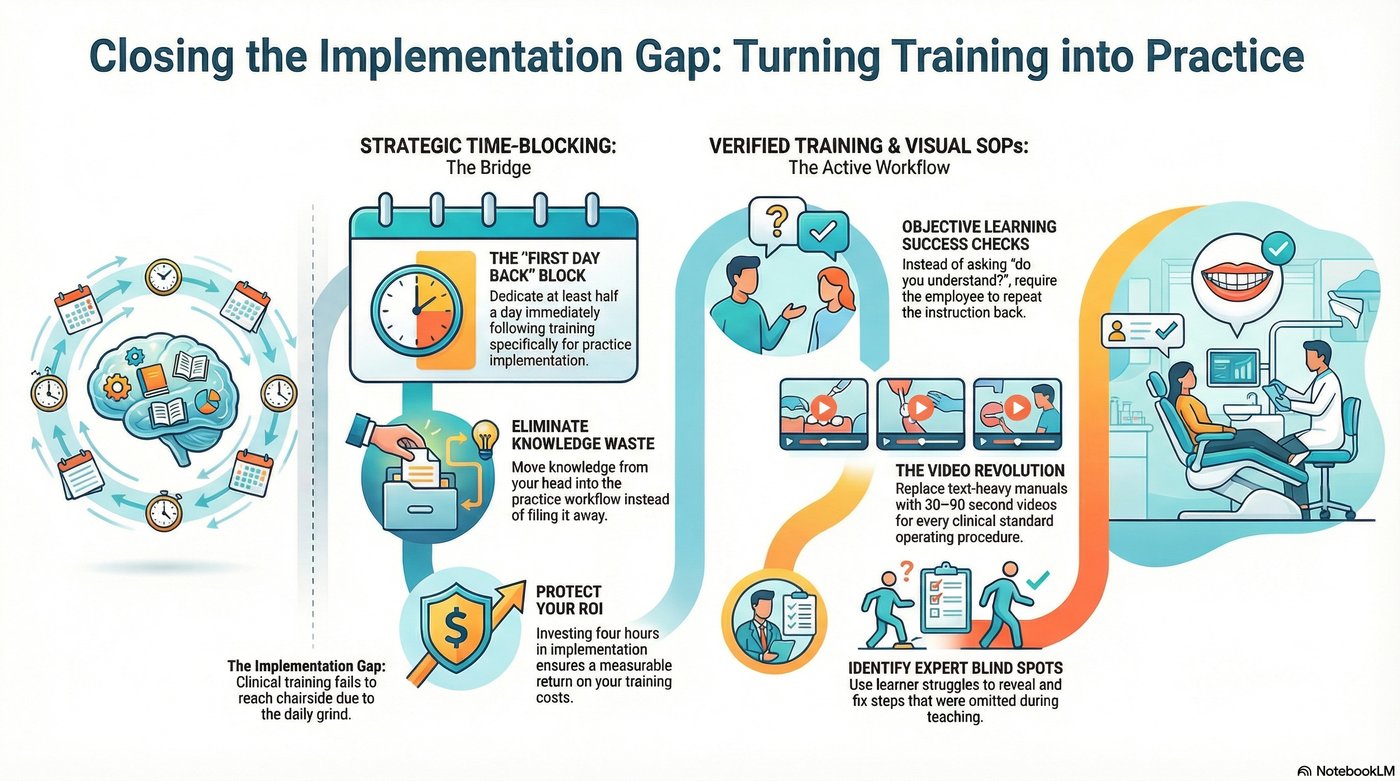
In the pursuit of orthodontic excellence, we invest thousands of euros and countless hours in continuing education. We attend “Power Weeks,” fill notebooks with strategies, and return to the clinic on Sunday night fueled by inspiration. Yet, by Wednesday, the notebook is buried, and the “hamster wheel” of daily appointments has crushed the momentum of change. In Lean Orthodontics, this is the ultimate form of knowledge waste.
This cycle of enthusiasm followed by operational stagnation is a common failure point, even in the most ambitious practices. This “implementation gap” is where profitability erodes and team frustration mounts. It is not a lack of commitment but a failure of leadership to design a system that actively supports behavioral change within the busy clinical environment. We must treat new knowledge as a strategic asset, not just a feel-good expense.
I am Dr. Martin Baxmann, and I have realized that the most dangerous illusion in practice management is the belief that explanation equals implementation. To transform your practice, you must bridge the gap between “knowing” and “doing” by creating a structured environment that prioritizes the transfer of knowledge over the simple collection of credit points.
The First Rule of Knowledge Transfer: The “First Day Back” Block
The primary reason new processes fail is a lack of time. Most clinicians feel guilty about being away from the chair, so they schedule a “marathon Monday” starting at 6:00 AM. This is a strategic error. When you book a training course, you must simultaneously block out at least half a day on your first day back for implementation time.
The purpose of this protected block is to prevent immediate re-entry into the operational chaos that the training was meant to solve. This dedicated window allows for critical, high-leverage activities that convert abstract concepts into tangible, practice-specific workflows. For instance, a new patient communication script learned at a conference must be immediately adapted and loaded into the scheduling software.
This quiet time is not a luxury; it is the only way to move knowledge from your head into the practice’s actual workflow. Use this block to update your digital manuals, brief your team on new protocols, and prepare the necessary materials. This focused session should be mandatory, with no exceptions for emergency appointments or walk-ins.
The ROI of those few hours is massive. Closing the practice for an extra four hours won’t drive you into bankruptcy; it is the investment required to ensure your training delivers a measurable return on investment (ROI). Furthermore, the leader’s act of prioritizing implementation sends a powerful cultural signal: new systems are important enough to temporarily halt daily operations for their successful integration.
From Subjective Nods to Objective Checks
In the daily rush, we often ask our team, “Did you understand?” and receive a reflexive “Yes”. We assume alignment, but when mistakes happen later, we realize the instruction was never truly absorbed. Employees rarely admit confusion because they do not want to look incompetent.
This subjective dynamic creates a liability loop where potential clinical errors are silently incubated. A “yes” is a psychological comfort, but it is never a confirmation of true competence. In a high-stakes setting like orthodontics, an incorrect understanding of, for example, new sterilization protocols or appliance seating can lead to immediate and costly complications.
To eliminate this bottleneck, we must move to Objective Learning Success Checks. Instead of asking if they understand, ask the employee to repeat the instruction in their own words. This simple “repeat-back” reveals gaps in understanding immediately—before a single bracket is placed or a single scan is taken.
The most powerful objective check is a practical demonstration in a simulated or low-stakes environment. If a new patient flow is implemented, ask a staff member to walk through the entire sequence, explaining the why behind each action. This approach distinguishes between simple rote memorization and the true mastery needed for independent decision-making under pressure.
The Video Revolution: Short-Form Standard Operating Procedures
In a lean practice, we have replaced heavy, text-based manuals with short, punchy videos (30–90 seconds long) for every Standard Operating Procedure (SOP). Visual learning is significantly more effective for clinical tasks than reading a binder.
This digital shift leverages how modern teams consume information, moving from passive consumption to active, visual engagement. Short videos provide immediate, reliable visual cues—such as the precise angulation required for a mirror during a photo series—that dense text simply cannot replicate. This feature drastically reduces the learning curve for complex clinical and administrative skills.
The video serves as a “perpetual teacher”. When a new employee is trained, they watch the video, observe the demonstration, and then perform the task. This creates a powerful feedback loop. If the learner struggles with a specific step, it often reveals an expert blind spot—a part of the process that was so “obvious” to the teacher that it was left out of the video.
A successful video SOP library must be dynamic and easily accessible, housed in a centralized location like an internal wiki or private cloud folder. Team members should be empowered to flag videos that are outdated or unclear. This transforms the training materials from a management burden into a collaborative tool for continuous operational excellence and shared knowledge refinement.
Conclusion:
Bridging the implementation gap requires a systematic shift in how clinic leaders approach professional development. By institutionally protecting the “First Day Back” Block, demanding objective confirmation of understanding through practical checks, and adopting a modern, video-based SOP library, the practice ensures educational investment translates into superior operational efficiency. The true measure of a successful training program is not the collection of credit points but the sustained, measurable positive change observed in the daily clinical reality.