

The Human Side of Lean: Empathy and Gratitude as Clinical Tools
Published on: Jul 2, 2026
Redefining Empathy in the Orthodontic Clinic
Lean management in dentistry is often misunderstood as a cold, mechanical pursuit of efficiency. Critics fear that “timing the steps” strips the soul from the patient-doctor relationship. However, true Lean practitioners know that waste is anything that doesn’t add value to the patient.
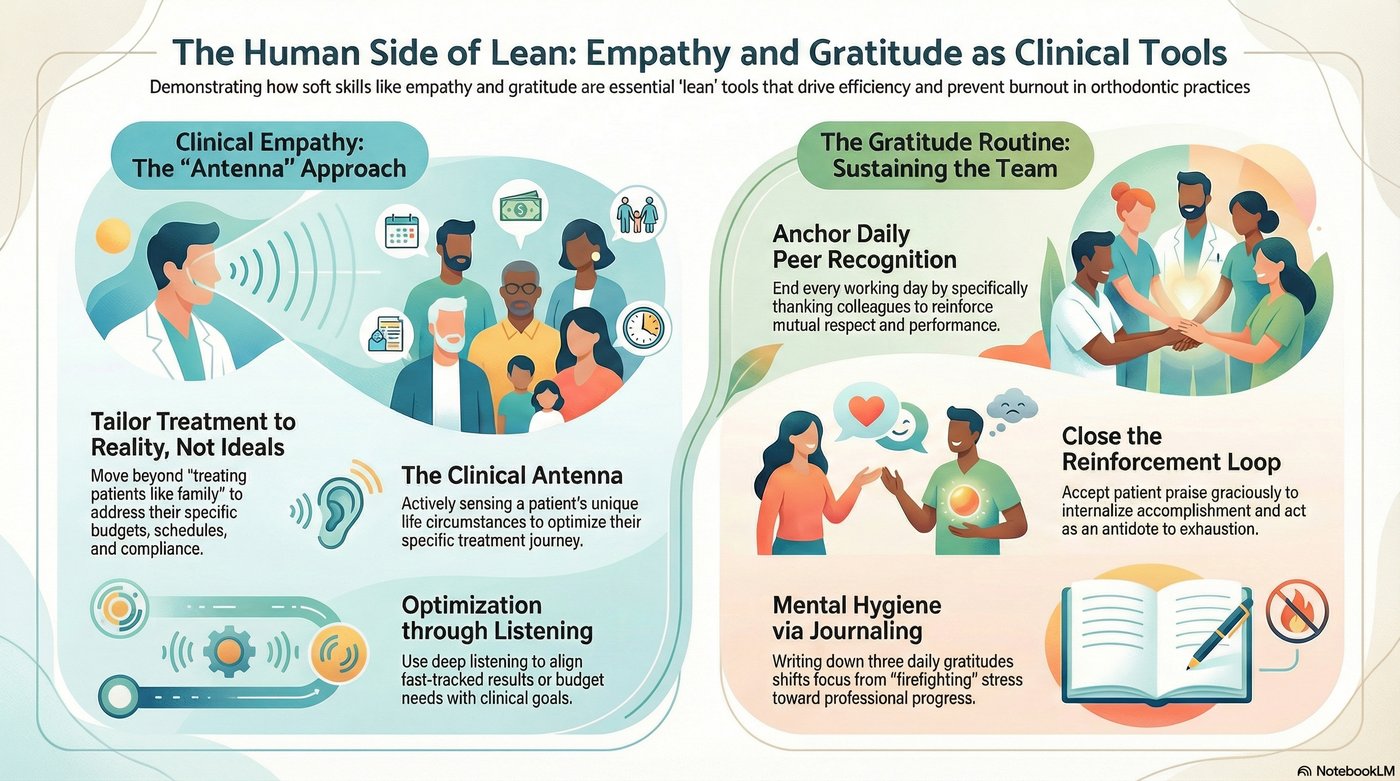
Empathy is the most precise tool for identifying value. It is not about simply being “nice.” In a clinical setting, empathy is the active process of “putting out your antenna” to capture a patient’s hidden needs. It is the diagnostic step for the patient’s life, not just their teeth.
Consider a teenager who seems uncooperative with aligners. A non-empathic Lean approach might label this as “compliance waste.” An empathic approach discovers that the student is overwhelmed by exam stress. By adjusting the protocol to their reality, we eliminate the waste of a failed treatment cycle.
Clinicians often say, “I treat everyone like my own child.” While well-intentioned, this is a clinical trap. Your child has your values and your budget. Your patient has theirs. True clinical empathy means building a treatment plan that respects the patient’s actual circumstances and goals.
The Gratitude Routine: Ending the Day on a High Note
High-performance dental teams are fueled by psychological safety and recognition. Gratitude is the mechanism that maintains this fuel. It must be transformed from a spontaneous feeling into an anchored, daily routine within your practice management workflow.
At the end of a grueling clinical day, the default is to focus on the one difficult case or the broken bracket. A leadership-focused gratitude routine forces the brain to scan for the wins. This isn’t toxic positivity; it is strategic mental hygiene for professional longevity.
Take three minutes before leaving the office to specifically thank three colleagues for their support. “Thank you for handling that emergency call so I could stay focused on the patient” is more powerful than a generic “good job.” It reinforces the specific behaviors that drive efficiency.
Crucially, we must also learn to accept gratitude from our patients. Many practitioners reflexively dismiss praise with “It was nothing.” By doing so, you devalue the team’s effort. Instead, say, “Thank you, the team worked hard to make this happen for you.” This validates everyone involved.
The Positive Reinforcement Loop
We once conducted an experiment where assistants were instructed to say a simple “here you go” or “you are all set” after completing a procedural step. This small verbal cue naturally triggered a “thank you” from the patient. This isn’t just polite; it’s a feedback loop.
When the team hears those two words repeatedly throughout the day, it serves as a micro-recharge. It reminds them that their technical tasks—like changing an archwire or taking an impression—have human value. This loop reduces the “factory-line” feeling that sometimes plagues busy clinics.
To maintain this perspective, keep a gratitude journal. Each evening, write down three specific professional accomplishments. This shift in focus is essential for those in high-pressure leadership roles. It moves you from a state of “firefighting” to a state of intentional progress.
Conclusion: The Path to Professional Fulfillment
Efficiency and empathy are not at odds; they are the two sides of the same coin. A practice that is efficient but cold will suffer from high staff turnover and poor patient retention. A practice that is empathic but disorganized will suffer from burnout and financial instability.
The “oil” that keeps the gears of a Lean practice turning smoothly is the human connection. By practicing active gratitude and clinical empathy, you enhance the satisfaction of your team and your patients. These tools allow you to reclaim the joy and purpose of your craft.
Leadership in the modern dental world requires more than technical skill; it requires the emotional intelligence to lead a team through the complexities of patient care. Start today by thanking a colleague and listening more deeply to a patient. The results will be reflected in your clinical outcomes.