

The Heat of Progress: Why Conflict is Essential for Practice Growth
Published on: Jun 1, 2026
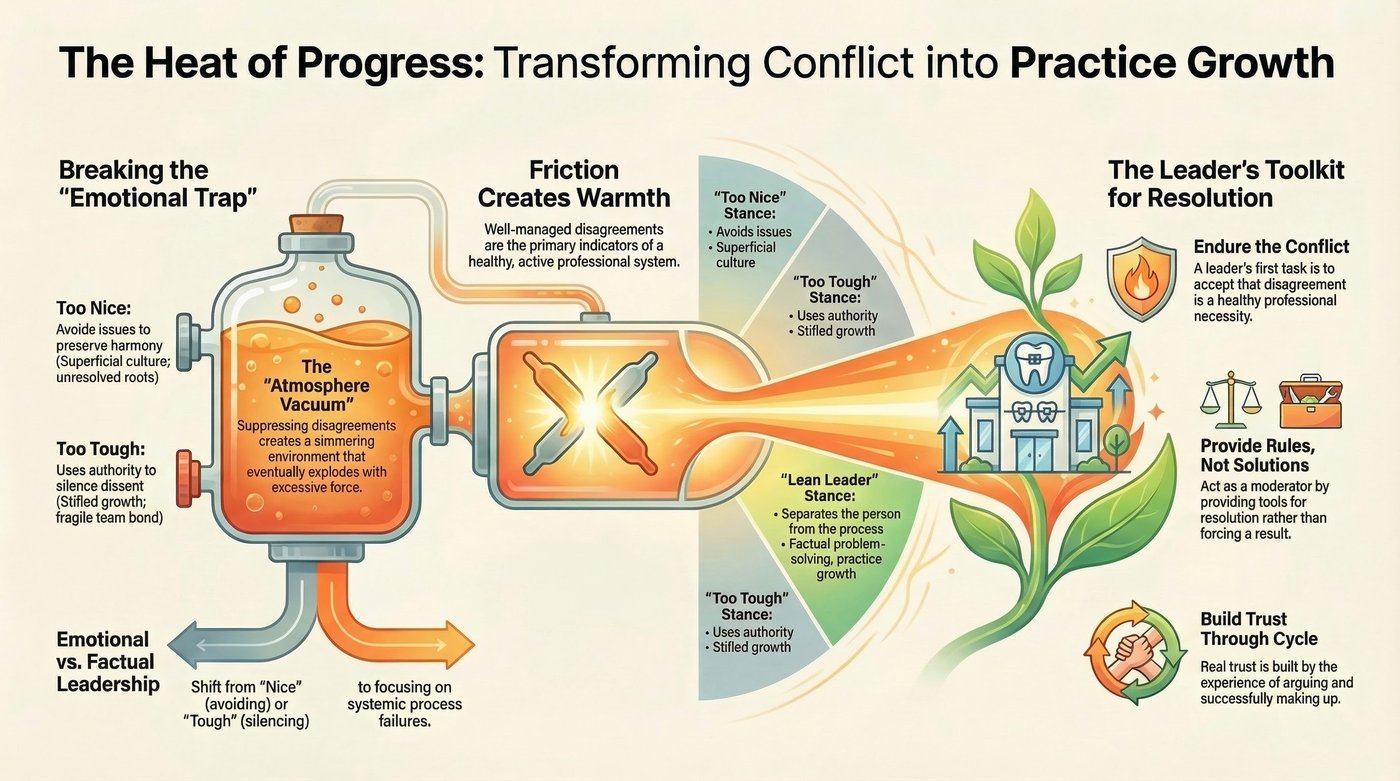
In many orthodontic and dental clinics, conflict is treated like a clinical emergency—a fire that must be extinguished immediately to maintain a perceived “nice” or tranquil atmosphere. This common reaction stems from a fear that any internal disagreement will translate into patient dissatisfaction or team turnover. However, as Dr. Martin Baxmann wisely observes, if you consistently suppress every disagreement and sidestep productive tension, you inadvertently eliminate the necessary heat required for professional growth and innovation.
Real, sustainable progress in high-level dental practice management doesn’t emerge from a total absence of friction; it arises from a leadership team learning how to not only endure that friction but strategically channel it, turning raw tension into a constructive, measurable force for the entire team. For a practice owner focused on scaling and efficiency, the objective is never to avoid conflict, but to master its execution.
To successfully lead a high-performing clinic—whether it specializes in clear aligners, complex restoratives, or advanced pediatric care—we must move beyond the emotional, reactive trap of being merely “nice” or “tough”. The shift must be toward embracing the objective, factual level of systems and problem-solving. When conflict is managed with clarity and intentionality, it ceases to be a disruptive event and becomes, instead, the vital, sometimes challenging, birth of a more robust and resilient practice culture, capable of adapting to market changes and clinical demands.
The “Atmosphere Vacuum”: Moving from Emotional to Factual
Many practice leaders and practitioners eventually find themselves mired in a simmering “bad atmosphere” where the uncomfortable truth, whether about clinical throughput or front-desk inefficiencies, is rarely spoken. This creates an Atmosphere Vacuum—a silent space where small issues fester and grow. Often, the practice owner, seeking to preserve harmony, tries to ignore the accumulating problem, hoping it will simply vanish. This strategy inevitably fails, leading the frustrated leader to eventually “explode” with excessive, disproportionate force when the annoyance or systemic failure becomes too much to bear.
The fundamental mistake in this cycle is rooted in staying confined to the emotional level of connection. This is where leaders default to personality-based reactions:
Being “Too Nice”: This involves avoiding the core issue entirely to preserve a superficial, temporary harmony. It sacrifices long-term success for short-term comfort.
Being “Too Tough”: This is using authoritarian power or position to silence dissent or perceived resistance without truly solving the underlying root cause. It creates compliance, not commitment.
A truly lean and effective practice leader understands the necessity of separating the person from the process. By intentionally moving the conversation to the factual level, you gain the necessary distance to address the systemic failure in the patient intake protocol or the clinical handoff process, rather than attacking the individual’s character or work ethic. This friction, when focused on objective data—like scheduling errors, supply shortages, or lab turnaround times—creates constructive warmth. In a stable professional bond, well-managed, protocol-focused disagreements are the clearest signs of a healthy, actively self-correcting system.
The Leader as a Professional Moderator
Your primary task as a practice owner—your highest leverage activity in this scenario—is to endure the conflict without reacting emotionally or taking sides. You must mentally prepare yourself for the fact that professional disagreements are a healthy, even expected, symptom of a high-growth professional environment. Instead of instinctively fearing the argument or the raised voices, your role is to act as a neutral, professional moderator, a process expert.
A good moderator’s goal is to provide the “Rules and the Tools” for self-guided resolution within the team, rather than dictating the solution itself. This empowers team members and embeds problem-solving skills into the practice’s DNA.
Listen Actively and Confirm Understanding: Ensure all conflicting parties feel genuinely heard, validated, and understood, thereby lowering emotional defenses, without the leader taking a definitive side. Use mirroring techniques to confirm what they said, focusing on facts and impacts.
Identify the “Trigger” and Root Cause: Immediately determine if the conflict is about an interpersonal personality clash or if it is the result of a specific, flawed clinical or administrative protocol. Ninety percent of the time, the trigger is a process failure, not a people failure.
Encourage Directness and Process Ownership: Guide the team members to speak directly to each other, using the factual problem as the focal point, before escalating the issue to the “higher court” of management. This fosters accountability and peer-to-peer respect, minimizing reliance on the leader for arbitration. This step is critical for developing a truly autonomous team capable of self-management.
Conclusion: Building Trust through Resolution
The foundational principle of a thriving dental practice culture is not zero conflict but effective resolution. Trust within a high-performing team is never built in a vacuum of forced silence; it is forged through the shared, sometimes difficult, experience of engaging in a necessary argument and successfully, professionally, resolving the issue. This reliable, predictable cycle of conflict identification, moderation, and resolution is the empirical evidence that proves a team structure is stable, mature, and built to last.
When you, as the leader, cease trying to suppress the inevitable “heat” of friction and instead begin channeling that energy toward defined procedural improvement—whether that’s revising hygiene recall protocols or optimizing patient flow—you fundamentally transform your practice. It moves from being a fragile group of reactive individuals who avoid tough conversations into a synchronized, highly accountable, self-healing team focused on peak performance. Conflict, therefore, is not the problem; it is the untapped resource for unparalleled practice growth.