

The Gift of Dissatisfaction: Using Patient Feedback as a Tool for Lean Improvement
Published on: Jun 14, 2026
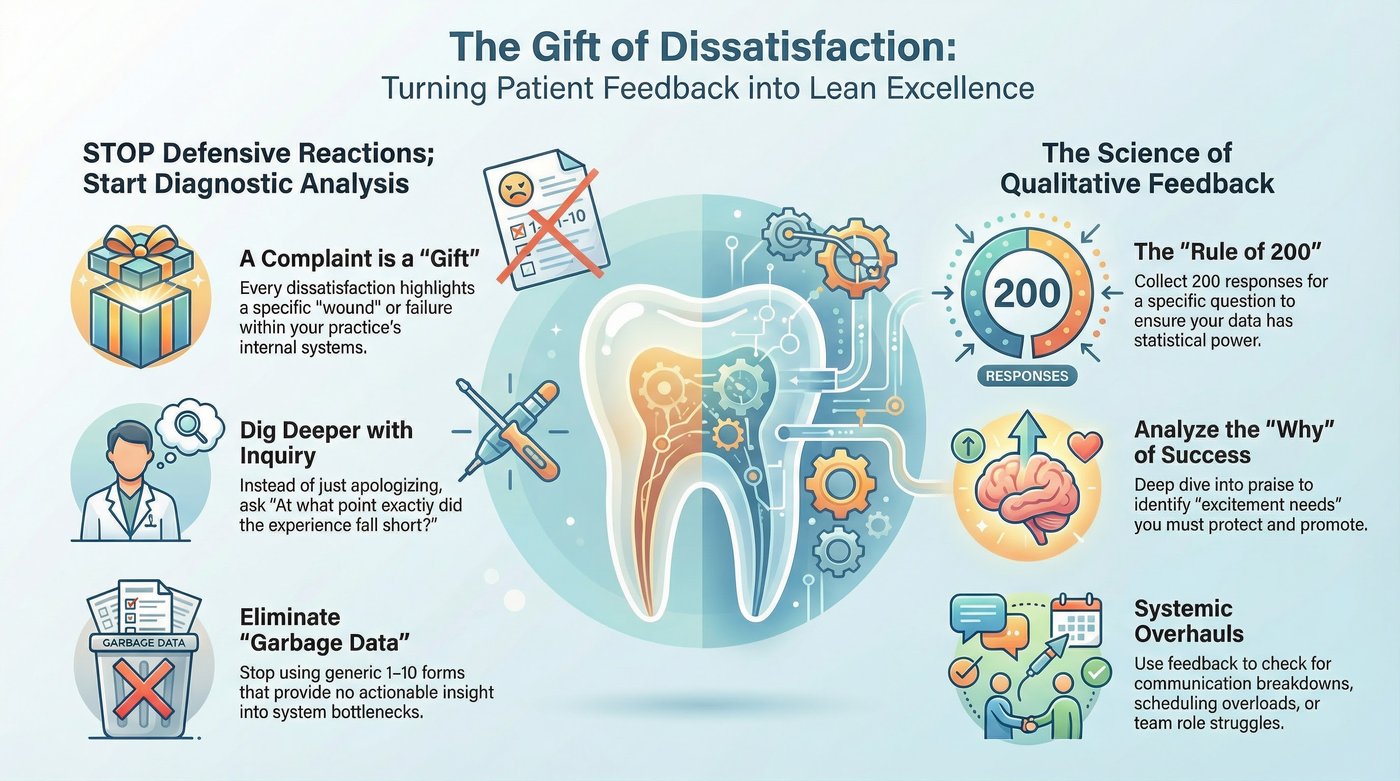
In Lean Orthodontics, “waste” (Muda) is any process that fails to add value to the patient. Generic satisfaction surveys often produce “garbage data” that lacks the granularity needed for meaningful change.
To achieve operational excellence, leadership must treat feedback as a high-fidelity diagnostic tool. Negative responses reveal the specific points where your clinical or administrative systems are fracturing.
A practice that ignores subtle friction is destined for stagnation. We must actively hunt for dissatisfaction to identify hidden bottlenecks that hinder the patient journey and reduce overall clinic throughput.
When a patient complains about wait times or a confusing financial discussion, the typical response is defensive. Many doctors simply apologize or offer a discount to “make the problem go away” quickly.
However, an apology without root-cause analysis is a wasted opportunity. In a lean culture, a complaint is a gift. It acts as a spotlight, illuminating a specific failure in your documented workflows.
Analyzing the Friction: Why Complaining is a Gift
Leadership requires setting aside the ego to find the grain of truth in every critique. If a parent is unhappy with their child’s progress, it often reveals a gap in your clinical communication protocols.
When friction occurs, move past the “what” and into the “why.” Ask the patient: “At what exact moment did you feel the experience fell short of your expectations?” This identifies the specific touchpoint failure.
Often, frustration is not about the clinician but the system supporting them. Complaints usually point to a failure in team performance or a significant bottleneck in daily practice efficiency.
Is the scheduling template misaligned with the actual procedure times?
Is there a recurring breakdown in the hand-off between the treatment coordinator and the clinical assistant?
Is a specific team member lacking the training or resources to execute their role effectively?
By treating every grievance as a case study, you convert a liability into an asset. You are no longer just troubleshooting; you are performing a Kaizen event to ensure the error never recurs.
The “Science” of Data Collection
Data-driven decisions require a statistically valid sample. Many practices make the mistake of reacting to a single loud voice without verifying if that voice represents a broader trend.
In lean management, we seek patterns, not just anecdotes. If one patient complains about parking, it might be a bad day. If ten do, it is a system failure requiring attention.
Instead of open-ended surveys, set a specific data goal. For example, decide to track a single metric—like “Clarity of Post-Op Instructions”—until you have 200 responses to achieve statistical power.
This quantitative approach allows leadership to distinguish between an isolated human error and a systemic flaw. It provides the objective evidence needed to justify changes in training or technology.
Qualitative Praise: Knowing Why You Win
Success leaves clues, and praise should be subjected to the same rigorous analysis as complaints. When a patient says, “I love this place,” that is only the beginning of the inquiry.
Ask them: “What specific action did we take today that made you feel that way?” This uncovers your “excitement needs” as defined by the Kano model—the things that truly delight patients.
If patients consistently mention the “digital workflow” or “on-time starts,” you know exactly where to double down. This clarity prevents the team from wasting energy on “value-added” tasks that patients don’t actually care about.
Building a Culture of Continuous Improvement
Transitioning from generic “satisfaction” to scientific “inquiry” fundamentally shifts your practice culture. It signals to your team that you prioritize objective truth over temporary comfort.
Eliminate “Garbage” Data: Replace broad 1-10 scores with specific, actionable questions regarding specific patient touchpoints.
Identify the “Vital Few”: Isolate the top three system improvements that would yield the highest increase in patient value.
Standardize Feedback Reviews: Make feedback analysis a weekly leadership ritual rather than an occasional reaction to a crisis.
Engage the Front Line: Empowers the staff to collect qualitative insights during the “Gemba walk” of clinical operations.
Conclusion: Engineering a Better Practice
Successful practice management is not a finish line; it is a cycle of constant iteration. By using sophisticated feedback loops, you stop guessing and start engineering a practice that delivers excellence by design.
Every patient interaction provides a data point to trim waste and amplify value. The most resilient dental practices are those with the humility to listen to dissatisfaction and the discipline to use it for growth.