

The General Dentist’s Blueprint for Orthodontic Success: Integration Without Overwhelm
Published on: Jun 24, 2026
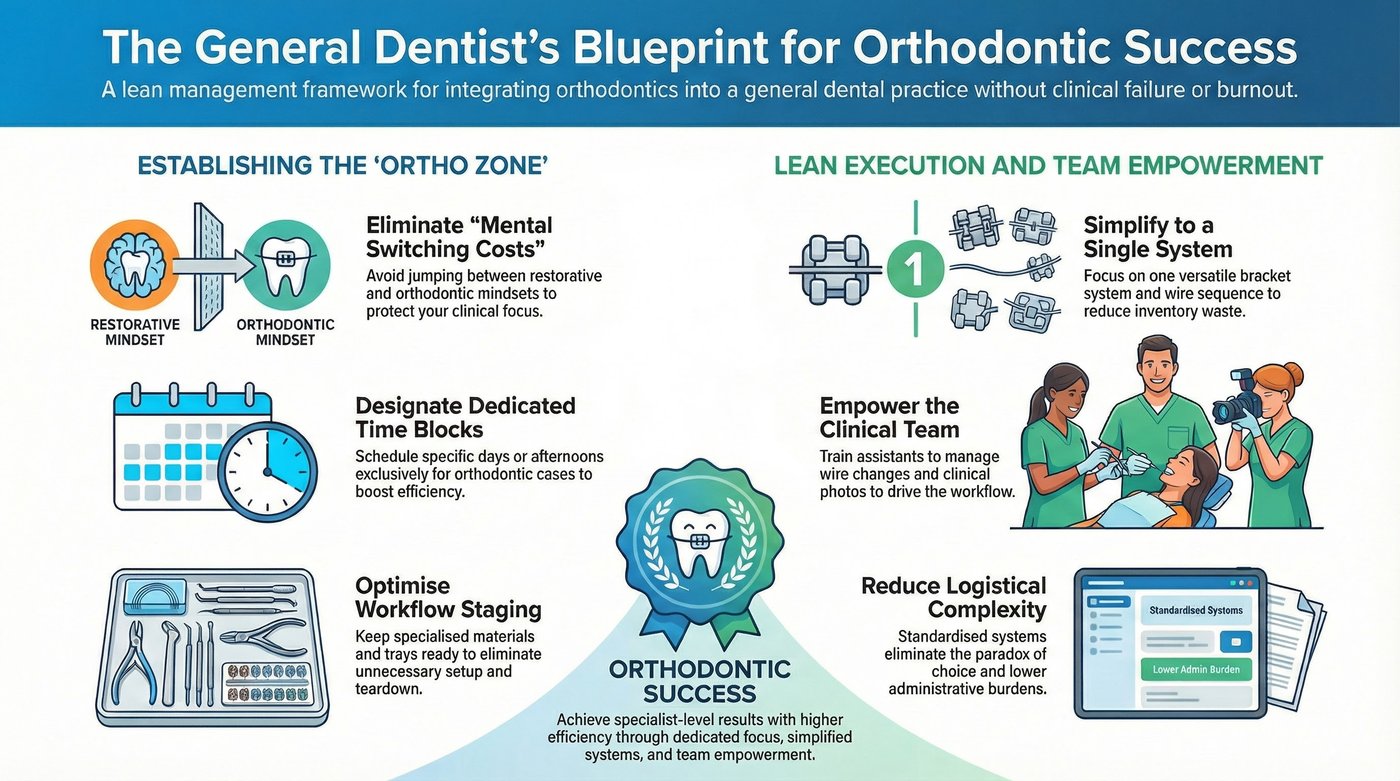
Many general practitioners see orthodontics as an attractive “side hustle” to increase revenue. However, treating orthodontics as a casual addition to a busy restorative schedule is a recipe for clinical failure and professional burnout. When you jump from a complex crown preparation to a bracket adjustment and then back to an endodontic procedure, you are paying a massive “mental switching cost”.
This rapid transition between completely distinct procedural protocols and material setups introduces cognitive drag and increases the potential for preventable errors.
The failure to establish a dedicated system is a business flaw, not a clinical one. Many practices underestimate the time lost in re-sterilization, material retrieval, and the doctor’s necessary re-orientation to the specialty.
I am Dr. Martin Baxmann, and together with insights from my colleague Dr. Christian Hertwig, I want to share the lean blueprint for integrating orthodontics into your general practice. To succeed, you must move away from “dabbling” and toward a structured, departmentalized approach that protects your focus and ensures specialist-level results. This strategic shift turns orthodontics into a predictable, profit-generating department.
The Power of the “Ortho Zone”: Dedicated Scheduling
The most significant barrier to efficiency in a hybrid practice is a fragmented schedule. In lean management, we strive to eliminate “unnecessary motion”—this includes the mental motion of switching between entirely different clinical mindsets. In the operational context of a high-volume dental office, motion waste translates directly into extended chair time and lower daily production.
The solution is to designate specific days or blocks exclusively for orthodontics. For example, you might start with one afternoon a week and expand to two full days as your case load grows. This isn’t just a scheduling preference; it’s a non-negotiable operational anchor that maximizes your clinical and team readiness.
When you dedicate a Thursday and Friday solely to orthodontics, your entire team enters the “Ortho Zone”. The specialized trays are already out, the materials are staged, and your mental energy is entirely focused on one discipline. Furthermore, your front-office staff is trained to communicate the dedicated schedule to patients, leading to better compliance and fewer late arrivals or cancellations, which often plague general dentistry schedules. This specialization allows your efficiency to skyrocket and reduces the stress of constant setup and teardown throughout the day. By “batching” procedures—such as performing all initial bondings in the morning block and all adjustments in the afternoon—you achieve superior muscle memory and clinical flow, minimizing waste.
Reducing Complexity: The Lean Inventory Strategy
Traditional orthodontic education often overwhelms practitioners with a dizzying array of bracket types, wire sequences, and auxiliary tools. A general dentist trying to stock 10,000 different items will quickly drown in logistical waste and inventory costs. The inventory burden of multiple systems often includes dead stock, expired materials, and unnecessary ordering complexity, directly eroding profitability.
A lean practitioner achieves excellence through simplification. By adopting a streamlined, high-performance inventory—focusing on a single, versatile bracket system and a standardized wire sequence—you eliminate the paradox of choice. This simplicity allows the practice owner to minimize capital tied up in inventory and ensures that only proven, high-quality materials are used consistently.
You no longer have to wonder which wire to use next; the system makes the decision for you. For instance, choosing a clear aligner system or a single, high-tech self-ligating bracket across 90% of cases simplifies training and ordering dramatically. This reduction in complexity is what allows a general dentist to achieve predictable, high-quality results without the administrative burden of managing a massive orthodontic warehouse. Simplification is the ultimate key to quality control, as it reduces clinical variables that could lead to unforeseen treatment complications or poor outcomes.
Ownership and Competence: Empowering the Clinical Team
You cannot integrate orthodontics in isolation; your team must be the engine of the workflow. If your assistants only see orthodontics as “extra work” they don’t understand, they will inadvertently create bottlenecks. These bottlenecks often manifest in poor record-keeping, slow chairside assisting, or ineffective patient education, all of which delay treatment and frustrate patients.
Leadership in a hybrid practice means investing in hands-on team training. This training should designate a dedicated “Ortho Lead Assistant” who is responsible for inventory management, patient records, and chairside setup. This individual becomes the practice’s internal expert and a crucial accountability partner for the doctor.
When your staff understands how to change wires, capture high-quality clinical photos, and manage the patient’s progress, they transition from passive helpers to active drivers of the orthodontic department. This competence breeds enthusiasm. When your team feels confident in the “Ortho Zone,” they provide a superior patient experience, which is the ultimate driver of internal referrals and practice growth. Empowered team members can handle routine issues, improve patient compliance with hygiene and elastic wear, and free the doctor to focus solely on diagnosis and complex adjustments, maximizing clinical efficiency.
Conclusion
The successful integration of orthodontics into a general practice is fundamentally a leadership and operational challenge, not purely a clinical one. By intentionally moving away from fragmented, multi-disciplinary scheduling and adopting a dedicated “Ortho Zone,” practitioners eliminate cognitive drag and maximize clinical readiness.
This strategic efficiency, coupled with a lean inventory strategy that prioritizes simplification and high-quality standardization, reduces administrative complexity and ensures predictable patient outcomes. Ultimately, success hinges on empowering a competent “Ortho Lead Assistant” who acts as the engine of the department. Embrace this structured blueprint to transform orthodontics from a stressful ‘side hustle’ into a profitable, high-value component of your practice, securing both professional focus and superior patient care.