

The “Gemba Walk”: Why the Secret to Practice Growth is Hiding at Your Front Desk
Published on: Jun 22, 2026
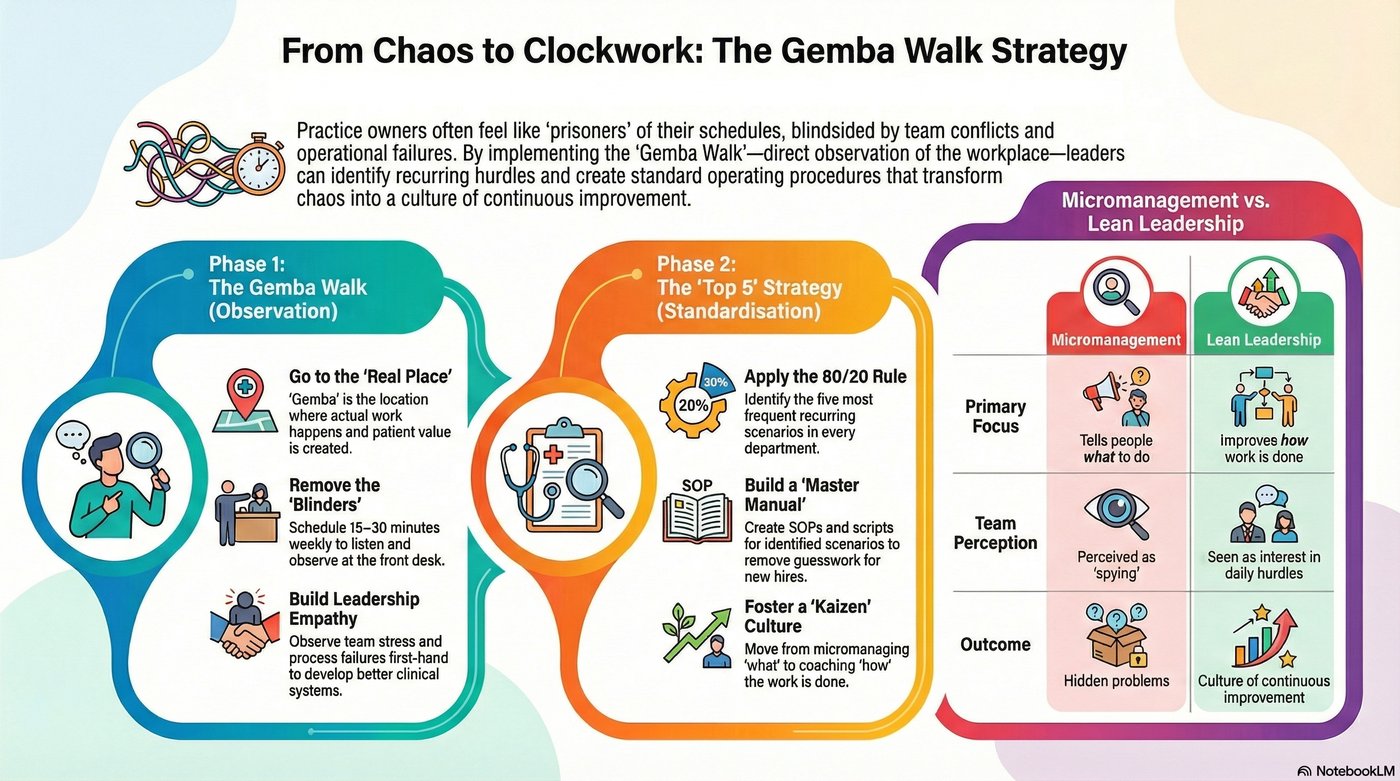
Many orthodontic practice owners feel like prisoners in their own clinics. They are constantly “pushed” by their schedules, blindsided by team conflicts, and only find out about operational failures when it is far too late to prevent them. If you feel like you are losing control of your clinic’s efficiency, the solution is not to retreat to your back office to strategize. The solution is the Gemba Walk.
I am Dr. Martin Baxmann, and I want to introduce you to one of the most powerful tools in Lean management. “Gemba” is a Japanese term meaning “the real place”—the location where the actual work happens and where value is created for the patient.
This concept is not theoretical; it is about recognizing that every system failure, from delayed insurance claims to a disorganized sterilization workflow, has visible roots at the operational level. By staying insulated, leaders unintentionally allow waste to compound, eroding profitability and team morale.
To transform your practice from a place of chaos to a place of clockwork, you must leave the treatment chair and go directly to the source of the truth. This intentional shift in focus transforms you from a reactive manager of symptoms into a proactive architect of systems.
Seeing the Truth: Leadership through Observation
In most practices, the doctor is siloed in the treatment room. You are insulated from the reality of the reception desk, the sterilization room, and the lab. You cannot fix what you cannot see. I recommend scheduling 15 to 30 minutes every week to sit at the front desk. Crucially, you are not there to check emails or handle administrative tasks; you are there to listen.
The goal of this weekly commitment is to identify the eight classic forms of waste (DOWNTIME) within your practice. Observing the check-in process, for example, reveals how much time is wasted due to duplicate data entry or a confusing sequence of forms.
When you sit with your reception team, the “blinders” come off. You might witness a team member handling a difficult financial conversation with brilliant empathy—a behavior you can then standardize across the team. Or, you might see the reality of their stress: the phone ringing while a patient stands in front of them and an email notification pings simultaneously.
This is the operational reality that leads to burnout and costly mistakes. This direct observation allows you to see why processes fail. It is not about spying; it is about developing the leadership empathy required to build better systems.
By identifying these root causes in real-time, you secure tangible ROI, such as cutting the time from patient arrival to clinical seating by two minutes, which translates to massive annual gains in throughput.
The “Top 5” Strategy: Standardizing the 80/20 Rule
The Gemba Walk is only the first step. To turn observation into efficiency, you must apply the Pareto Principle. This principle asserts that 80% of your problems or successes stem from just 20% of the causes. Ask each department to identify the “Top 5” recurring situations they face every day.
For example, 80% of your staff’s daily anxiety likely revolves around five core issues.
For Reception: Is it the angry parent on the phone, the insurance rejection, or the last-minute cancellation? A standardized script for “Handling the Upset Patient” removes emotional guesswork and ensures brand consistency.
For the Clinical Team: Is it managing sterilization protocol compliance, accurately scanning for aligners, or seating complex appliances? The Top 5 should cover clinical bottlenecks that directly impact appointment duration.
For the Lab: Is it a specific appliance error or a recurring miscommunication on prescriptions? Clarifying nomenclature and establishing a two-way confirmation loop for lab work minimizes costly remakes and patient delays.
Once you have identified these five scenarios, you create a Standard Operating Procedure (SOP) for each. This becomes your “Master Manual”—a living document, not a binder on a shelf. These SOPs must include detailed scripts for conversations and precise workflows for technical tasks, ensuring every team member handles critical situations identically.
When a new hire starts, you don’t throw them into the fire and hope for the best. You give them the scripts and workflows for the situations that occur 80% of the time. This standardization removes the “guesswork” that causes employee anxiety and clinical delays, drastically lowering onboarding time and improving service quality immediately.
From Micromanagement to Process Coaching
Many doctors avoid the Gemba Walk because they fear being perceived as a micromanager. However, there is a fundamental difference: a micromanager tells people what to do; a Lean leader helps the team improve how the work is done. Micromanagement is focused on control; process coaching is focused on empowerment.
By being present where the work happens, you can provide immediate, meaningful feedback. This requires framing observations as a discussion about the process, not a critique of the person. Praise what goes right in real-time and provide “in-the-moment” coaching for what goes wrong.
This builds a culture of continuous improvement (Kaizen). Encourage your team to identify flaws in the new SOPs and propose modifications; they are the experts on the process reality. When your team see you taking an interest in their daily hurdles, they stop hiding problems and start helping you solve them. This collaborative approach turns your front desk staff into process innovators, ensuring systems evolve to meet the growing demands of the practice.
Conclusion:
The path to sustainable practice growth is paved not with marketing schemes but with operational excellence. The Gemba Walk is the leadership discipline required to achieve this. By consistently stepping out of the clinical comfort zone and observing the flow of work, you gain the empathy and factual data necessary to build ironclad systems.
System standardization, driven by the “Top 5” strategy and reinforced by process coaching, eliminates daily chaos, reduces team turnover, and ultimately, unlocks the full revenue potential hidden within your existing clinical footprint. Make the commitment today to move from being pushed by your practice to leading it.