

The Gemba Walk: Closing the Gap Between Leadership and the Treatment Chair
Published on: Jul 2, 2026
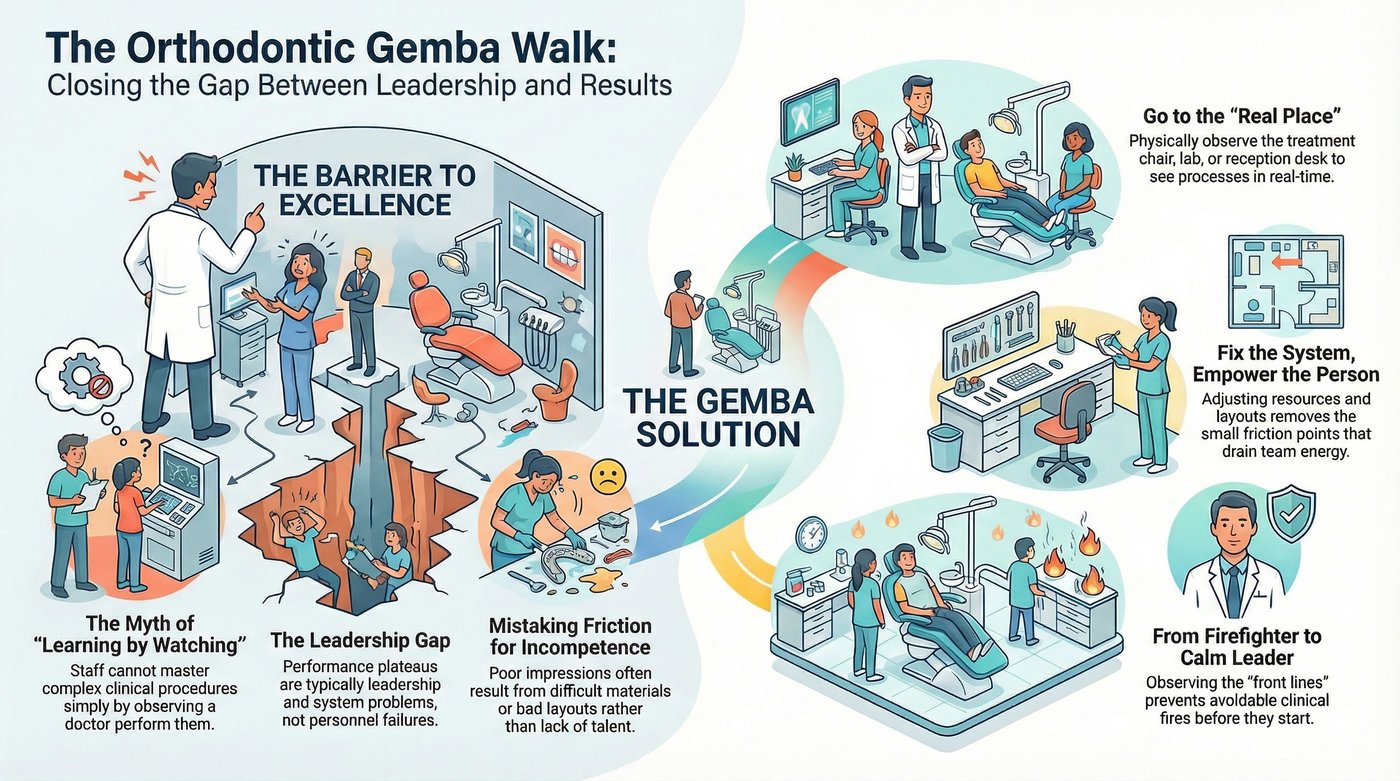
The Myth of “Learning by Watching”
A common frustration for many orthodontists is the feeling that their team has hit a ceiling. You might feel that while your assistants are great at handing you instruments, they lack the initiative or skill to perform more complex tasks, like fitting a splint or taking a centric registration independently. When a task isn’t performed to your standard, the typical reaction is a resigned, “I’ll just do it myself.”
This reaction, while understandable in the pressure of a full schedule, perpetuates a cycle of dependency and stunted professional growth within the practice. It shifts the primary responsibility for task completion back to the doctor, preventing the delegation necessary for scale and high-level focus. The assumption is that proximity to expertise equates to absorption of skill.
In lean orthodontics, we recognize that this is not a personnel problem; it is a leadership problem. Assuming that a team member will master a complex clinical procedure just by watching you do it is a mistake. To achieve operational excellence, you must bridge the gap between your expectations and the actual clinical work. You must go to the “Gemba.”
The gap between competence and confidence is not closed through passive observation. Clinical excellence requires a structured process of training, direct coaching, and immediate feedback loops. Leadership must move beyond delegating the “what” and take ownership of the “how.” Failing to define a standardized process (a standard work document) means every new procedure is a chaotic, individual experiment, leading to inconsistent patient outcomes and unnecessary chair time.
For instance, an assistant may observe you successfully placing an archwire for months. However, when asked to place a simple ligature tie, they may hesitate because the specific sequence of steps, tool grip, and force application were never explicitly taught, only seen. The complexity lies in the unarticulated micro-decisions that an experienced doctor makes intuitively. Effective clinical leadership requires articulating and documenting these intuitions.
Standing on the Front Lines
“Gemba” is a Japanese term meaning “the real place”—the place where value is created. For us, that is the treatment chair, the lab, or the reception desk. A Gemba walk involves physically going to these areas, not to micromanage, but to observe the process in real-time.
The purpose of this observation is not to find fault but to illuminate the process. It is a dedicated period, perhaps 15-20 minutes, where the leader acts solely as an anthropologist of their own practice. You are documenting the actual workflow, which often differs significantly from the documented, ideal workflow you believe is in use. This practice brings the leader into direct contact with the operational realities faced by the team.
If impressions are consistently coming out poorly, don’t immediately blame the assistant’s ability. Step into their shoes. Use the same material in the same room. You might discover that a specific brand of alginate is difficult to mix in that environment or that a dull distal end cutter is inadvertently bending wires, making removal a struggle. You cannot fix what you cannot see from your private office.
Consider a scenario where the sterilization process is frequently delayed. Observing the Gemba might reveal that the ultrasonic cleaner is positioned 20 feet away from the sink, forcing the assistant to traverse a busy hallway with dripping cassettes. The solution is not a memo about speed, but a simple relocation of equipment. By removing this physical obstacle, you unlock productivity and reduce the risk of cross-contamination, a true insight gained only from the front lines.
Identifying Systemic Friction
Often, what looks like a behavioral issue or a lack of talent is actually a resource or layout problem. By observing the “front lines,” you catch the small friction points that drain your team’s energy. Is the room layout hindering the assistant’s reach? Are staff members struggling with a software bottleneck that prevents them from calling patients back?
Systemic friction manifests as wasted motion, unnecessary inventory searching, or information delays. In a busy clinic, two minutes wasted per patient on retrieving records or sterilizing instruments can cumulatively eliminate an entire hour of productive chair time over the course of a day. These inefficiencies are the true cost of poor systems, far outweighing the cost of the necessary equipment or training.
When you observe a team member searching three different cupboards for a specific ligature color, you have found systemic friction. The immediate correction is not admonishment, but implementing a visual management system—perhaps a shadow board or a clearly labeled, centralized cabinet—to ensure all necessary supplies are located at the point of use. This simple change eliminates search time and allows the assistant to focus purely on patient care.
These insights allow you to make immediate adjustments to your resources. When you fix the system, you empower the person. This is the cornerstone of dental leadership: providing your team with the tools and the environment they need to succeed, rather than just demanding better results. It transforms the leader’s role from reactive disciplinarian to proactive system architect.
Conclusion: From Firefighter to Calm Leader
The Gemba walk is the antidote to the “firefighting” mentality. By being present where the work happens, you identify avoidable fires before they start. It shifts the entire practice culture from reacting to crises to actively managing processes. This transition is essential for any clinic aiming for scalable growth and predictable profitability.
True system-level stability provides a foundation for high-quality patient care. When clinical and administrative processes are standardized and reliable, the team is less stressed, errors decrease, and the overall patient experience improves dramatically. The leader moves from constantly intervening in daily chaos to focusing on strategic development.
It allows you to provide clear, practical feedback and ensures that every corner of your practice stays aligned with your vision. Stop assuming and start observing; it is the only way to move your practice toward a disciplined, reliable autopilot. The disciplined leader understands that the journey to operational excellence begins not with a new mission statement, but with a simple walk to the treatment chair.