

The Future of Orthodontic Self-Employment: Adapting to a Changing Market
Published on: Jul 1, 2026
A Generation in Transition
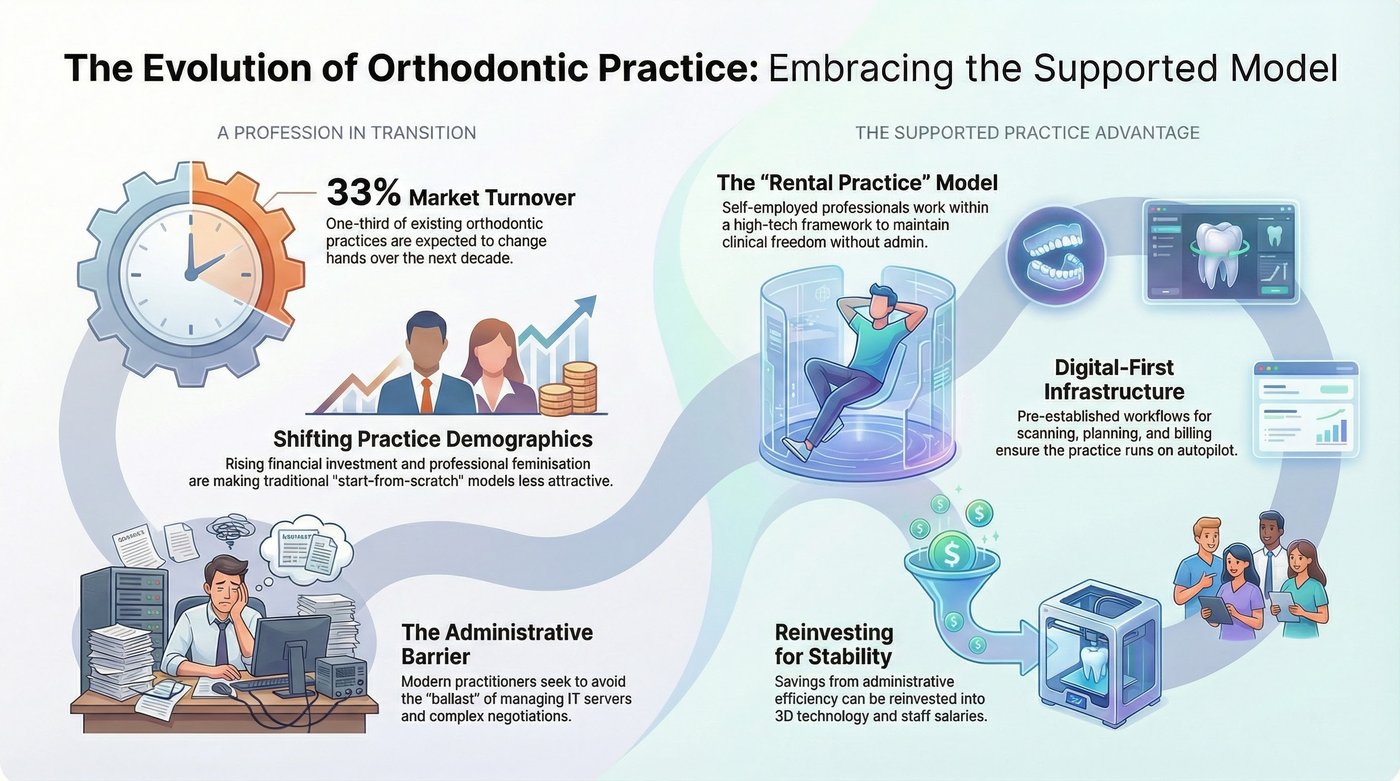
The orthodontic market is currently navigating a profound structural shift. Over the next decade, market analysts anticipate that approximately one-third of all existing practices will change hands as the current generation of baby-boomer clinicians enters retirement. This transition represents a massive transfer of clinical assets and patient relationships.
Simultaneously, the demographic profile of the profession is evolving. The increasing “feminization” of dentistry, coupled with the aggressive entry of large-scale financial investors and Dental Support Organizations (DSOs), has rewritten the rules of engagement. For many young doctors, the traditional model of “starting from scratch”—scouting locations, securing heavy equipment loans, and building a patient base from zero—is becoming less attractive and financially riskier.
These new practitioners often carry significant student debt and prioritize a healthier work-life integration. They are looking for ways to practice high-level clinical orthodontics without being tethered to the 24/7 demands of traditional small business ownership. The market must now provide pathways that balance autonomy with institutional support.
To remain competitive and successful in this high-cost environment, the new generation of leaders and entrepreneurs must identify models that offer clinical freedom without the administrative nightmare. They require systems that allow them to step into an existing, functional ecosystem rather than building a fragmented one from the ground up.
One rising solution is the “rental practice” or “plug-and-play” model. In this setup, self-employed professionals operate within a supported, high-tech framework. They retain their status as independent clinicians but leverage a shared infrastructure for logistics, technology, and branding. This mirrors the evolution of coworking spaces but is tailored for the precision-demanding world of orthodontics.
Consider a young specialist who wants to offer clear aligner therapy. Instead of investing $50,000 in scanners and software, they join a platform that already provides top-tier intraoral scanning, 3D planning suites, and a trained nursing pool. This shifts the financial burden from a capital expenditure (CapEx) to an operational expenditure (OpEx), significantly improving initial cash flow.
Clinical Freedom Without Administrative Ballast
Modern practitioners want to focus on their craft—the biological movement of teeth and the creation of beautiful smiles—not on managing IT servers, fixing hardware, or negotiating complex contracts with factoring companies. The administrative ballast of a traditional practice can consume up to 40% of a doctor’s weekly schedule, leading to burnout and decreased clinical throughput.
A supported self-employment model effectively strips away these distractions. By offloading the non-clinical “back office” tasks to a specialized partner, the practitioner regains cognitive bandwidth. This allows for a deeper focus on complex cases and patient experience, which are the true drivers of practice growth in a saturated market.
Mentoring: Access to a network of senior clinicians who provide guidance on complex cases, helping younger doctors avoid the isolation often felt in solo private practice.
Digital Processes: Access to pre-established, efficient workflows for digital impressions, CAD/CAM planning, and automated patient communication systems that reduce manual errors.
Secure Infrastructure: Professional billing, insurance credentialing, and HIPAA-compliant IT systems that run on autopilot, ensuring that revenue cycles are consistent and data is protected.
This approach dramatically reduces the “barrier to entry” for new doctors. Instead of spending years paying down a massive practice acquisition loan before seeing a profit, the clinician can reach profitability within months. It ensures that the focus remains on operational excellence and patient outcomes from day one.
Furthermore, it allows for a form of self-employment that mitigates traditional business risks. By operating under a premier brand, the doctor benefits from established marketing funnels and a reputation for quality. This creates a safety net that solo practitioners rarely enjoy, allowing for sustainable growth without the typical “growing pains” of a small startup.
The Socio-Economic Impact of Efficiency
Efficiency in a dental practice is not merely about maximizing personal profit; it has a direct and measurable impact on the surrounding community. When a practice utilizes a professional billing and administrative partner, it transforms from a high-stress workspace into a stable, reliable economic engine.
For example, a clinic that automates its invoicing and debt collection can reduce outstanding accounts by 15-20%. In a practice generating $1 million annually, that is $150,000 to $200,000 in freed-up liquidity. This isn’t just extra money; it is capital that can be used to improve the standard of care for every patient who walks through the door.
The money saved by reducing administrative waste can be strategically reinvested. This might mean upgrading to the latest 3D printing technology for in-house aligner production, which lowers costs for patients. It could mean securing staff salaries for years to come, creating a loyal and motivated team that provides better continuity of care.
Additionally, these funds can support local social initiatives or provide pro-bono care for underserved populations. By utilizing a partner that understands the specific financial nuances of dentistry, you ensure that your practice remains a professional and discreet assistant to your patients. Your business becomes a pillar of health and stability in the local economy.
Conclusion: Building the Practice of the Future
The evolution of orthodontics in the 21st century demands a radical shift in how we view the “business” of the clinic. The old ways of isolated, manual management are no longer viable in a world of digital transformation and corporate competition. Clinicians must decide if they want to be office managers or master practitioners.
By embracing professional billing systems and exploring new models of supported self-employment, you protect your clinical freedom and your practice’s long-term future. You ensure that you remain the owner of your clinical decisions while benefiting from the scale and efficiency of a larger system.
Ultimately, the goal is to create a high-performing environment where the doctor can be a doctor, the team can be a team, and the practice can thrive on a sustainable, liquid foundation. The practice of the future is lean, digital, and focused entirely on the patient journey.