

The Financial Heart: Crisis-Proofing Your Practice Manager Role
Published on: Jul 2, 2026
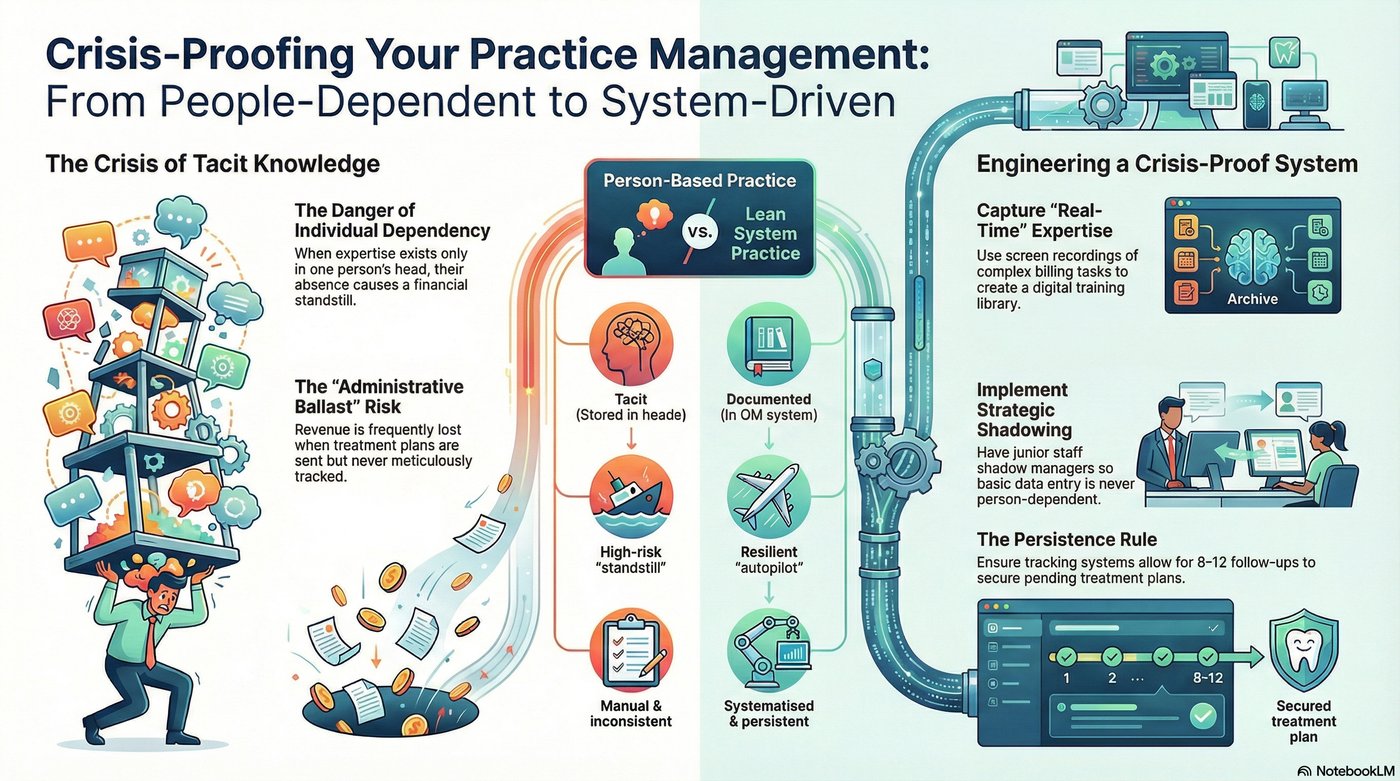
The Danger of Tacit Knowledge
What happens to your practice if your billing manager suddenly leaves? For many orthodontists, the answer is a financial standstill. The abrupt departure of a tenured practice manager reveals a core vulnerability in the organizational design of many high-performing clinics. The critical functions—insurance verification, complex appeals, and revenue cycle management—are often concentrated into a single, irreplaceable role. This consolidation of expertise, while seemingly efficient, creates a single point of failure that can halt cash flow instantly.
Most clinics rely on “tacit knowledge”—expertise that exists only in the head of one key person. This includes undocumented payer-specific quirks, historical billing trends, and relationships with insurance representatives. When that person is absent, the “financial heart” of the office stops beating. This is not merely an inconvenience; it represents a significant risk to the stability and valuation of your business. Clinic leaders must recognize that financial security is directly tied to process robustness, not personnel loyalty.
In lean orthodontics, we move away from dependency on individuals and toward dependency on systems. This philosophy requires a fundamental shift in leadership: processes must be owned by the practice, not the person who executes them. True dental leadership involves building a crisis-proof structure where knowledge is documented, shared, and integrated into the practice’s DNA. This proactive approach ensures operational continuity and preserves the financial health of the enterprise, regardless of staff turnover.
Documenting the “How” with Digital Tools
To prevent a knowledge vacuum, you must integrate the manager’s workflows into your quality management (QM) system. A robust QM system transforms individual expertise into standardized organizational assets. Relying on traditional paper manuals is insufficient for the complexities of modern billing, especially with constantly changing insurance regulations and nuanced provider contracts. Instead, the modern dental leader must leverage technology to capture expertise in real-time.
Capturing Core Processes
Screen Recordings: Have your manager record their screen while they process complex insurance claims or treatment plans. These are invaluable assets. For example, a five-minute video demonstrating how to successfully appeal a denied claim—detailing specific codes and required attachments—is exponentially more effective than a 20-page instruction manual. These videos become a dynamic, searchable training library for future staff.
Shadowing Protocols: Develop formal, mandatory shadowing protocols where junior team members are required to observe the practice manager early and often. This ensures that basic, high-volume tasks, such as initial patient data entry or scheduling follow-ups, can be handled by multiple people. This distribution of basic competence frees the practice manager to focus their time on high-level strategy, complex case management, and financial analysis.
Deviation Documentation: Standardize your clinical workflows down to the most granular steps, so that the billing manager only has to manually record what was different or a deviation in a specific case. In a lean system, 95% of cases should follow a standard path. This principle significantly reduces the manual workload required for documentation and minimizes the potential for human error inherent in repetitive data entry. Focus documentation on exceptions, not the rule.
The Persistence of the Follow-Up
A major, yet often overlooked, form of waste in orthodontics is “money left on the table”—specifically, revenue tied to treatment plans that were sent to the patient or insurer but never returned or completed. A lean practice manager is fundamentally not just a bookkeeper or an administrative head; they must be a flow manager, actively ensuring the movement of patients and payments through the revenue cycle.
The leadership team must set the expectation that the sales cycle does not end when the treatment plan is presented. In professional sales, the best results often occur between the eighth and twelfth follow-up interaction. Practices often quit after the second or third attempt, leaving hundreds of thousands of dollars in potential revenue dormant. This represents a failure of management structure, not personnel effort.
Your management structure must include a meticulous, automated tracking system for every treatment and cost plan presented. This goes beyond simply noting a task in a spreadsheet. It requires dedicated software prompts and structured outreach schedules, whether the task is following up on a six-week insurance deadline, securing a pending patient signature for an elective procedure, or chasing delinquent payments. Persistence is the key to maintaining a healthy and predictable cash flow. When the business side is tracked meticulously and driven by systematic follow-up, you successfully avoid the “administrative ballast” of forgotten revenue that drags down profitability.
Conclusion: Building a Swiss Watch
Structuring the practice manager role is not merely about hiring a good employee or outsourcing key tasks; it is about engineering a self-sufficient, resilient system. Leaders who successfully crisis-proof their practices view their operations as a set of interconnected processes, much like the precision gears of a Swiss watch.
By systematically documenting workflows and relentlessly implementing robust tracking systems, you ensure the core financial and administrative functions of the practice continue to run on autopilot. This operational independence allows the business to thrive regardless of individual staff changes, dramatically reducing key-person risk. The ultimate benefit for the dental leader is the peace of mind and strategic bandwidth gained, which frees you to focus on the highest-value task: delivering exceptional patient care and planning for the practice’s future growth. A crisis-proof structure is the foundation of sustainable, scalable dental leadership.