

The Family Practice Blueprint: Turning Generational Harmony into Operational Excellence
Published on: Jun 24, 2026
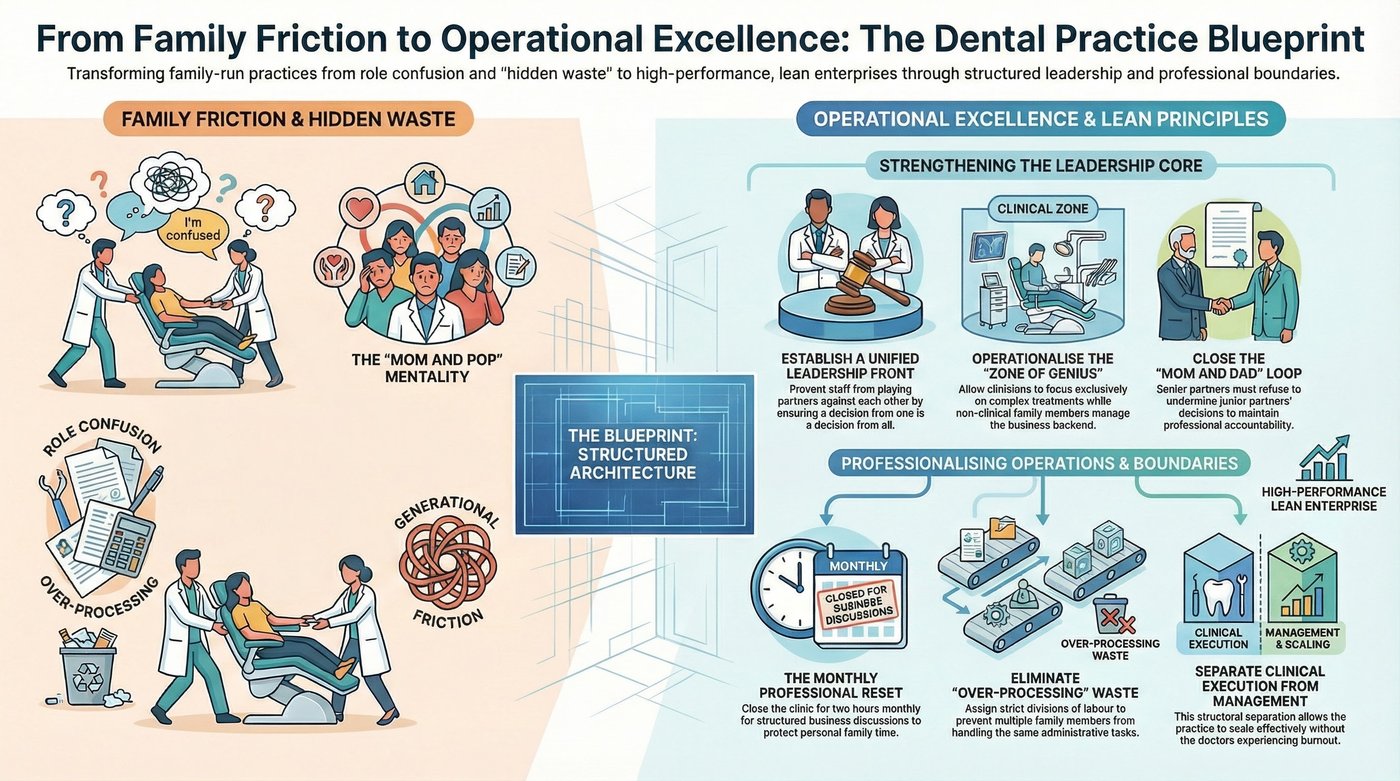
In the dental world, family-run practices are common, yet they are frequently plagued by a specific type of “hidden waste”: role confusion and generational friction. When boundaries between personal and professional lives blur, the result is often a chaotic environment where decisions are undermined, and efficiency is sacrificed for the sake of family harmony.
This lack of structure often leads to “decision paralysis,” where staff members are unsure who to report to or which doctor’s philosophy takes precedence in a clinical dilemma. Over time, this ambiguity erodes the practice’s culture and slows down patient throughput.
However, as I have observed in high-performance clinics like that of Dr. Theresa Scheffler—who works alongside her father, mother, and siblings—a family practice can actually be the ultimate model of a lean enterprise. The secret lies in moving away from a “mom and pop” mentality and toward a structured architecture based on specialized roles, rigid scheduling, and unified leadership.
In these elite practices, the family bond acts as a catalyst for trust rather than a source of conflict. By applying lean principles specifically to the family dynamic, these clinics eliminate the redundancy that typically kills profitability in smaller operations.
The Specialized Division of Labor
One of the greatest forms of waste in a dental practice is “over-processing”—where multiple people attempt to handle the same administrative or clinical tasks. In successful family practices, this is solved through a strict division of labor.
Without clear lines of authority, you might find two family members ordering the same dental supplies or giving conflicting instructions to a dental assistant. This redundancy doesn’t just waste money; it creates an environment of constant second-guessing among the staff.
In the Scheffler model, the doctors focus exclusively on their “Zone of Genius”—for example, one focusing on complex implantology while the other masters orthodontics. Crucially, the non-clinical family members handle the entire administrative and management backend. This allows the clinicians to stay in a “flow state” with their patients, free from the distractions of billing, HR, or logistics.
By separating clinical execution from business management, the practice scales without the doctors burning out. For instance, while the senior doctor performs a complex restorative case, the office manager (perhaps a sibling or spouse) ensures the claims are filed and the next month’s marketing strategy is ready. Every family member has a specific “lane,” and they stay in it.
Unified Leadership: Closing the “Mom and Dad” Loop
A common leadership challenge in multi-generational practices is the team’s tendency to play partners against each other. If a junior doctor says “no” to a staff request, the employee may go to the senior partner (the parent) to get a “yes.” In psychology and management, this is a toxic loop that destroys authority.
This behavior, often called “triangulation,” forces family members into unnecessary conflict. If not checked immediately, it allows staff to bypass established protocols, leading to inconsistent patient care and a breakdown in the office’s standard operating procedures.
Lean leadership requires absolute unity. If a staff member attempts to bypass a junior partner, the senior partner’s first response must be: “Have you already discussed this with them?” By refusing to undermine each other, the family solidifies a singular leadership front. The team quickly learns that a decision from one is a decision from all.
This creates a culture of respect and professional accountability that is essential for a stress-free workplace. When the staff sees that the doctors are in total alignment, they stop looking for loopholes and start focusing on their own performance. Unity at the top translates to efficiency in the ops.
The Monthly Professional Reset
Family dynamics have a tendency to spill over into the dinner table, which is the opposite of a lean lifestyle. To prevent this, successful family practices implement a rigorous “Meeting Culture.” Once a month, the clinic is closed for two hours of dedicated, professional discussion.
This is not a casual chat; it is a structured meeting to address material needs, scheduling conflicts, and strategic growth. Using a formal agenda ensures that grievances are aired in a productive environment rather than over Sunday dinner. This separation is vital for long-term emotional and professional sustainability.
By handling business matters during business hours, the family preserves their personal relationships and ensures the practice continues to evolve as a professional clinical enterprise. This “Professional Reset” allows the family to enjoy being a family when the lab coats come off, knowing the business is on a clear, agreed-upon path.
Conclusion
The success of a family-run dental practice hinges on the willingness to transition from informal tradition to professional structure. Embracing lean principles is the critical step, defining strict operational boundaries and enforcing a specialized division of labor to eliminate hidden waste and role confusion.
This architectural shift, paired with an unbreakable front of unified leadership, transforms familial bonds from a liability into a competitive asset. When doctors and managers commit to clear protocols and respect professional accountability, efficiency naturally follows.
Ultimately, by institutionalizing structured business communication—such as the “Monthly Professional Reset”—practices safeguard their personal relationships while securing their financial future. This commitment to structure is the blueprint for turning generational harmony into scalable, high-performance operational excellence.