

The Entrepreneurial Orthodontist: Why Medicine and Business Are Inseparable
Published on: Jun 9, 2026
In the academic halls of dental school, we are trained to be elite clinicians. We learn the mechanics of tooth movement, the biology of bone remodeling, and the intricacies of occlusion. This specialized training focuses almost exclusively on technical mastery and patient care protocols. However, the moment you sign a lease for a practice or take out a loan for a 3D scanner, you have stepped into a new role: the entrepreneur. Many practitioners resist this label, feeling it is too “commercial” for the medical field, a view that risks the very sustainability of their clinical mission.
But as Dr. Martin Baxmann emphasizes, failing to recognize yourself as a business owner is the single greatest risk to your long-term clinical success. The perception that business is separate from medicine is a critical oversight. Business acumen is the necessary engine that powers sustainable, high-quality healthcare delivery. If the practice is not financially healthy, its ability to invest in superior technology, advanced CE, and top-tier staffing diminishes, ultimately impacting clinical outcomes and patient safety.
Being an entrepreneur is not about “selling out”; it is about the science of decision-making. Every aspect of your professional life—from the team you hire to the location you choose—is an entrepreneurial choice that dictates the quality of care you can provide. Effective leadership ensures that clinical judgment can be executed without operational limitations.
The Financial and Operational Reality
Whether we like the term or not, a dental practice operates in the service sector. The comprehensive patient experience, from initial consultation to retention follow-up, constitutes the service product your business delivers. As an owner, you take on significant personal and financial risks, managing debt, overhead, and the payroll for your entire team. You are responsible for the livelihoods of your staff and the safety of your patients. Embracing an entrepreneurial mindset means prioritizing strategic financial health to ensure operational longevity and clinical stability.
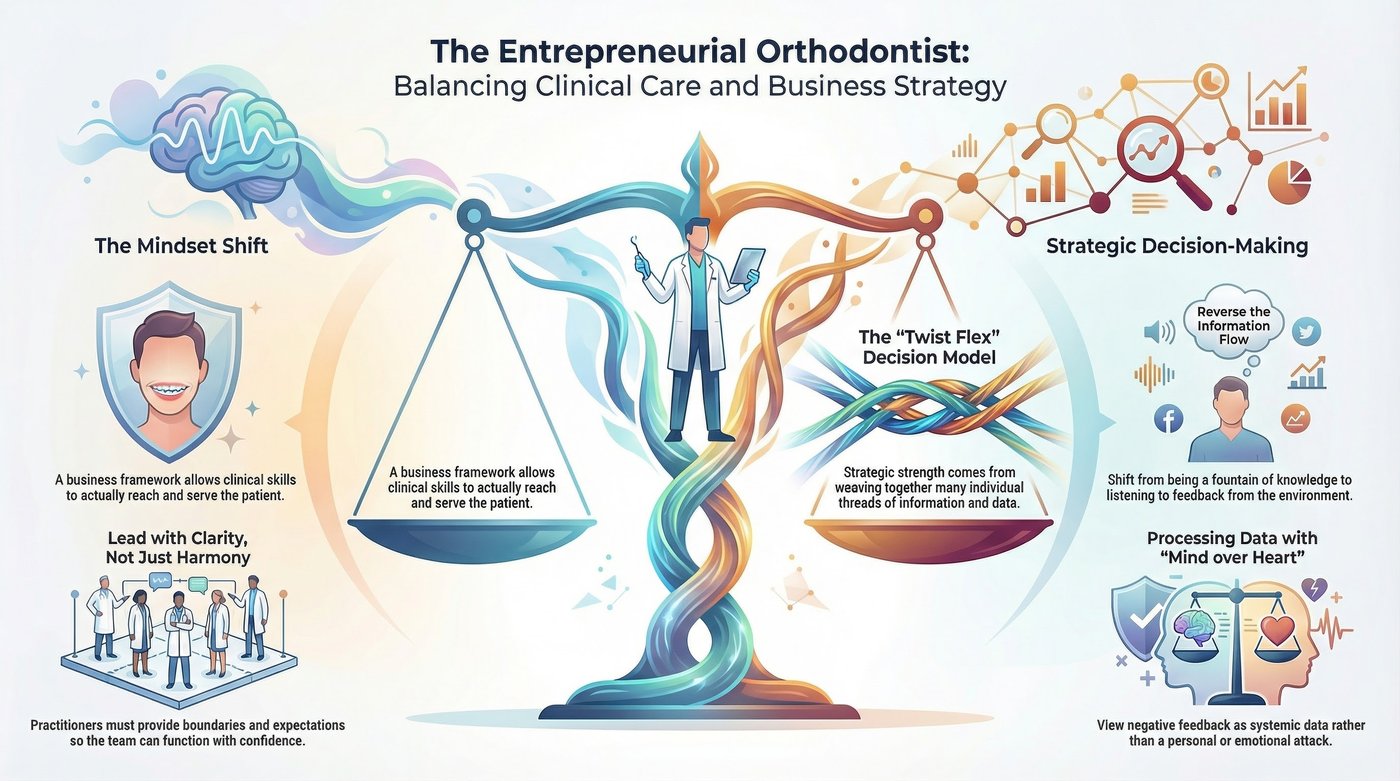
Consider the operational impact of poor financial planning. When a practice has excessive debt or fails to manage resource allocation efficiently, the pressure often leads to compromises, such as delaying maintenance on critical sterilization equipment or minimizing necessary staff training hours. This is a clear instance where business inefficiency directly precipitates a clinical vulnerability. Entrepreneurship is the framework that allows your clinical skill to reach the patient.
Without strategic decision-making in areas like cash flow analysis, supply chain management, and competitive market positioning, even the most talented doctor will find themselves overwhelmed by debt, poor staff retention, and operational chaos. By accepting the role of the entrepreneur, setting key performance indicators (KPIs) for both front office efficiency and clinical throughput, you provide the foundational stability your clinic needs to thrive and continuously improve patient outcomes.
The “Twist Flex” Theory of Decision-Making
Dr. Baxmann uses a unique orthodontic analogy to describe high-level decision-making: the “twist flex” wire. On the outside, a successful business strategy looks like one thick, solid unit—a sign of stability that builds patient and referral confidence. But inside, that strategy is composed of hundreds of tiny, individual wires of information. This internal, braided complexity provides the strategy with its superior strength and resilience to market forces or unexpected operational challenges.
Each “wire” represents a piece of objective data: a patient’s feedback, a financial metric like new patient acquisition cost, a staff observation about workflow bottlenecks, or a lesson learned from a past mistake. For a specialty practice, these inputs might include the true ROI on a new digital impression scanner, the time cost associated with pre-authorizations, and a targeted analysis of local competitor pricing models.
The more individual threads of verifiable information you can gather and weave together, the stronger and more flexible your final strategic decision will be. Making an informed entrepreneurial choice means having the discipline to systematically consume and understand these diverse inputs—not relying solely on anecdotal evidence—before pulling the trigger on a major investment or a shift in service delivery. This rigorous process minimizes risk and ensures alignment between clinical ambition and business capacity.
Reversing the Information Flow
One of the most profound shifts in moving from “clinician” to “entrepreneur” is how you handle information. In a didactic or university setting, the doctor is the established “fountain of knowledge” who informs the patient. In a lean entrepreneurial practice, this flow is fundamentally reversed, emphasizing active, system-wide listening. The owner’s role shifts to that of a strategic integrator, capturing intelligence from all touchpoints.
Your most valuable strategic data comes from listening to your environment: your patients, your team, and your key metrics. A negative Google review, for instance, shouldn’t be met with emotional defensiveness or immediate rebuttal. Instead, it should be read with the “mind” rather than the “heart,” viewed as a non-judgmental piece of evidence. It is a vital piece of data that reveals a systemic failure, such as inadequate scheduling, communication, or a gap in post-operative instructions.
Clinic leaders must institutionalize a reliable feedback loop to consistently capture this market intelligence. This involves utilizing short daily huddles to gather staff observations about friction points and implementing concise patient surveys to gauge perceived value and referral intent. By listening to what the market and your team are telling you, you can refine your processes, proactively correct systemic weaknesses, and maintain the competitive advantage necessary for sustained clinical excellence.
Conclusion: Clarity Over Harmony
Many practice owners avoid taking a strong entrepreneurial stance because they want to maintain a sense of “harmony” and avoid being seen as authoritarian. They often prioritize team comfort over necessary corrective action or strategic restructuring. However, systemic thinking teaches us that effective leadership is not about avoiding conflict; it is about filling the operational space with clarity, defined expectations, and measurable standards.
If you withdraw from your role as the primary strategic decision-maker, you create a vacuum that will inevitably be filled by someone else—often a high-influence staff member or by default policies—leading to operational drift, inconsistent execution, and internal conflict. This lack of intentional, structured leadership directly undermines the practice’s ability to deliver consistent clinical results.
Being an entrepreneur means providing the structural boundaries and performance expectations that allow your team to function with confidence and professional autonomy within defined parameters. When you lead with strategic intent, clearly communicating the ‘why’ behind every operational and financial decision, you create a stable, high-performing environment where clinical excellence is not just a hope, but a predictable, managed outcome.
Ultimately, the most successful dental and orthodontic practices recognize that the scalpel and the spreadsheet are interdependent tools. Embrace the entrepreneurial title not as a distraction from clinical work, but as the foundational responsibility that protects and optimizes it. By merging clinical expertise with decisive strategic business leadership, you secure not only the practice’s profitability but also its enduring capacity to serve the community with the highest standard of ethical and exceptional care. This comprehensive integration of roles is the key to true professional longevity and meaningful impact.