

The Empathy Paradox: Why “Nice” Leaders Often Fail Their Teams
Published on: Jun 30, 2026
The Misconception of the “Cold” Lean Leader
In the pursuit of operational excellence, we often look to figures like Sherlock Holmes or Spock—models of pure, data-driven rationality. Because of this, many orthodontists and dental practice owners fear that adopting lean orthodontics means becoming cold or even ruthless. This misunderstanding is a critical barrier to necessary growth and process refinement. The core philosophy of Lean is actually “Respect for People,” not emotional detachment.
I frequently hear from colleagues who feel paralyzed; they know a structural change is necessary, but they are “too empathetic” to upset a long-term employee. This inaction might stem from kindness, but it is fundamentally a failure of leadership. For example, delaying the implementation of a modern, efficient digital charting system because one veteran staff member prefers paper is a choice driven by sentimentality, not true compassion.
This is a leadership trap. If you avoid a necessary decision because you are worried about one person’s temporary reaction, you aren’t being empathetic—you are being sentimental. True dental leadership requires the courage to make decisions that secure the stability of the entire organization. When a necessary process change is delayed, the whole team suffers from reduced productivity and friction.
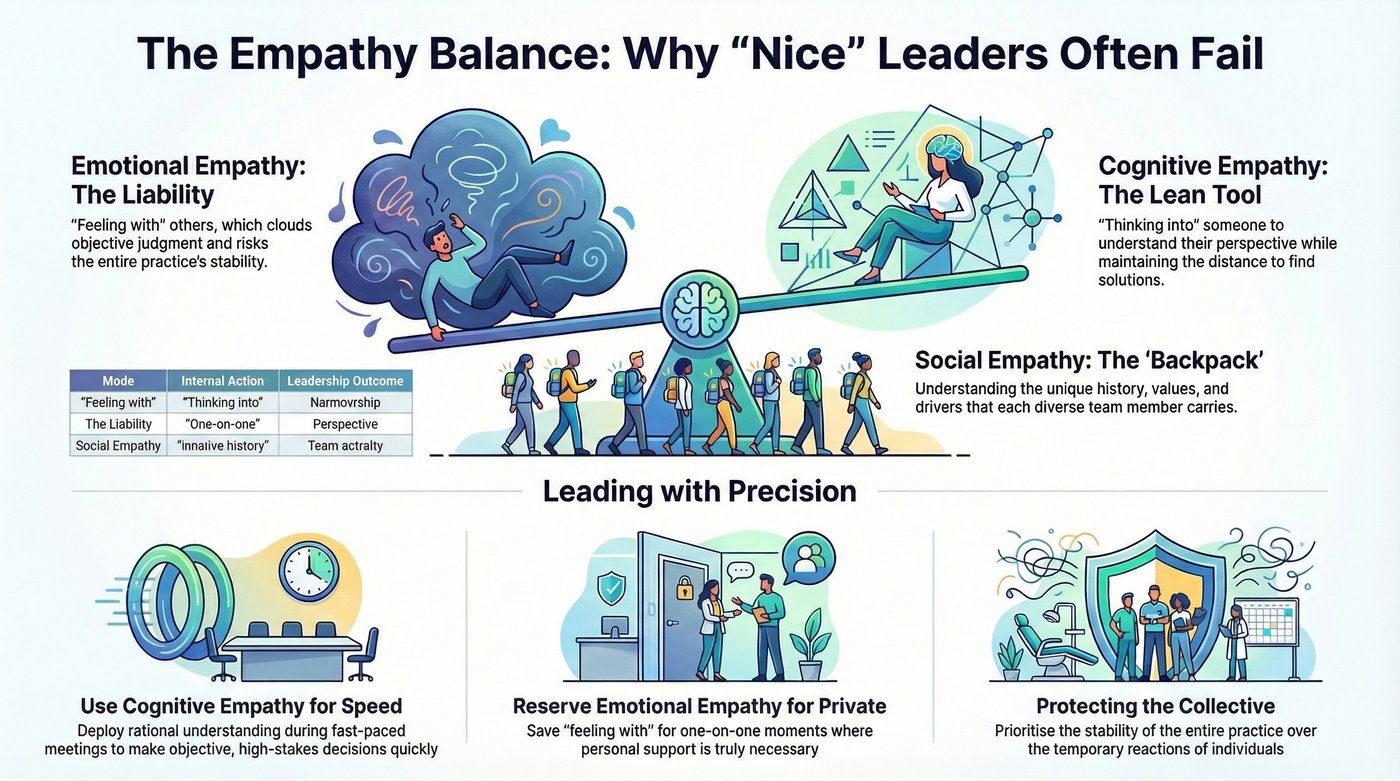
Real leadership means protecting the collective. Failing to make a rational choice puts the stability of the entire practice ecosystem at risk. To lead effectively, you must learn to distinguish between the different “flavors” of empathy. A leader’s job is not to ensure constant individual comfort but to guarantee the collective success and security of the patient care model and the business itself.
Emotional vs. Cognitive Empathy
To maintain a high-performing practice, you must understand the two primary forms of empathy: emotional and cognitive. Confusing the two often leads to managerial paralysis and team resentment when underperformance is tolerated.
Emotional Empathy: This is “feeling with someone”. If an employee is stressed, you feel stressed. While this makes you human and is appropriate for personal relationships, it is a liability for a practice owner. If your judgment is clouded by the immediate emotions of those around you, you cannot make the objective decisions required to secure the future of your team. A prime example is when a leader knows a hygienist is consistently running 15 minutes behind schedule, causing patient bottlenecks, but avoids the tough conversation because they “feel bad” for the employee’s personal struggles.
Cognitive Empathy: This is “thinking into someone”. It is the rational ability to understand what another person is feeling without becoming overwhelmed by it yourself. This is the domain of the lean leader. You recognize the “why” behind an employee’s behavior—perhaps they are stressed by the new scheduling software—but you maintain the distance necessary to focus on the solution. Cognitive empathy is essential for objective performance reviews. It allows a leader to recognize an employee’s fear of failure (the ‘why’) and then respond with a structured training plan (the ‘solution’), rather than simply accepting the poor results. This rational distance turns compassion into measurable action.
The “Backpack” of Social Empathy
Modern orthodontic teams are diverse, consisting of different personality types and cultural backgrounds. The effectiveness of a cohesive practice relies on the leader’s ability to navigate these differences intentionally.
Social empathy allows you to understand the “backpack”—the history, values, and drivers—that each employee carries. This concept goes beyond surface-level feelings to grasp the deeper motivators that shape professional behavior. For example, one team member may be driven primarily by results and efficiency metrics, while another values harmony and team security above all else.
By understanding these perspectives, you aren’t just being “nice”; you are being precise. Precision in leadership means customizing your feedback and motivation strategies. A leader can tailor their communication to move each individual toward the practice’s goals. For the results-driven associate, a leader might use data and quantifiable progress; for the harmony-driven office manager, they might emphasize how a new process benefits the team’s overall well-being and stability. This deep understanding minimizes friction during change management.
Conclusion: Leading with Precision
Lean leadership is about knowing which “mode” to use and when. This intentional deployment of empathy is the crucial difference between a leader who is merely liked and a leader who is truly effective. The “nice” leader often defaults to emotional empathy, leading to inconsistent standards and a lack of accountability across the dental team.
In a high-speed meeting where you must make ten decisions in five minutes, cognitive empathy is your tool. It enables you to quickly process team concerns without getting stalled by their stress, allowing for rapid, data-driven solutions. Save emotional empathy for the private, one-on-one moments where it is truly needed—such as coaching sessions or personal crises.
By mastering this balance, you create a secure environment where your team feels understood but remains focused on practice efficiency. Leading with precision transforms “niceness” from a leadership liability into a powerful, strategic asset. This approach builds a resilient, accountable, and high-performing dental or orthodontic practice that serves both its team and its patients optimally.