

The Economics of Motion: Why Short Paths are the Secret to a Calm Clinic
Published on: Jun 30, 2026
The Cumulative Cost of “The Long Way”
In a busy orthodontic practice, we often measure success in clinical outcomes and monthly revenue. However, we rarely measure the “hidden tax” of unnecessary movement. Every time an assistant walks across the hallway to find a clinical camera, or you reach for a curing light that was placed just out of reach, you are consuming a finite resource: your team’s energy. In lean orthodontics, we recognize that these tiny fragments of wasted time accumulate into hours of lost productivity every single month.
These seemingly minor diversions—a 20-foot walk for an instrument, a 15-second search for a form—do not just cost seconds; they introduce significant cognitive load. When a team member must break focus to acquire a misplaced tool, they risk miscommunication or oversight during the critical moments of patient care. A real-world audit tracking movement in a non-optimized clinical setting often shows auxiliary staff walking miles over the course of a single week, energy that could have been dedicated to high-value patient interaction.
This wasted motion translates directly into team stress and burnout. A chaotic environment where necessary items are perpetually missing or misplaced diminishes job satisfaction and increases staff turnover, a major economic drain on any clinic. High-performing practices understand that a calm clinic is a predictable clinic, where the physical environment supports focus, not fragmentation.
To achieve operational excellence, you must master the “Principle of Short Paths.” This is not just about moving faster; it is about moving less. By shortening the physical, clinical, and communicative distance in your office, you reduce friction and create a practice that runs with effortless precision.
Engineering the “Arm’s Reach” Standard
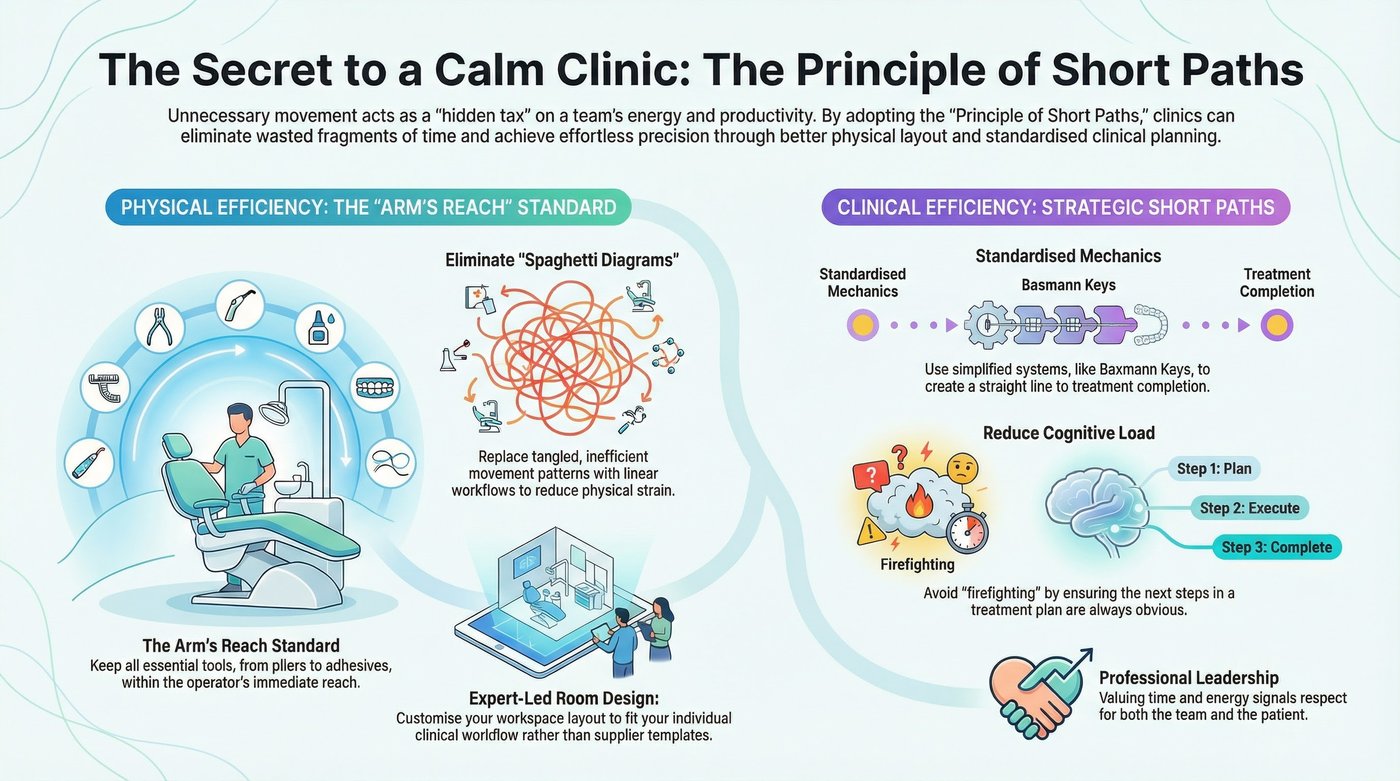
Short paths begin with the physical layout of your workspace. A poorly planned office often resembles a tangled mess of movement—a phenomenon we visualize using a “spaghetti diagram.” This diagram reveals the chaotic, non-linear travel patterns of staff, often showing team members crossing paths multiple times during a single procedure. Identifying and untangling these routes is the first step toward optimization.
The most effective approach is to implement the “Arm’s Reach” standard by defining clear work zones. The primary clinical zone—the area immediately around the chair—must hold 90% of all instruments and materials needed for standard procedures. This eliminates the need for the operator or assistant to turn away from the patient, preserving both infection control integrity and patient comfort.
In a lean-optimized room, every movement is linear. Everything needed for a procedure—from pliers to adhesives—should be within arm’s reach of the operator. When furnishing a new room, do not leave the design solely to a supplier. You are the clinical expert; you must ensure the setup fits your individual workflow to minimize physical strain and maximize practice efficiency.
For example, a right-handed orthodontist’s most frequently used tools must be positioned for immediate, ergonomic access, often mounted on movable tray systems rather than fixed, distant shelving. The principle also applies to inventory management: point-of-use supplies in treatment rooms must be standardized and restocked daily using a defined “kitting” process. This ensures every operatory is uniformly prepared for the next 10 to 15 appointments, eliminating mid-procedure scrambles and material hoarding.
Short Paths in Clinical Strategy
The principle of short paths extends beyond the floor plan and into your diagnostic mind. “Hero cases”—complex treatments that require constant detours and “firefighting”—are often the result of a lack of standardized planning. These outlier cases consume disproportionate time, energy, and mental focus, acting as a major bottleneck in the schedule.
By using a simplified system for your mechanics, such as the Baxmann Keys, you create a straight line to the finish line. This clinical standardization removes harmful variability. Instead of inventing a new, bespoke solution for every complex tooth movement, the doctor is following a defined, proven algorithmic path. This is crucial for delegation, as well, since assistants can confidently anticipate the next clinical step without constant physician direction.
There is nothing more inefficient than spending five minutes of a ten-minute appointment just trying to remember what the treatment plan was. When your planning is standardized, the next steps are obvious, and the “clinical path” remains as short as possible. Effective practices mandate a brief, pre-check of the patient’s chart before they are seated, using a simple visual scorecard that outlines the specific objectives for that visit. This minimizes chair time dedicated to planning and maximizes time spent on execution.
Short paths must also apply to communication within the team and with the patient. Implementing a concise, structured handover protocol ensures that information transfer between the front desk, the assistant, and the doctor is instantaneous and complete. For patients, using standardized, clear language about treatment progression reduces confusion and the need for repetitive explanation, cutting down on time-consuming calls later.
Conclusion: The Precision of the Minimalist
Shortening your paths is an act of professional leadership. It signals to your team and your patients that you value their time and your own energy. This commitment to minimalism—the intentional reduction of non-value-added activity—is the hallmark of a world-class practice.
By eliminating the “long way,” you preserve your focus for the high-level clinical decisions that truly move the needle. When the daily operational friction is removed, your cognitive reserve is freed up. This allows you to engage more deeply with complex diagnoses, mentor your team effectively, and maintain the steady, calm demeanor that defines confident leadership. The short path is not just an efficiency metric; it is the foundation for sustainable growth and a professional, stress-free clinical environment.