

The “Cookbook” Method: Scaling Operational Excellence in Orthodontics
Published on: Jul 4, 2026
Why Every Practice Needs a Recipe for Success
In the kitchen of a Michelin-star restaurant, the chefs don’t guess the ingredients for their signature dishes every night; they follow a precise recipe. This ensures that every guest receives the same elite experience, regardless of who is working the line. Why should a high-performing orthodontic practice be any different?
In modern dental practices, consistency is the ultimate differentiator. It minimizes chair time variation, reduces supply waste, and builds patient trust through predictable outcomes. A failure to standardize means relying entirely on the memory and individual skill of each team member, which is inherently unsustainable as you grow.
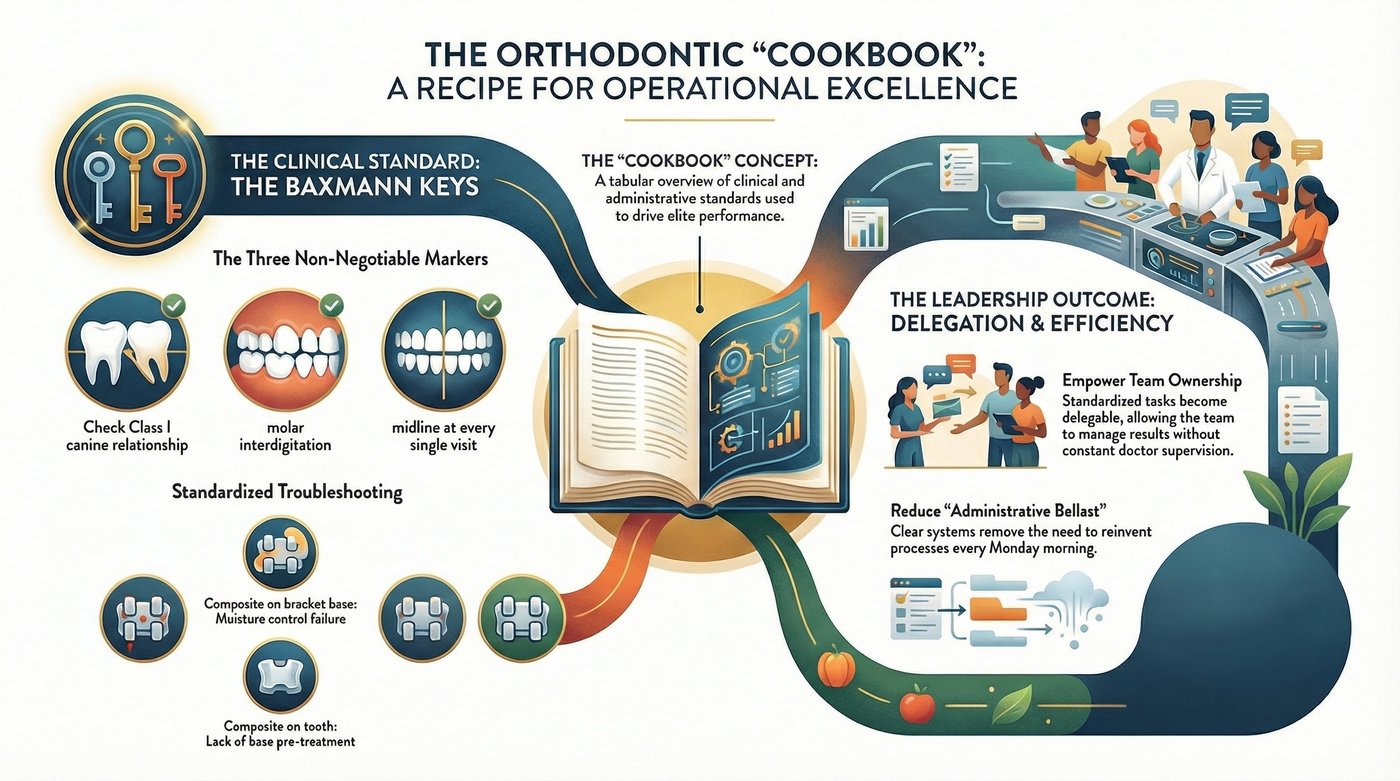
To achieve operational excellence, you need what I call a “Cookbook”—a tabular overview of your clinical and administrative standards. This resource serves as the single source of truth for all procedures, from sterilization protocols to patient intake interviews. It is the backbone of repeatable, high-quality care.
This isn’t about stifling clinical judgment; it’s about providing a “recipe” that ensures high-level execution with significantly less effort. When administrative overhead is minimized by clarity, clinical staff can focus their energy on patient interaction and complex decision-making, not on remembering routine steps. This structured approach is essential for scaling a multi-site operation or integrating new associate doctors.
Standardizing the Clinical workflow: The Baxmann Keys
A core part of clinical standardization involves the “Baxmann Keys.” We check three specific markers at every single visit: the Class I canine relationship, molar interdigitation, and the midline. These markers are not exhaustive but are critical indicators of treatment progression.
Making this check a non-negotiable standard transforms the assistant’s role from passive helper to active co-pilot. They are trained to immediately assess these three critical relationships upon seating the patient, creating a valuable pre-check for the doctor.
This provides a common language for the doctor and the assistants. For example, if an assistant notices the midline is off before the doctor even reaches the chair, they are already thinking within the standard framework of correction. They might proactively gather relevant tools, such as power chains or archwire bending pliers, anticipating the next step.
This synergy is what drives dental team performance to its highest level. When every team member operates from the same playbook, the collective intelligence of the practice is harnessed efficiently. This proactive standard saves minutes per patient, which compounds into hours of reclaimed chair time over a month.
Troubleshooting Through Standards
Standardization even makes error resolution faster and more systemic. Consider the common issue of a loose bracket. In a standardless practice, it’s often treated as an isolated annoyance, leading to reactive fixes and wasted time.
In a lean practice, the staff follows a standardized check before remediation begins: Is the composite still attached to the bracket base, or is it still on the tooth surface? This inquiry is a diagnostic standard, not just a procedural step.
This simple standard immediately identifies where the process failed—whether it was compromised moisture control during the bonding process (composite on the bracket, implying saliva contamination) or a lack of proper base pre-treatment (composite still on the tooth). The standard converts an unexpected error into a teachable, fixable moment.
Because the check is standardized, the solution is immediate and targeted. You stop guessing and start fixing the root cause, which is the hallmark of practice efficiency and quality assurance. Furthermore, this data informs future training adjustments, ensuring the failure mode is permanently eliminated from the workflow. This systematic defect reduction is crucial for maintaining low bond failure rates across an entire clinic or group of practices.
Making Complexity Delegable
As we have discussed in dental leadership, you cannot delegate what you have not standardized. Delegation in a complex medical field requires precision. A written standard provides the exact guardrails necessary for delegation to be safe and effective.
A clear, precise description of a task—or even better, a short demonstration video embedded in the “Cookbook”—makes complex processes safely delegable to any trained employee. This includes sophisticated tasks like placing clear aligner attachments or prepping the patient for an indirect bonding appointment. The “Cookbook” ensures procedural fidelity regardless of which assistant performs the task.
When you have a “cookbook” for your archwire sequences, appliance combinations, and even your “LATTE” concept for complaint handling (Listen, Acknowledge, Take action, Thank, Ensure satisfaction), you empower your team to take ownership of the results. The team stops asking, “What do I do now?” and begins executing the predefined standard solution.
This strategic delegation reduces the administrative ballast on the doctor, freeing up valuable time for diagnosis, treatment planning, and business development. It cultivates a culture of accountability and allows the team to show what they are truly capable of achieving when given clear expectations and documented procedures. This is the difference between a doctor who manages every small detail and a CEO who leads a predictable system.
Conclusion: The Path to a Productive Monday
The goal of lean management is to make the work lighter and more successful, transforming the practice from a collection of individuals into a synergistic system. By adopting a “Cookbook” approach, you institutionalize your best practices and turn tacit knowledge into explicit, scalable procedures.
You can return to your practice on a Monday morning and start “Step One” immediately, without needing to recap theory or reinvent your systems for every patient. This predictability is what allows practice leaders to step away from the chair for development days or vacations without fear of operational meltdown. Standardization is the engine of a productive and predictable practice. It is how you grow your clinic while maintaining your sanity and your passion for orthodontics, ensuring sustainable excellence for years to come.