

The Consistency Tax: Why the “Small Things” are the Hardest to Master
Published on: Jun 28, 2026
Beyond the Big Catastrophes
When we think about the risks of running an orthodontic practice, our minds naturally drift toward the dramatic: a massive loan, a construction delay, or a daunting tax audit. While these “big events” are stressful, they are not the most exhausting part of a practitioner’s life. The true silent killer of efficiency and morale is the cumulative drag of minor inconsistencies, an insidious challenge often overlooked by even the most experienced clinic leaders.
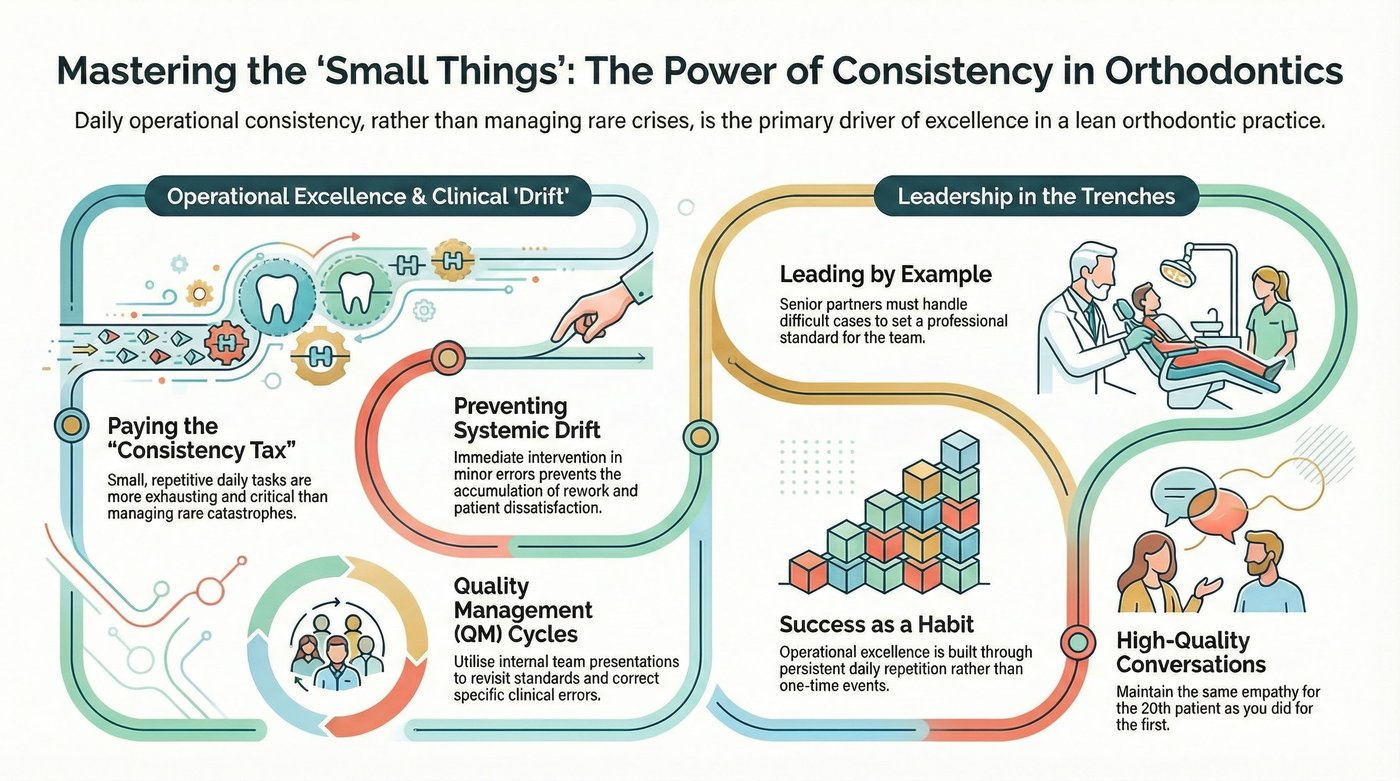
In lean orthodontics, the most taxing—and most rewarding—investment is consistency. This “consistency tax” is the price paid daily to maintain peak operational standards, ensuring that every touchpoint—from the phone answering script to the final retainer check—meets an unvarying benchmark of excellence. It’s the invisible labor of holding the line against entropy in a busy clinical environment.
Consistency is the simple, repetitive act of starting over every single day and ensuring that every system runs exactly as designed. It means having the same empathetic, high-quality conversation with the 20th patient of the day as you did with the first. Consider the seemingly small task of inventory management; consistent tracking prevents expensive rush orders, minimizes chair-time disruptions searching for supplies, and maintains a predictable case flow.
It is the discipline of doing the work even when the initial excitement has faded and you’d rather just “put your feet up.” The small things—like meticulous sterilization protocols, accurate coding, or confirming patient insurance before appointment day—are where the practice truly saves money and builds reputation. This unwavering commitment is the “fuel” that drives operational excellence.
The Quality Management of Repetition
In a clinical setting, a lack of consistency manifests as “drift.” This subtle erosion of standards can begin with something seemingly minor, like clinical photos starting to look blurry, or follow-up calls for treatment plans being missed. This drift signals a failure in process adherence, often leading to downstream clinical complications or patient service breakdowns.
A consistent leader doesn’t just ignore these small deviations; they intervene immediately. The intervention must be systemic, not punitive, addressing the ‘why’ behind the inconsistency. This often involves standardizing protocols—such as implementing mandatory checklists for new patient intake or utilizing visual management tools in the sterilization area—to make the correct action the easiest action.
In our practice, we combat this drift through internal training sessions where team members give presentations to each other. This peer-to-peer knowledge transfer fosters shared accountability and ensures a deep, practical understanding of established protocols. It moves the concept of quality from an abstract mandate to a lived, collective responsibility.
If bracket adhesive errors increase, we don’t just complain; we revisit the quality management (QM) schedule. This proactive, data-driven approach is critical. For instance, a rise in canceled appointments may not require a new marketing strategy but rather a consistent review of the appointment confirmation script and timing. Keeping these “small wheels” turning requires immense energy, but it is exactly what prevents the “administrative ballast” of rework and patient dissatisfaction. The time spent correcting one simple, repetitive mistake far exceeds the time required for consistent execution in the first place.
Leadership in the Trenches
Consistency also applies to your role as a leader and entrepreneur. The standards you set for yourself dictate the ceiling for your entire team. A true professional commitment extends beyond clinical hours and into the administrative rigor required to sustain a thriving business.
There is a dangerous trend where senior partners delegate all the “difficult” or “unpleasant” tasks to juniors while only seeing the easy private patients. This creates a disconnect and erodes dental team performance. When the leader’s behavior is inconsistent with the clinic’s stated values—for instance, arriving late but expecting staff punctuality—it sends a clear message that standards are conditional.
A true leader stays in the trenches, maintaining the same level of commitment to difficult cases as they do to the pleasant ones. This means being present and engaged during administrative meetings, diligently reviewing overhead reports, and consistently adhering to the same communication standards expected of the newest hire. By modeling this discipline, you set a professional standard that your team will naturally follow.
When a leader demonstrates consistency in their daily habits—from filing charts promptly to providing balanced, constructive feedback—they normalize high performance. Remember, success is not a one-time event; it is a habit built through the persistent pursuit of perfection. The leader’s consistency becomes the cultural cornerstone, transforming individual tasks into collective excellence.
Conclusion:
Ultimately, the commitment required to run a world-class orthodontic practice is not reserved for handling the occasional crisis. It is paid daily through the Consistency Tax, a relentless dedication to the micro-level processes that define operational excellence. Leaders must understand that patient satisfaction, financial health, and team morale are not built on grand strategies but on the flawless, repeatable execution of every appointment confirmation, inventory check, and clinical protocol. By modeling this discipline and aggressively eliminating “drift,” clinic leaders transform individual tasks into a collective culture of high performance. Mastering these small things is what truly separates a good practice from an exceptional one, paving the most direct path to sustainable success and professional fulfillment in lean orthodontics.