

The Consistency Myth: Why Your Practice Needs a Clinical “Cookbook”
Published on: Jun 30, 2026
The Romantization of the “Unique” Case
In university, we are taught a romanticized notion: every patient is a unique biological puzzle that requires a completely bespoke solution. While it is true that we treat individuals, this mindset often becomes an excuse for clinical inconsistency. This tendency to over-customize every detail, rather than leveraging proven protocols, severely drains clinical efficiency.
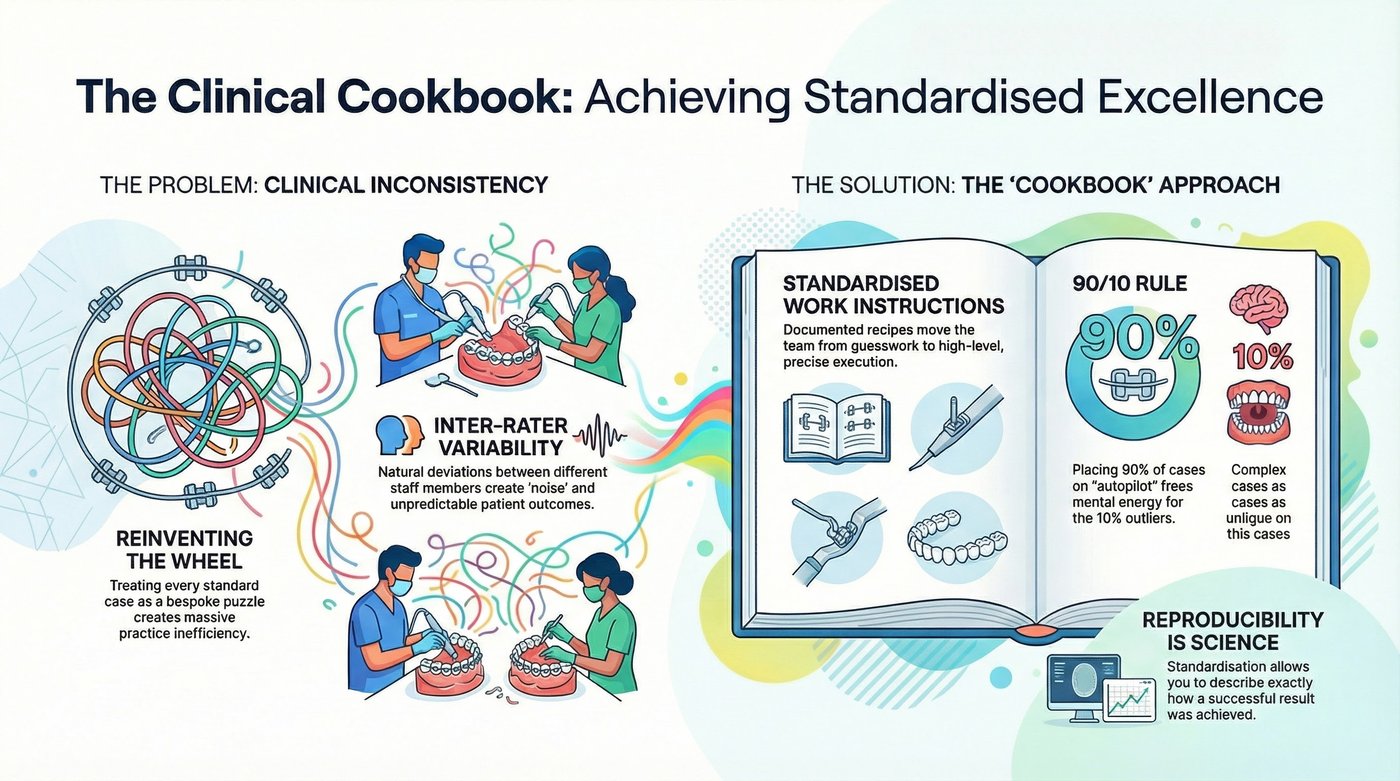
If every 6-millimeter overjet or bilateral Class II feels like you are reinventing the wheel, your practice isn’t just “individualized”—it’s inefficient. This constant mental taxation on the doctor is a significant barrier to scaling a successful practice and often leads to decision fatigue. It hinders the smooth flow necessary for high patient volume.
We must shift our perspective from viewing standard procedures as restrictive to seeing them as foundational excellence. For example, establishing a single, proven bonding protocol ensures maximal bond strength across every patient, every time, eliminating variables due to personal preference or haste.
In lean orthodontics, we recognize that elite performance—much like that of a Michelin-starred kitchen—is built on standardized excellence. The world’s top restaurants don’t succeed through spontaneous creativity, but through relentlessly precise, documented steps that guarantee a consistent product.
A clinical “cookbook” approach doesn’t lower your quality; it establishes a “Gold Standard” that ensures your results are consistently high, regardless of which assistant is chairside or how busy the schedule becomes. This documented standard becomes the ultimate training manual and a reference point for auditing treatment quality.
Practices that lack this standardization often find their case completion times stretching unpredictably. A standard Class I non-extraction case that should take 18 months can easily drift to 24 months or more simply due to varied appointment intervals or non-standardized appliance adjustments.
This “cookbook” essentially codifies the Principal Doctor’s best thinking and experience, making it accessible and repeatable by the entire clinical support team. It transforms proprietary knowledge into scalable practice infrastructure.
Reducing Inter-Rater Variability
Even with a perfect recipe, a novice will not produce the same result as a master chef. This is due to inter-rater variability—the natural deviation that occurs when different people perform the same task. In a dental setting, this variability is the primary source of clinical “noise” and unpredictable outcomes.
Consider the process of impression-taking or digital scanning. If four different assistants use slightly different techniques, the quality of the final diagnostic data will vary significantly, forcing the doctor to compensate or request costly retakes.
To push this variability toward zero, a lean practice utilizes standardized work instructions. These instructions are not just general guidelines; they are ultra-specific, often visual, step-by-step guides for every repeatable procedure.
From the way diagnostics are captured to the specific sequence of archwires used for leveling, every step is documented. This documentation includes material specifications, specific torque values, and even the exact wording to use when communicating the next step to the patient.
Implementing clear standards for processes like debonding or appliance delivery ensures the final result delivered to the patient is uniformly high-quality, irrespective of the clinician on duty. This builds deep patient trust in the entire brand, not just the principal doctor.
This moves the team from a state of guesswork to a state of precision. When the “recipe” is clear, the team can execute at a high level without constant supervision. This autonomy allows the doctor to step back from micro-management and focus on strategic leadership within the practice.
Furthermore, reducing inter-rater variability directly impacts the cost of care. Standardized instrument sterilization and tray setups, for instance, minimize waste, reduce human error, and enhance compliance with regulatory safety standards. It’s a mechanism for operational risk mitigation.
The process of creating the “cookbook” itself is a powerful training exercise, forcing the leadership team to critique and optimize their current best practices, resulting in a continuous improvement cycle that benefits the whole team.
Reproducibility as the Foundation of Science
Some fear that standardization leads to “assembly-line” orthodontics. On the contrary, reproducibility is the cornerstone of scientific medicine. A result achieved randomly, even if magnificent, holds little clinical value if the steps taken to achieve it cannot be taught and reliably repeated by others.
If you cannot describe exactly how you achieved a magnificent result, you cannot reliably repeat it. By creating a clinical manual, you are building a library of successful outcomes. This library becomes the core intellectual property of the practice.
This structural approach to orthodontic practice management allows you to delegate with total confidence. Delegation is only truly effective when the process, not the outcome, is standardized, minimizing the chance of error when staff members execute the task.
It frees your mental energy to focus on the 10% of cases that are truly “outliers,” while the standard 90% run on a high-quality autopilot. These outlier cases—complex surgical-orthodontic plans, craniofacial anomalies, or those requiring multidisciplinary input—are where the doctor’s specialized expertise is most needed and valued.
For clinic leaders, this shift means you are managing a robust system, not constantly managing people. This scalable system enables faster onboarding of new associates or hygienists, ensuring they are productive and delivering the “practice standard” results within weeks, not months.
A clinical “cookbook” is not a static binder on a shelf; it should be a living, digital document reviewed quarterly. It is the clearest expression of your commitment to excellence and the most powerful tool for ensuring profitable, predictable growth.
Conclusion: From Artistry to Infrastructure
The choice facing modern dental and orthodontic practices is not between artistry and standardization; it is between unpredictable brilliance and reproducible excellence. The clinical “cookbook” shifts the practice’s foundation from the proprietary skill set of one doctor to a scalable, auditable system. This move transforms the practice from a collection of individual efforts into a cohesive, high-performing enterprise. Implementing standardized work processes is the ultimate act of clinical leadership. It mitigates risk, ensures consistent patient satisfaction, and drastically improves operational efficiency. By codifying your best thinking today, you are not limiting your future—you are creating the infrastructure for predictable, profitable, and stress-free growth. Start building your clinical infrastructure now, and turn your expertise into your legacy.