

The Conductor’s Mandate: Mastering Rhythm and Timing in Orthodontic Leadership
Published on: Jun 11, 2026
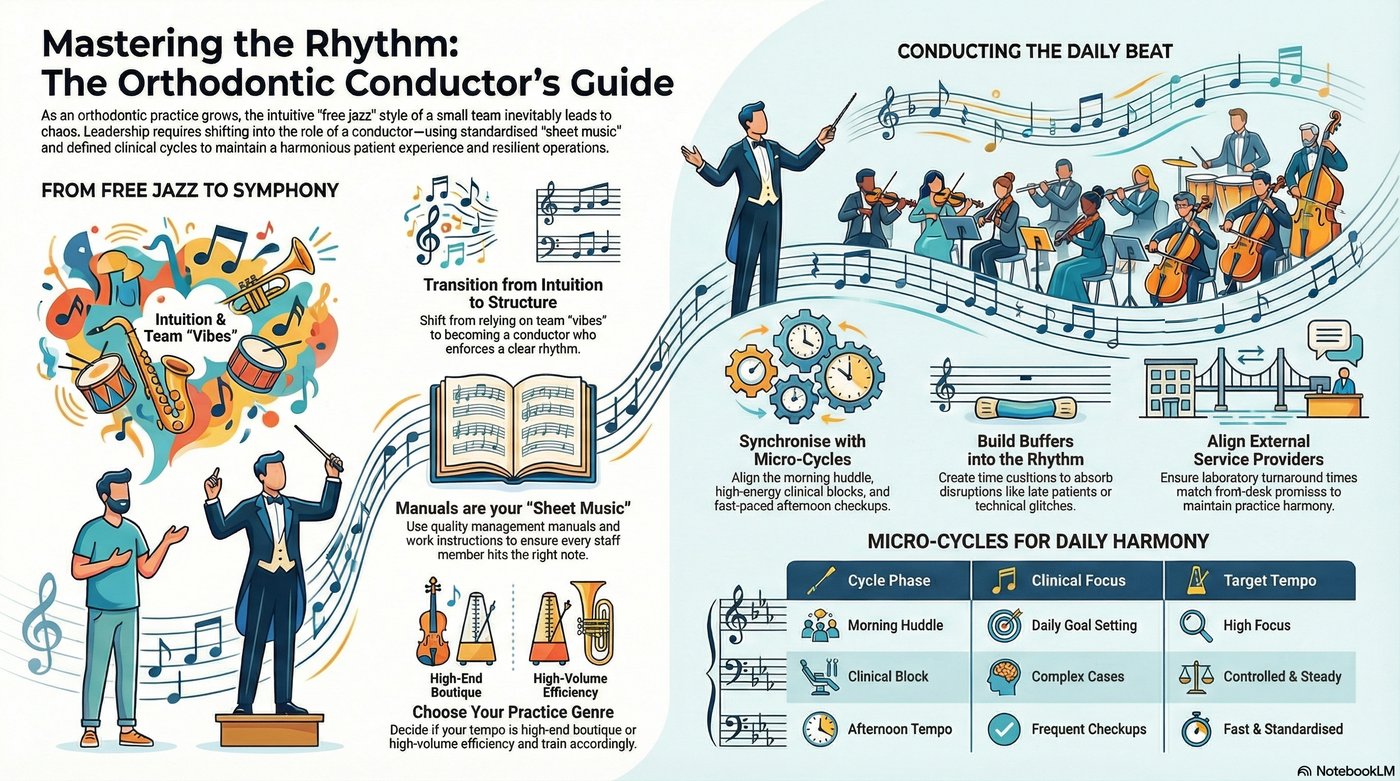
In the early stages of an orthodontic clinic, the operational style is often akin to a free jazz band. You have a small, tight-knit group of highly specialized individuals who have worked together for so long that they don’t need sheet music. They improvise, anticipate each other’s moves, and thrive on a shared, intuitive “vibe.”
However, as a practice grows—adding more treatment chairs, more associates, and more administrative staff—that improvisational style inevitably breaks down. What was once creative energy transforms into chaotic noise. Without a centralized method of operation, the very flexibility that defined your early success becomes your greatest liability.
Scaling a practice requires a fundamental shift in how the team processes information. When a clinical assistant no longer knows what the doctor is thinking just by a glance, you have reached the limits of intuition. At this point, the lack of a formal rhythm leads to missed steps, inconsistent patient communication, and mounting internal stress.
True leadership in orthodontic practice management requires a shift from being a fellow musician to becoming the conductor. Your role is to establish, protect, and enforce the rhythm of the practice. Without a clear beat, even the most talented team will struggle to produce a harmonious patient experience.
The conductor does not play the instruments; they ensure that every instrument is played in synchronization. In a clinical setting, this means you are no longer just the primary producer of clinical results. You are the architect of the environment in which those results are produced, ensuring that the tempo remains sustainable for the long term.
From Free Jazz to Symphony: The Need for “Sheet Music”
The transition from a small boutique clinic to a high-performance organization is where many practitioners stumble. The original team members, hired for their ability to improvise, may resist the introduction of formal structures. They often view protocols as a constraint on their professional autonomy rather than an enabling framework.
Meanwhile, new staff members lack the “soul” of the founding era and desperately need clear instructions to function. Without “sheet music,” these new hires are left guessing, leading to a fragmented culture where different “sections” of the practice are operating under different sets of unwritten rules.
In a lean orthodontic system, your “sheet music” consists of your quality management manuals and standardized work instructions. You cannot expect a newcomer to hit the right note at the right time if the music isn’t written down. Documentation provides the safety net that allows for consistent clinical excellence.
As the conductor, you must decide which “genre” your practice is playing—whether it’s high-end boutique or high-volume efficiency. If your team thinks they are playing a slow ballad while the schedule is written for a fast-paced concerto, the resulting friction will burn out your staff and alienate your patient base.
Practical implementation means creating “Standard Operating Procedures” (SOPs) that are alive. These shouldn’t be dusty binders but digital, accessible guides that define exactly how a debonding appointment or an initial consultation is performed. When everyone follows the same script, the patient feels a sense of professional continuity that builds deep trust.
The Micro-Cycles of Clinical Success
The rhythm of your practice is composed of recurring micro-cycles. These are the patterns that keep your daily work synchronized. Leaders must recognize that time management is actually energy management. By structuring the day into distinct movements, you optimize the clinical flow for both speed and precision.
The Morning Huddle: Setting the beat for the day.
The Clinical Block: Ensuring high-complexity cases are handled when energy is highest.
The Afternoon Tempo: Managing high-frequency checkups with a faster, standardized pace.
If you don’t define these cycles, the schedule will define them for you, usually resulting in a frantic, uncoordinated rush. A common mistake is “sprinkling” difficult procedures throughout the day. This forces the team to constantly switch gears, which is the fastest way to kill clinical momentum and increase the margin for error.
By consciously setting the tempo of the appointment calendar, you create a predictable environment. For example, by “blocking” all long-wire changes in the mid-morning, the clinical floor enters a specific state of focus. The team knows the tempo, the tray setups are ready, and the doctor can move efficiently between chairs without mental fatigue.
Managing External Disruptions to the Beat
A resilient practice rhythm must be strong enough to absorb external shocks. Patients will arrive late, suppliers will experience delays, and IT systems will glitch. Part of your leadership task is to build enough “buffer” into the rhythm to handle these disruptions without the entire orchestra falling out of sync.
In many practices, the “buffer” is forgotten in the quest for maximum efficiency. However, a rhythm that is too tight will break at the first sign of trouble. Leadership involves calculating the “takt time” of your clinical flow—knowing exactly how much time each step truly takes—and adding a 10% margin for the unexpected.
This extended orchestra includes your dental lab and external service providers. If your laboratory’s turnaround time doesn’t match your front-desk promises, the harmony is lost. I learned this firsthand: promising a 24-hour turnaround for aligner plans proved unsustainable and created a constant state of emergency for the staff.
By adjusting the rhythm to a realistic 48-72 hours, we restored balance. We communicated this change clearly to the “audience”—our patients. Interestingly, patients didn’t mind the extra day; they minded the uncertainty of the previous system. A reliable, slightly slower beat is always preferable to a fast one that constantly skips.
Leadership also means holding these external partners accountable to your rhythm. If a lab consistently misses deadlines, they are a “musician” playing out of tune with your practice. You must either coach them back into the tempo or find a new partner who respects the beat you have established for your organization.
Conclusion: Take the Baton
Mastering rhythm and timing is not a one-time event but a continuous exercise in clinical leadership. It requires the courage to stop the music when things go wrong and the discipline to start again with a clearer count. If the results in your practice are currently discordant, do not look first to blame the musicians.
Leadership is about how you use the baton. The conductor is the one responsible for the tempo. If the harmony is lost, you must be willing to step up, clarify the rules of the house, and retrain the section that has lost the beat. You must be the steady hand that the team looks to when the “noise” of a busy clinical day threatens to overwhelm the mission.
Ultimately, a healthy rhythm provides security for your team. When people know what to expect, they perform at their highest level. This stability translates directly into the patient experience. A patient who enters a calm, rhythmic environment feels cared for and safe. They recognize, perhaps only subconsciously, that they are in the hands of a master conductor.
As you move forward, take the baton with confidence. Refine your sheet music, protect your daily cycles, and ensure your external partners are in sync. When the rhythm of your practice is true, the “music” you create—thousands of beautiful smiles and a thriving, motivated team—will be your greatest professional legacy.