

The Communication Blueprint: Distinguishing Fact from Friction in Patient Consultations
Published on: Jun 18, 2026
In the high-stakes environment of an orthodontic consultation, the word “no” is often the most misunderstood part of the conversation. Many clinicians hear a “no” and immediately concede, or worse, they try to “oversell” the clinical benefits, creating further resistance. This reaction stems from a lack of clarity regarding the patient’s psychological starting point.
In Lean Orthodontics, we recognize that not all resistance is created equal. To achieve higher case acceptance and professional mastery, you must learn to distinguish between a valid objection and a flimsy pretext. Failing to do so leads to “consultation fatigue,” where the team spends hours chasing patients who were never truly committed to the journey.
I am Dr. Martin Baxmann, and I believe that mastering this distinction is the key to unlocking a smoother patient journey. When you can identify exactly what is standing between your patient and a “yes,” you stop guessing and start leading. This shift from salesperson to clinical advisor is where the magic happens for both the practice and the patient.
The Objective vs. The Smoke Screen
To resolve resistance, you must first categorize it. Without categorization, your response will be reactive rather than strategic. Effective communication requires a diagnostic approach to the patient’s words, much like your approach to their malocclusion.
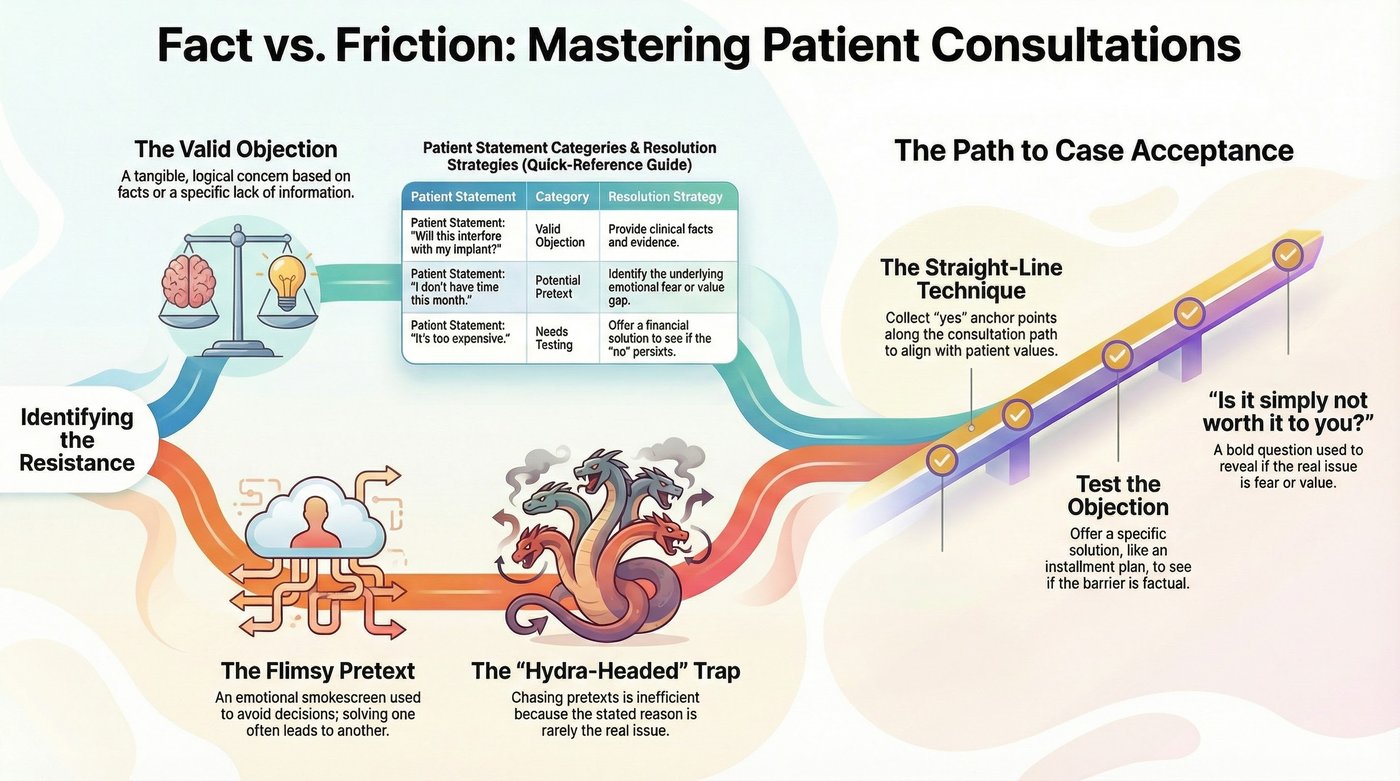
An Objection is a real, tangible concern based on facts or a lack of information. For example, “Will this treatment interfere with my existing implant?” or “How will this affect my speech during my daily meetings?” is a valid objection. It is logical and can be solved with clinical facts, visual aids, or logistical adjustments.
A Pretext (or Excuse) is a smokescreen. It is an emotional barrier often used to hide the real issue or avoid a decision. Pretexts are “hydra-headed”—if you solve the “lack of time” excuse, the “wrong day of the week” or “need to talk to my spouse” excuse immediately takes its place. These are symptoms of a deeper hesitation.
The issue with a pretext is rarely the reason stated. It is usually an underlying emotional resistance or a lack of perceived value. If you spend your energy solving the pretext, you are chasing a moving target. To be efficient, you must cut through the noise and find the emotional root, whether it is a past trauma or a simple lack of trust in the proposed outcome.
The Straight-Line Technique: Collecting Anchor Points
A lean communication strategy follows a straight line from the proposal (A) to the agreement (B). Along this path, you must collect “yeses” as anchor points. These anchors prevent the conversation from drifting into irrelevant territory and keep the patient focused on the benefits they previously agreed upon.
“We agree that preventing cavities during treatment is a priority, correct?” (Yes)
“We agree that a more comfortable experience with softer wires is ideal.” (Yes)
When you reach the final hurdle—often the price—you are already anchored in the patient’s own values. If they then say, “It’s too expensive,” you test the objection immediately. “If we offered an installment plan of €50 a month, would that solve the problem and allow us to start?”
If they say yes, it was a factual financial objection. If they say no, you have identified a pretext. The issue isn’t the money; it’s that the patient hasn’t internalized the value of the final result yet. You must then pivot back to the anchor points of health and confidence that they already agreed to earlier in the consultation.
The Bold Question: Cutting Through the Noise
When you identify a pretext, you must be brave enough to address it directly. A powerful question to ask is: “Is the treatment simply not worth it to you right now?” This might feel confrontational, but it is actually deeply respectful of everyone’s time. It forces the patient to confront their own logic and prioritize their goals.
You cannot force a value where none exists. If the patient truly does not value the outcome, a lean leader stops the process there to focus on those who do. However, often this question reveals the real fear, such as a fear of pain or a concern about emergency availability during their busy schedule. By identifying the real fear, you can convert the emotional pretext into a solvable factual objection.
Conclusion: From Friction to Flow
Distinguishing fact from fiction is not about manipulation; it is about clarity. By separating legitimate clinical concerns from emotional smokescreens, you create a more transparent and efficient consultation process. This approach respects the patient’s intelligence while protecting your practice’s most valuable resource: time.
When you master these communication blueprints, you don’t just sell more cases; you build stronger relationships based on mutual understanding. Start testing objections today, and you will find that the path to “yes” is much shorter than you previously imagined. Your patients will thank you for the leadership, and your practice will flourish under the efficiency of Lean Orthodontics.