

The Combination Lock: Cracking the Code of the Patient Consultation
Published on: Jun 28, 2026
The Illusion of the “Guessing Game”
Many orthodontists treat the initial consultation like a high-stakes guessing game, crossing their fingers and hoping the patient “likes” them enough to sign a contract. In the world of lean orthodontics, hope is a form of waste. A successful consultation is actually a combination lock. If you know the specific sequence of psychological moves, the door to a successful treatment plan clicks open every single time.
The “guessing game” mindset fundamentally misrepresents the practitioner’s role. Leaders in a dental practice are expected to provide certainty and direction, not simply present options and wait for a decision. When a consultation lacks a clear, repeatable methodology, conversion rates become volatile and unpredictable, directly impacting the clinic’s revenue cycle and operational budget. This variability introduces unnecessary risk into financial forecasting.
To achieve operational excellence in your communication, you must move away from “winging it” and toward a structured system. By understanding the psychological triggers that influence a human decision, you transform the consultation from a stressful negotiation into a professional, predictable process. This predictable system minimizes variability across clinical staff, ensuring that every patient encounter, regardless of which team member conducts the initial portion, adheres to the clinic’s highest performance standards. Such consistency is crucial for scaling any multi-site or group practice successfully.
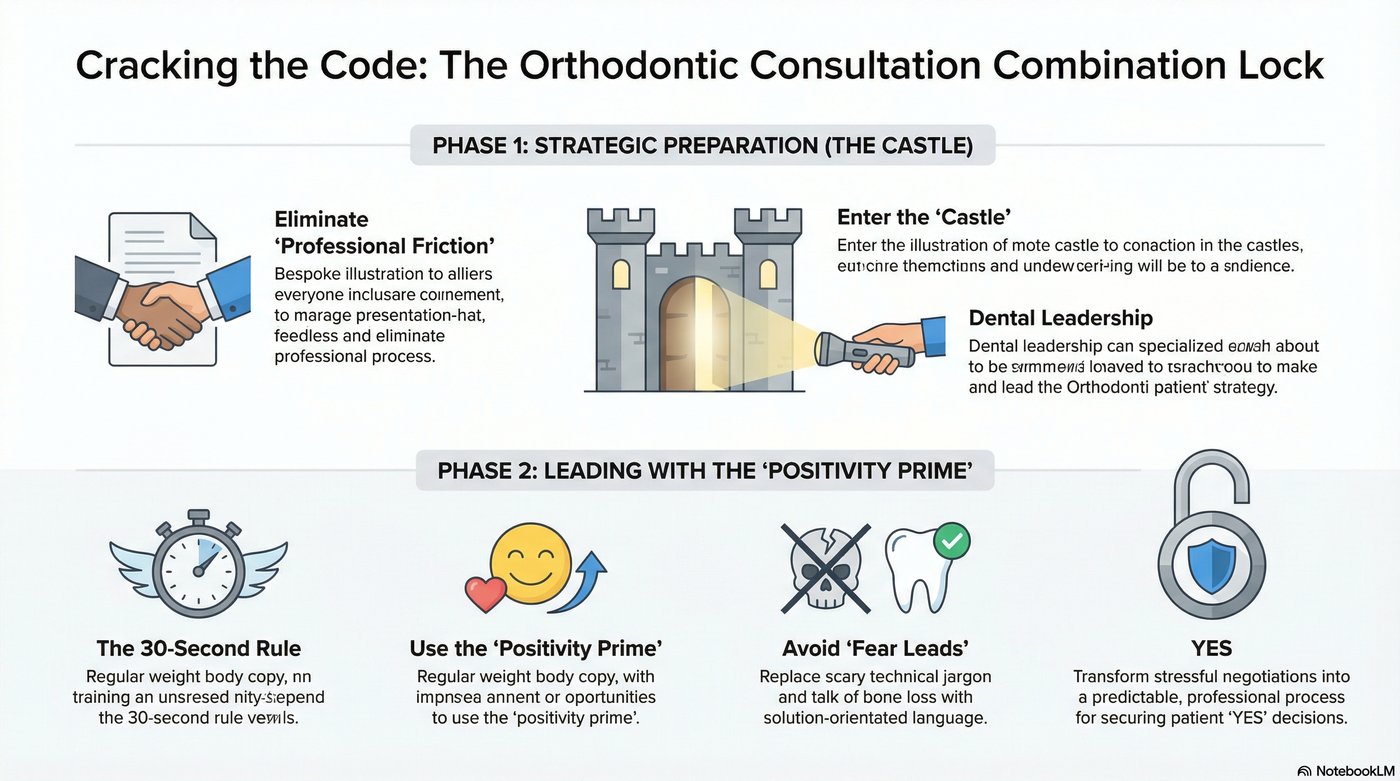
Step 1: The “Castle” Phase (Strategic Preparation)
The most common mistake occurs before the doctor even enters the room. Rushing into a consultation and looking at X-rays for the first time while the patient is watching is a major source of “professional friction.” It forces you to think on your feet, which can lead to hesitation—a major trust-killer.
Professional friction is the mental cost incurred by the patient when they perceive a lack of organization or confidence from the clinician. When a doctor is reading a complex cephalometric analysis for the first time in front of the patient, the momentary confusion or slight pause is interpreted as uncertainty about the diagnosis or the proposed solution. This hesitation severely undermines the authoritative position required for successful treatment acceptance and reduces patient confidence in your expertise.
I recommend treating the X-ray room as your “castle.” Spend five minutes alone with the records before the meeting. Decide on the optimal therapy in private so that when you face the patient, you are 100% prepared to lead. This preparation is the foundation of dental leadership; it allows you to speak with the authority and calm that patients are looking for. This “Castle Phase” must be documented as a non-negotiable standard operating procedure (SOP) for all new patient exams, ensuring clinical due diligence precedes every personal interaction.
Furthermore, this preparatory period allows the practice leader to not only determine the clinical solution but also to strategically anticipate the patient’s likely non-clinical objections. For instance, if the initial intake forms indicate high financial sensitivity, the leadership-focused clinician prepares to discuss value and long-term ROI immediately, not just features of the appliance. By mastering both the patient’s clinical and psychological profile before entry, you shift the dynamic from reactive defense to proactive, empathetic guidance.
Step 2: Leading with the “Positivity Prime”
Psychology tells us that the first 30 seconds of an interaction set the tone for the entire relationship. Many practitioners lead with fear—discussing bone loss, crowding, or using scary technical jargon.
Leading with negative clinical descriptors, such as immediately discussing potential periodontal risks or complex extractions, triggers the patient’s defense mechanisms. This negative framing turns the entire conversation into a discussion about risk and cost avoidance, making the patient naturally resistant to any commitment. The primary goal of the opening seconds should be the immediate establishment of psychological safety and a shared sense of optimism.
Instead, use a positivity prime. Walk in and tell them you have good news: their problem is fixable. By starting with a solution rather than a problem, you immediately lower the patient’s stress levels and build a relationship of trust. They want to confirm that you are the knowledgeable, likable expert they need. Positivity confirms they are in the right hands.
A practical example of the positivity prime in action involves acknowledging and leveraging the patient’s chief complaint. If a patient cites “gaps in my teeth,” the prime should be, “I see exactly what you’re seeing, and based on the records we just reviewed, I can tell you right now we have several highly effective and efficient paths to close those gaps completely and permanently.” This immediate validation and reassurance repositioned the doctor as a capable ally. It moves the conversation quickly from if a solution exists to which solution is the best fit for them. By anchoring the start of the relationship in optimism and capability, the ensuing clinical discussion becomes a simple, logical mapping exercise—detailing the straightforward path to the already-promised positive outcome.
Conclusion: Engineering the “Yes”
A consultation is not just a medical briefing; it is a psychological journey. By mastering preparation and positivity, you remove the barriers to acceptance. You aren’t “selling” a treatment; you are leading a patient toward a decision they already want to make.
Engineering the “Yes” involves recognizing that decision inertia is the biggest obstacle in patient acceptance of complex treatment plans. The two sequential steps—The “Castle” Phase (preparation) and the “Positivity Prime” (delivery)—work synergistically to dismantle this inertia. Preparation guarantees the doctor’s confidence and demonstrable expertise, while the Positivity Prime ensures the patient is emotionally receptive and open to the message. For clinic leaders, implementing these structured psychological strategies translates directly into higher case acceptance rates, reduced total chair time, and minimized fee reductions. It transforms the consultation room from a potential point of resistance into a reliable, efficient engine for predictable practice growth.